
53 MW solar park on former landfill to power Leuna chemical site
A 53 MW solar park on a remediated landfill will supply green electricity to Germany's Leuna chemical hub from 2027.
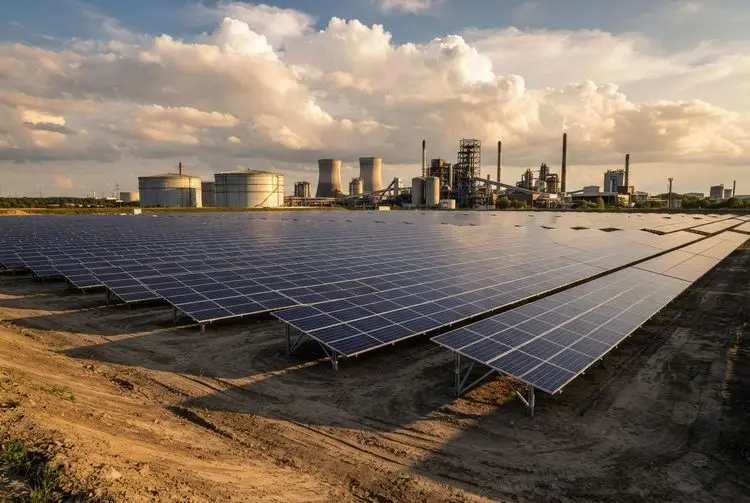
A 53 MW solar park is set to rise on a former industrial landfill at the Leuna chemical site in Saxony-Anhalt, turning a legacy waste dump into a renewable energy asset for one of eastern Germany's most important industrial regions.
The project, developed by site operator InfraLeuna GmbH since 2021, will cover 55 hectares of a decommissioned tailings pile originally used for lime sludge, slag, ash and coal waste. LIVOS Group has taken over financing, construction and operation, investing approximately 30 million euros. Operations are scheduled to start in June 2027, with electricity available to industrial customers from July 1, 2027.
Project details and output
The solar park will install 71,700 modules across the site, generating roughly 61,000 MWh of electricity annually. That output is equivalent to the consumption of about 17,000 households and will save approximately 23,000 metric tons of CO₂ per year compared to grid-mix electricity.
The electricity will feed into InfraLeuna's 30-kV medium-voltage grid and be supplied to companies at the chemical site. Supply contracts have already been finalized. The Leuna chemical site's total electricity demand is equivalent to roughly two-thirds of all households in Saxony-Anhalt, underscoring the scale of industrial energy needs the project helps address.
Green electricity from the solar park is also expected to support green hydrogen production at the site, where flexible power plants cover gaps in renewable generation.
Site remediation and reuse
The landfill is owned by MDSE Mitteldeutsche Sanierungs- und Entsorgungsgesellschaft mbH, which professionally remediated and decommissioned the site. MDSE secured the land for the project via a long-term lease, enabling a productive reuse without taking up valuable farmland.
Ingolf Puritz, Managing Director of MDSE, said: "As the owner of the waste dump we have professionally remediated and decommissioned the site and continue to bear responsibility here for protecting people and the environment. At the same time, we support the development of new opportunities: Utilizing the southern expansion for renewable energy enables a sensible reuse of the landfill site without taking up valuable farmland and with short distances to the chemical site."
A possible future expansion of the solar park by an additional 42 hectares is under consideration, which would further increase capacity and output.
Industry and political backing
District Administrator Sven Czekalla of the Saale District highlighted the project's significance for the regional economy. "Where slag and ash were once stored, clean electricity is now being generated for one of eastern Germany's most important industrial regions. The solar park reduces CO₂ emissions and makes Leuna less dependent on the energy market. This strengthens the chemical industry hub and secures good jobs in the Saale District," Czekalla said.
InfraLeuna Managing Director Dr. Christof Günther noted the project's role in meeting customer demand for certified green electricity. "With this solar park, we are adding another important component to the energy supply at the chemical site. In response to our customers' needs, the new facility enables the delivery of green electricity that meets strict European standards. To this end, we have spent several years developing this project, creating the necessary conditions, and securing LIVOS as a strong partner for its implementation," Günther said.
Development partners
Several firms contributed to project development. Dornier Power and Heat GmbH, G.U.T. Gesellschaft für Umweltsanierungstechnologien mbH, IPROconsult GmbH, and Froelich & Sporbeck were involved alongside the City of Leuna and the State Administration Office of Saxony-Anhalt.
LIVOS Group representatives Andreas Hoffmann, Maximilian Jahr and Deniz Yildiz are managing the project on the investor and operator side. The project faced challenges in planning, construction site preparation and water balance management, which InfraLeuna addressed over several years of development before bringing in LIVOS in August 2025.
The Leuna solar park exemplifies a growing trend in Germany: converting brownfield and post-industrial sites into renewable energy generation assets, avoiding land-use conflicts with agriculture while delivering clean power directly to large industrial consumers.