
Fox ESS Flags Skills Shortage as Brazil BESS Market Scales
Fox ESS Brazil specialists say a lack of qualified professionals is the main obstacle to consolidating the country's battery storage market.
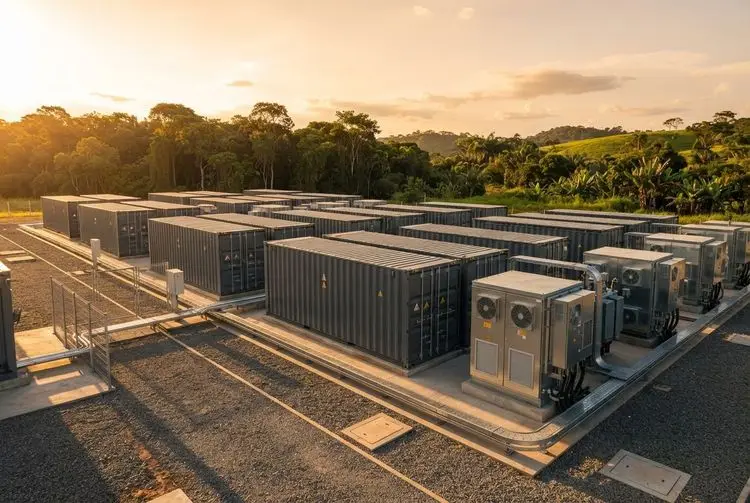
Brazil's battery energy storage market is being held back less by hardware than by people. A shortage of qualified professionals is the main obstacle to consolidating battery energy storage systems (BESS) in the country, according to Fox ESS Brazil representatives Matheus Bueno and Paula Bordin do Prado, who addressed the issue on episode #198 of the Papo Solar podcast, published last Tuesday (27).
Bueno is Pre-Sales Coordinator at Fox ESS Brazil. Paula Bordin do Prado is an electrical engineer specializing in storage. Together they placed workforce readiness at the centre of the market's bottleneck, and training emerged as the recurring theme of the conversation.
"Training is a pain point in the market," Bueno said.
PV habits carried into storage design
According to the two specialists, commercial and technical methods developed for grid-connected photovoltaic (PV) projects are being wrongly applied to storage. Paula Bordin do Prado described the pattern as a "mindset bias" — a tendency to treat a battery system as an extension of a PV array rather than as a separate asset with its own design requirements.
Correct BESS sizing, they argued, depends on three inputs: the client's consumption profile, the conditions of the power supply and the objectives the client wants the system to meet. Skipping that groundwork produces specifications that look reasonable on paper but do not match how the site actually operates.
Paula Bordin do Prado illustrated the gap between what customers say and what they need: "[We] try to direct the questions to the end customer, because if you ask the end customer, who is a layperson, how long they want battery life, that's it, 24 hours. It's different from asking them, when their power goes out, how many hours they are actually without power?"
That distinction has practical consequences. Autonomy requirements vary widely — some sites need to ride through frequent short outages, while others require long uninterrupted operation. Storage sales and installation therefore call for a technical, consultative approach rather than a catalogue-driven one.
Falling costs widen the addressable market
Cost trends are pushing more of those conversations into the pipeline. ABSAE, the Brazilian Association of Energy Storage Solutions, reports that battery costs fell 53% between 2020 and 2025, and projects market potential of R$ 77 billion by 2034. Solar Talk also highlighted that a battery price drop of more than 50% has widened access to the technology.
Cheaper batteries do not solve the skills gap — they expose it. Seventy-four percent of recruiters report difficulty filling technical positions, a figure that points to pressure across the sector rather than at a single company.
Where demand is concentrated
The specialists identified four segments driving BESS uptake in Brazil:
- Commercial and industrial (C&I) customers using peak shaving, load shifting and backup for essential equipment. - Agribusiness, where solar plus storage supports irrigation, refrigeration and product storage. - Residential systems aimed at higher self-consumption, grid autonomy and backup capability. - Electric vehicle (EV) charging, where batteries relieve the grid at peak times and enable chargers at sites with constrained connections.
Hotels, supermarkets and industries use BESS to offset outages and cut their reliance on diesel generators. Interest has grown alongside changes to distributed generation regulation and concerns about power flow reversal on the grid.
Training partnership with Canal Solar Educacional
Fox ESS and Canal Solar Educacional are partnering to train professionals, with details of the initiative still to be announced. The move targets the pain point the two specialists identified on the podcast.
The commercial stakes are significant. BESS investment may still exceed the cost of a conventional photovoltaic system, and understanding battery characteristics, safety requirements and consumption profiles is essential to justifying that outlay. Poor specification and installation compromise performance and prevent consumers from obtaining the results they expected — a risk the specialists linked directly to the shortage of trained professionals.
For now, the message from Fox ESS Brazil is that storage is not a bolt-on to PV. It is a separate discipline, and the Brazilian market's ability to convert falling battery prices into delivered projects will depend on how quickly the workforce catches up.