
INA Solar to Start 4.5 GW TOPCon Cell Line by Year-End
Narmadapuram plant work runs at full pace as the Jaipur module maker pushes backward integration from 5.5 GW of capacity.
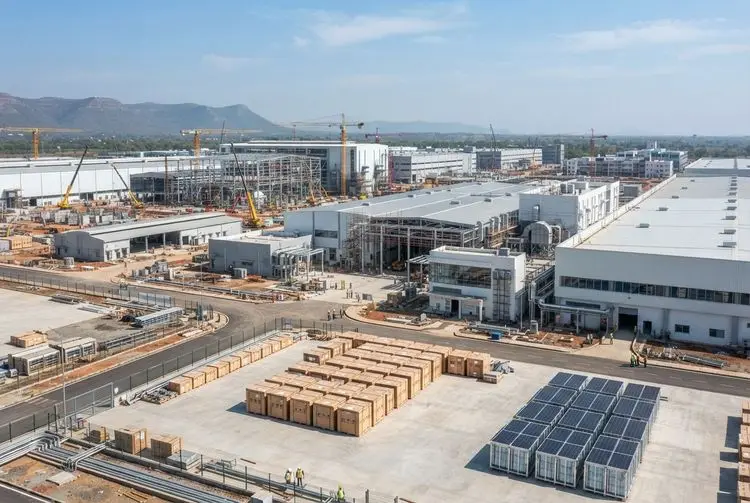
INA Solar expects to have a 4.5 GW TOPCon (tunnel oxide passivated contact) cell line running at Narmadapuram in Madhya Pradesh by the end of the year, a step that would move the Jaipur-based manufacturer from module assembly into cell production. "Our 4.5 GW TOPCon cell line will be ready by year-end," said Abhishek Kaushal, Chief Business Officer of INA Solar, in an interview at the Bharat Renewable Energy Summit and Expo 2026 in New Delhi.
The line is built around the G12R wafer format. Utility work at the site is progressing at full pace, and the company expects the cell plant to be operational within one to one-and-a-half quarters. For a manufacturer that has so far bought cells on the open market, owning that supply is the difference between competing on assembly cost and competing on the full value chain.
From 50 MW to 5.5 GW
INA Solar was founded in 2017 with 50 MW of capacity. It now operates 5.5 GW of module manufacturing, all of it at a single site in Jaipur, Rajasthan — an unusual concentration that keeps logistics, quality control and process engineering under one roof. The company describes itself as India's first listed company among module manufacturers.
Its customer base spans utility-scale projects, the mid-segment and the distributed market. Those three segments place very different demands on a manufacturer: utility buyers negotiate on price and delivery scale, mid-segment customers on configuration flexibility, and distributed buyers on availability and service reach.
Backward integration beyond cells
Cells are only the first stage of the upstream push. The company plans to move further into ingot and wafer production, and it says work on that has already begun. ALMM 3 — the next phase of India's Approved List of Models and Manufacturers — is expected in 2028 to cover ingot and wafer, which gives manufacturers a policy horizon to build against.
Beside the cell line, INA Solar is putting up an aluminium extrusion plant with 18,000 metric tonnes per annum of capacity. That output is intended to cover roughly 4.5 GW of in-house module frame requirements, matching the scale of the new cell line. Junction boxes and other balance-of-system (BOS) products are now made domestically as well, reducing exposure to imported components.
IPP pipeline and a direct-to-installer push
Forward integration runs through an independent power producer (IPP) segment with a pipeline of nearly 500 MW. That includes 400 MW under the Kusum scheme in Rajasthan and 100 MW in Maharashtra — a route that lets the company hold assets rather than only sell equipment into them.
On the distribution side, the company plans 20-25 stock points to serve distributed solar customers directly. PM Surya Ghar 2.0 is expected soon, and the distributed segment is a key focus for the business. Stock points matter in that market because rooftop and small commercial installers buy in small volumes and cannot absorb long lead times.
India's capacity build-out
The wider market backdrop is one of rapid expansion. India's module manufacturing capacity now stands above 240 GW, while cell capacity has surpassed 40 GW and is seen surpassing 60-67 GW within six to eight months. ALMM faced initial challenges, but capacity has grown since its introduction.
Government emphasis on domestic manufacturing is driving backward integration across the sector, and geopolitical tensions are pushing many countries toward self-production. The COVID-era China Plus One strategy left India a strong contender, with its case resting on a skilled workforce, a talent pool and investment capability. Ministry support was cited for policy framing and the necessary push, and PM Surya Ghar was credited with taking solar to individual households.
What to watch
For installers and developers, the practical questions are timing and consistency: when the Narmadapuram line reaches commercial output, whether the extrusion plant ramps in step with it, and how quickly the planned stock points reach the regions where distributed demand is concentrated. For investors, the test is whether a company that scaled from 50 MW to 5.5 GW in modules can repeat that execution upstream into cells, ingot and wafer — and whether the IPP pipeline converts into operating assets. The cell line's commissioning over the coming quarters will be the first clear signal.