
Inox Wind and Vikram Solar shares plunge on weak Q2 earnings
Indian solar stocks tumble as quarterly results miss profit estimates despite revenue beats.
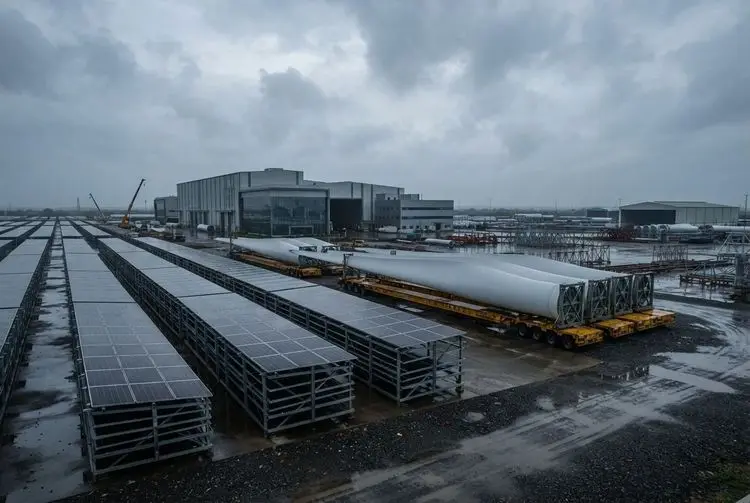
Shares of Inox Wind Ltd and Vikram Solar Ltd fell sharply on Monday as investors reacted to second-quarter earnings that showed steep profit declines despite mixed revenue performance.
Inox Wind dropped 10% to ₹57.69, while Vikram Solar fell 8.85% to ₹130.80 from its previous close of ₹143.50. The sell-off erased significant market value, with Inox Wind's market capitalisation settling at ₹10,212 crore and Vikram Solar's at approximately ₹4,928 crore.
JM Financial, which covers both stocks, described Inox Wind's results as "another disappointing quarter." The brokerage maintained its 'Add' rating on Inox Wind with a target price of ₹72, while retaining a 'Sell' on Vikram Solar with a target of ₹129.
Inox Wind: Revenue beats, profit misses
Inox Wind reported a 21% year-on-year increase in second-quarter revenue, which also grew 66% sequentially and beat analyst estimates by 12%. However, net profit fell 43% year-on-year, missing expectations by 33%.
The company won 350 MW of new orders during the quarter. Its total order book stood at 3.8 GW as of October 2026, down from 4.4 GW in July.
A key development was the acquisition of Wind World India's wind assets by Inox Green, Inox Wind's operations and maintenance subsidiary. The acquired assets total 4.5 GW, and Wind World India is expected to contribute ₹600 crore in revenue from the third quarter of FY27. Inox Green's O&M portfolio now stands at 12.5 GWp.
Inox Wind has set ambitious medium-term targets. The company guided for 70-75% revenue growth in FY27 with margins of 20-22%, and FY28 revenue of ₹7,500 crore at 20% margins. JM Financial, however, called these targets "highly unlikely" and projects more modest FY27-28 revenue growth of 20-22% with margins of 18-19%. The brokerage's target price of ₹72 is based on 11x September 2028 estimated EBITDA.
Vikram Solar: Profit collapses 95%
Vikram Solar's second-quarter results were similarly challenging. Revenue declined 2.9% year-on-year, though it beat muted expectations by 16.3%. Net profit plunged 95.4% year-on-year. JM Financial had estimated a loss of ₹8.3 crore for the quarter.
The company's order book stands at 8.2 GW, with 1.7 GW of new orders won in Q2. However, Vikram Solar removed approximately 1 GW of export orders from its pipeline due to US minimum import price rules, which have made exports less viable under current market conditions.
Vikram Solar is pursuing a major manufacturing expansion. Its cell plant, with a capacity of 9 GW, is expected to reach commercial production by March 2027. The company also plans to expand its battery energy storage system (BESS) capacity to 15 GWh by March 2030.
JM Financial projects Vikram Solar's module output at 3.8 GW in FY27, rising to 6.8 GW in FY28 before declining to 4.7 GW in FY29. The brokerage estimates FY27 revenue of ₹5,570.8 crore and FY28 revenue of ₹9,339.4 crore. Its 'Sell' rating and target price of ₹129 are based on 5x September 2028 estimated EBITDA.
What the results mean for the sector
The contrasting performance — revenue growth alongside steep profit erosion — highlights margin pressure across the Indian solar manufacturing value chain. For Inox Wind, the sequential revenue jump and order book additions suggest strong demand, but profitability remains constrained, likely by input costs and competitive pricing. The Wind World India acquisition will add scale from Q3 onward, but integration risks and the gap between company guidance and analyst projections warrant attention.
For Vikram Solar, the near-total profit collapse and the removal of export orders underscore the vulnerability of Indian module makers to US trade policy. The company's large order book of 8.2 GW provides revenue visibility, but the shift toward domestic cell production — with a 9 GW plant coming online only in March 2027 — means near-term margins will depend on module-only sales in a competitive domestic market. The planned BESS expansion to 15 GWh by 2030 signals a strategic pivot beyond solar modules, but that remains a multi-year play.
Investors will watch for Q3 results, when Wind World India revenue begins consolidating at Inox Wind, and for any further updates on Vikram Solar's cell plant timeline and export strategy adjustments.
(Disclaimer: This article is for informational purposes only and does not constitute investment advice. The author is not a SEBI-registered analyst.)