
LONGi to Supply 300,000 Panels for Australian Coal-to-Solar Project
Back-contact modules head to New South Wales as perovskite research hits 27.96% efficiency.
Two developments in the global solar sector illustrate the industry's dual trajectory: large-scale deployment of established technologies on repurposed fossil fuel sites, and continued laboratory advances in next-generation cell architectures.
LONGi Modules for 176 MW Australian Plant
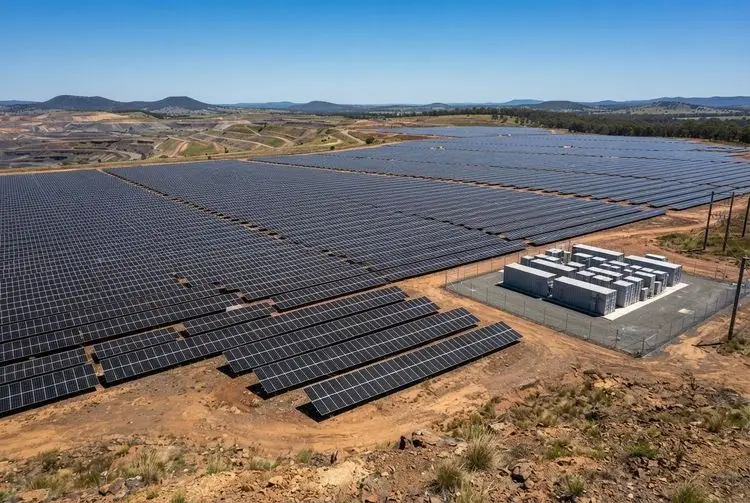
Around 300,000 Hi-MO 9 back-contact panels from LONGi will power OX2's Muswellbrook project in New South Wales, Australia. The 176 MW plant, which includes a 100 MWh battery, is scheduled to come online in 2028.
The Muswellbrook site occupies 482 hectares of rehabilitated mining land in the Upper Hunter region, an area that has historically supplied coal to Australia's power stations. Construction began in May. According to LONGi, the site is expected to generate approximately 347 GWh per year, enough to power some 52,000 Australian households, with up to 200 jobs created at peak build.
The project companies are predominantly European. OX2, the Swedish developer owned by private equity firm EQT, has more than 33 GW of wind, solar and storage projects in development and construction across Europe and Australia. The solar plant is being built by a joint venture of Bouygues Construction Australia and Equans Solar & Storage, both part of the French Bouygues group. The module deal was announced by Leon Zhang, head of LONGi's utility business in Europe.
LONGi is positioning its Hi-MO 9 technology as particularly suited to the hot conditions around Muswellbrook, where summer temperatures often exceed 35 degrees Celsius. The module has a temperature coefficient of −0.26 percent per degree Celsius, meaning less power is lost on hot days compared to most standard modules. LONGi also claims the modules degrade more slowly than conventional n-type products over the plant's 30-year warranty period.
"Our back-contact technology is designed to deliver maximum energy yield and long-term value, even in challenging environments," Zhang said.
The plant will have 135 MW of AC capacity behind the inverters. The timing of peak solar output coincides with peak electricity demand in New South Wales, driven by air conditioning use during hot summer afternoons.
The project reflects a broader trend of repurposing former coal land for solar generation, a practice already common in Europe. Examples include former mines in Lusatia, eastern Germany, and old power station sites along the River Trent in England. European developers and contractors are now applying this model in Australia.
In a related note, pv Europe reported that the global lithium-ion battery energy storage system market is set to reach $135 billion by 2037.
Xi'an Jiaotong University Reports Perovskite Efficiency Gains
Separately, a team led by Xi'an Jiaotong University has achieved a certified efficiency of 27.96% for an inverted perovskite solar cell, with the results published in Nature on November 18. A perovskite-silicon tandem cell built using the same methodology reached a certified stabilized output of 34.71%.
The research focused on improving the contact between the perovskite absorber and the C60 electron-transport layer. While common ammonium-salt treatments heal surface defects at this interface, their insulating components slow electron transfer. The team designed fully conjugated formamidinium molecules instead. The best of these, called BTFI, couples with the perovskite's electronic states and, in films with C60, accelerated charge-transfer dynamics by approximately 3.8 times compared to a standard ammonium salt.
Both cells are small-scale laboratory devices. The Tianjin Institute of Metrological Supervision and Testing certified a single-junction cell with a 0.0528 cm² active area. The SIMIT test lab measured the tandem on 97.24 mm², just under 1 cm².
Importantly, neither the paper nor the university claims these results as records. The efficiency chart maintained by the National Laboratory of the Rockies (formerly NREL) lists 28.0% as the best single-junction perovskite cell and 35.2% for perovskite-silicon tandems. The new single-junction result is 0.04 percentage points below the chart's best, while the tandem is 0.49 percentage points below. Soochow University and LONGi reported a 35.1% tandem in Nature two weeks earlier.
The single-junction cell achieved 27.96% certified efficiency on the reverse scan, 27.32% on the forward scan, and 27.84% stabilized output. The tandem cell reached 34.71% certified stabilized output, with 34.74% on the reverse scan and an open-circuit voltage of 2.009 V.
Stability testing showed the cells retained more than 95% of initial efficiency after 2,000 hours of maximum-power-point tracking under 1-sun illumination. However, the test was conducted on unencapsulated cells in nitrogen at approximately 45°C, not in open air or outdoor conditions.
The university's State Key Laboratory for Mechanical Behavior of Materials led the research. Six corresponding authors contributed, including Yuhang Liu of Xi'an Jiaotong and Michael Grätzel of EPFL in Lausanne. Researchers from Fudan University, the National University of Singapore, Northwestern Polytechnical University, and a CNPC research institute also participated.
The study covered laboratory cells only and provided no plan for scaling to larger devices or commercial panels.
Industry Context
Together, these developments highlight the solar industry's parallel tracks: deploying proven technologies at utility scale on repurposed industrial sites, while continuing fundamental research into higher-efficiency cell architectures. The LONGi project demonstrates the commercial viability of back-contact modules in challenging hot climates, while the Xi'an Jiaotong research advances understanding of interface engineering in perovskite cells, a critical step toward eventual commercialization of tandem technologies.
Both stories also underscore the increasingly global nature of the solar supply chain and project development, with European developers, Australian sites, Chinese module manufacturers, and international research collaborations all playing interconnected roles.