
Mini-channel cooling with porous media boosts PV efficiency by 27%
New numerical study shows porous mini-channels and machine learning can significantly improve photovoltaic panel performance.
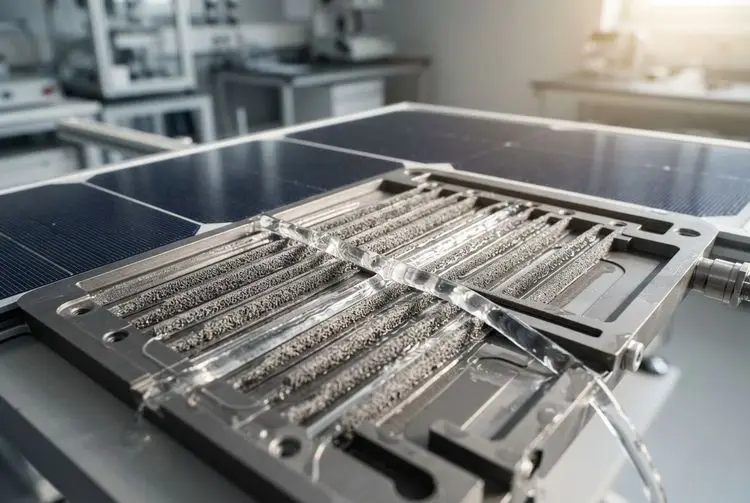
A numerical study published in Discover Applied Sciences has demonstrated that combining mini-channel cooling with porous media and fins can substantially improve photovoltaic electrical and thermal efficiency. The research, conducted by S. D. Farahani, A. Rabiee, S. Jafarmadar and A. Alizadeh, examined cross-flow arrangements, fluid dynamics and channel geometries to determine optimal cooling configurations for PV panels.
Heat buildup remains a persistent challenge for photovoltaic systems. Elevated cell temperatures reduce electrical conversion efficiency and accelerate degradation. Active cooling methods can mitigate this effect, but they introduce trade-offs in pressure drop, energy consumption and system complexity.
The study compared uncooled panels against mini-channel designs using air and water as coolants. With air as the working fluid, the mini-channel configuration delivered a 10 to 17 percent electrical efficiency gain over an uncooled panel. Switching to water coolant produced a 25 to 27 percent electrical efficiency gain — a significant improvement for system designers evaluating cooling options.
Air-to-water performance jump
Transitioning from air to water coolant yielded an 8 to 13 percent additional electrical efficiency improvement and a 7 to 8 percent exergy efficiency gain. The thermal efficiency surge was even more pronounced: 136 to 150 percent. However, the switch also came with a cost. Pressure drop increased by approximately three times, a factor that installers and engineers must account for when sizing pumps and balancing parasitic loads.
The researchers also examined the impact of partial porous medium insertion within the mini-channels. Altering the porous medium configuration changed performance by 0.2 to 7 percent, depending on the case. The solid-to-fluid conductivity ratio contributed a 7.2 percent increase in thermal efficiency.
Fins and porous regions
The study evaluated multiple configurations, labeled Cases 3-1 through 3-3, which varied the number of porous regions within the channels. Case 3-1 showed a 7.9 percent electrical efficiency improvement, while Case 3-3 reached 11.0 percent. Cases 4-1 through 4-3 examined mini-channels equipped with fins of varying heights.
Case 4-3, which featured the most developed fin geometry, demonstrated a thermal efficiency increase from 0.28 to 0.645 as the Reynolds number rose from 40 to 1500 — a 131 percent gain. Electrical efficiency in Case 4-3 increased by 8.7 percent over the same Reynolds range. The results indicate that combining fins with porous media can substantially boost heat transfer at higher flow rates.
More porous regions within the channels tended to boost electrical efficiency at higher Reynolds numbers, suggesting that flow regime and porous medium design must be matched carefully for optimal performance.
Machine learning and multi-criteria optimization
The research team trained a random forest machine learning model on data generated from the numerical investigation. The model successfully predicted both electrical and thermal efficiency across the range of configurations studied.
To identify the best overall design, the researchers applied the TOPSIS (Technique for Order Preference by Similarity to Ideal Solution) method, a multi-criteria decision-making tool. TOPSIS weighted three key performance indicators: electrical efficiency, thermal efficiency and pressure drop. The configuration rankings proved stable even when the criteria weights were varied, lending confidence to the results.
What this means for solar professionals
For system designers and installers, the study provides a data-driven framework for selecting cooling configurations based on site-specific priorities. Where water is available and pumping costs are manageable, the thermal and electrical gains are substantial. For remote or water-constrained installations, air-cooled mini-channels with optimized porous media and fins still offer meaningful efficiency improvements over uncooled panels.
The use of machine learning to predict performance from numerical data points toward a future where cooling design can be optimized without exhaustive physical prototyping. The stability of the TOPSIS rankings under varied weighting also suggests that the leading configurations are robust across different design priorities.
The study was published on November 20, 2026 in Discover Applied Sciences and reported via Bioengineer.org.