
Pakistan's Solar Share Hits 28% as Grid Faces Death Spiral
Citizen-led solar adoption surges to 28% of generation, straining Pakistan's national grid economics.
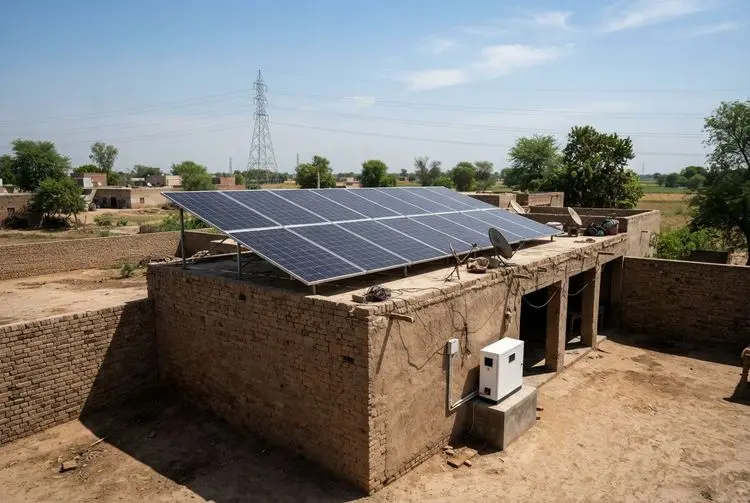
Pakistan's solar photovoltaic capacity has grown from just 1% of electricity generation in 2018 to 28% in 2025, driven not by government policy but by households and businesses fleeing soaring grid tariffs. According to the Pakistan-based think tank Renewables First, roughly seven million households now own solar panels.
Electricity tariffs have more than doubled in recent years, said Muhammad Hassan Dajana, industry liaison at Renewables First, while the cost of Chinese solar panels has fallen by 93%. For a country where the average monthly wage sits just under 40,000 Pakistani rupees (£110; $145), grid bills of 15,000-18,000 rupees have become unaffordable for many families.
A Citizen-Led Energy Transition
The solar boom has reshaped daily life and even cultural traditions. In rural Punjab, Faisal Shahzad received a 340W solar panel as part of his wedding dowry — now the most valued item in his home. "In the summer we ran it from 08:00 in the morning until the evening," he said, noting the family did not need grid power during daylight hours. "We ran our air cooler on it all day."
Shahzad noted that wedding gifts have shifted from motorbikes and household appliances to solar panels and air coolers. "It has almost become a must," he said. His family still relies on the national grid for evening and multi-appliance use, but plans to install 10-15 additional panels with battery storage to achieve full self-sufficiency.
Energy Minister Awais Ahmad Leghari acknowledged the shift as a rational economic response. "People have just found another way to be able to survive," he said. "It's a very healthy thing. We have adapted to the situation. The people have reacted and responded in a very economically viable and efficient manner."
The Utility Death Spiral
While the solar surge benefits a country that imports substantial fuel, it has created a looming crisis for the national grid. When customers buy less electricity from the grid, the fixed costs of maintaining infrastructure fall on fewer remaining consumers, forcing prices higher — which in turn pushes more households and businesses to adopt solar.
"You'll have a white elephant in the form of a state-owned enterprise that requires a lot of public funding to just stay afloat," Dajana said.
Leghari confirmed the costs are already materialising. "In just the past two years, the exodus from the grid has cost the rest of the consumers more than $500 million a year," he said. "That's a very big burden."
The government does not want to discourage solar adoption, Leghari explained, but aims to make the grid more competitive. Private power producers have faced criticism for locking Pakistan into costly, inflexible contracts, though producers point to poor grid maintenance as a factor in high bills. Leghari said the government has renegotiated most contracts and is now focused on improving grid efficiency through better storage, reduced waste and innovation.
Industrial Adoption and Battery Storage
Large-scale industrial users are also driving solar deployment. Kohinoor Textiles Mills in Islamabad operates a sprawling solar array that powers hundreds of machines entirely during sunlight hours. The heavy-furnace-oil engines the mill once relied on sit mothballed in a warehouse.
"We needed to reduce our energy costs and this was one way to do it," said CEO Taufique Sayeed Saigol, who added the company does not plan to disconnect from the grid entirely. "The state unfortunately doesn't have the resources so we can't really say that we blame everything on the state. We do some of the things ourselves."
In the coming weeks, Kohinoor and other firms will begin deploying industrial batteries to store excess solar energy for use during cloudy periods and at night.
Net Metering Policy Shift
The government's initial net metering policy allowed households to feed excess solar electricity into the grid and earn credits to offset nighttime consumption. That policy changed earlier this year, drawing criticism from business groups.
"Initially their policy was very helpful," said Arif Ehsan Malik, president of Faisalabad's chamber of commerce. "But then the policy changed. Now they have started purchasing at a lower rate and selling back at a higher rate." Malik said the change significantly impacts small and medium businesses.
Leghari defended the revision, arguing the original model was unsustainable. The electricity solar producers fed into the system was far cheaper than what they drew out, he said. "Those profits were coming at the cost of the rest of the consumers of the grid. Had we not changed those regulations, the rest of the consumers would have been burdened by at least 150 to 200 billion rupees a year, say, two years from now."
Two Paths Ahead
Leghari admitted the first wave of solar adoption was a "surprise" to the government but said solar has now been incorporated into 10-year forecasts and that the rate of grid defection has slowed. He wants Pakistan to run on "up to 90% clean power" — including renewables and nuclear — by the end of 2036, reducing imported energy dependence from 26% to 4%.
Pakistan has plans to open solar battery factories and encourage electric vehicle adoption. But the country stands at a crossroads.
"There are two paths ahead," Dajana said. One is a future where solar and the grid operate in parallel, demonstrating a successful gradual energy transition. The other is a cautionary tale burdened with a costly, declining grid.
Pakistan's experience offers a stark lesson for emerging markets worldwide: rapid, citizen-led solar adoption can deliver immediate relief from high electricity costs, but without careful grid planning and tariff reform, it risks creating a two-tier system where those unable to afford panels face ever-rising bills while the national grid becomes a fiscal burden on the state.