
Solar adoption in Somalia: off-grid households lead at 9.7% prevalence
New study of 6,883 Somali households reveals key drivers for solar PV uptake in a fragile post-conflict state.
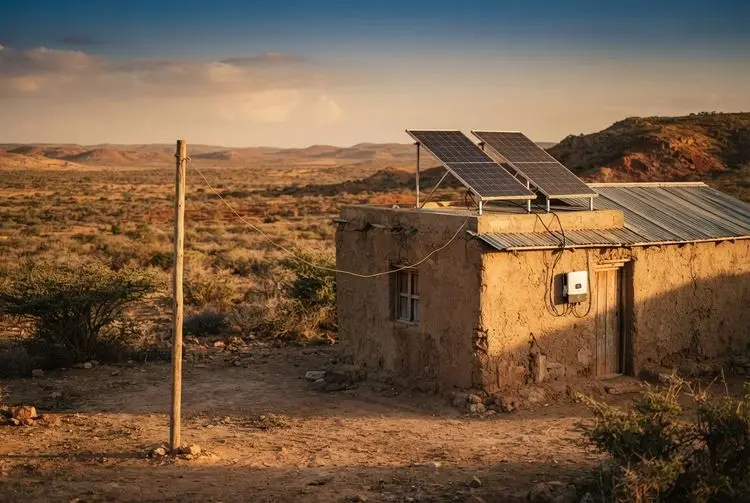
A new study published in Frontiers in Energy Research (Vol. 14, 2026) has mapped the determinants of solar photovoltaic adoption across Somalia, drawing on data from the Somali Integrated Household Budget Survey (SIHBS) 2022. The research assessed 6,883 households and found an overall solar adoption prevalence of 9.7% — a figure that reflects both the potential and the persistent barriers for decentralized energy in one of the world's most fragile states.
Somalia operates under severe infrastructural constraints. Centralized electricity distribution networks remain fragmented, unreliable or entirely absent across large parts of the country. In this context, decentralized solar PV is increasingly viewed as a viable alternative for basic electricity access, offering a pathway to energy leapfrogging — bypassing centralized infrastructure entirely.
Off-grid households drive adoption
The study found that off-grid households were 1.543 times more likely to adopt solar PV compared to grid-connected households (p<.001). This finding aligns with the reality of Somalia's energy landscape, where grid access is limited and off-grid solar offers a practical solution for households that would otherwise lack electricity entirely.
The researchers benchmarked four statistical models — logit, probit, complementary log-log and Lasso — and selected the complementary log-log model as the best fit based on AIC (3778.37), BIC (3990.31) and log-likelihood (-1858.19) criteria. The study was framed by the Diffusion of Innovation theory and the Energy Ladder Hypothesis, which help explain how new technologies spread through populations and how households transition from traditional fuels to modern energy sources.
Regional disparities are stark
Geographic location emerged as a powerful predictor of solar adoption. Households in the Middle Shabelle region showed 2.34 times higher adoption compared to the Awdal region baseline. In contrast, several regions showed significantly suppressed adoption rates. Gedo and Sool each recorded coefficients of 0.141 (p<.001), indicating dramatically lower likelihood of solar uptake. Bari (0.244), Galgaduud (0.262) and Mudug (0.192) also showed suppressed adoption relative to the baseline.
These regional disparities likely reflect differences in security conditions, market development, supply chains and the presence of humanitarian or development programs that distribute solar equipment. For solar industry professionals and investors, the data suggests that market entry strategies must be highly localized in Somalia, with some regions offering far more fertile ground than others.
Socio-demographic factors matter beyond income
The study examined 13 geographic, socio-demographic and infrastructural variables in total. Eight of the 13 predictors showed significant bivariate association with solar adoption. Notably, non-remittance households were 1.3 times more likely to adopt solar than households receiving remittances. This runs counter to the assumption that remittance income automatically drives clean energy investment — instead, it may reflect different spending priorities or the use of remittances for other basic needs.
Housing tenure also played a role. Renters were significantly less likely to adopt solar (coefficient 0.711) compared to homeowners, while households in unauthorized or rent-free accommodation showed a coefficient of 0.812. For installers and project developers, this underscores the importance of targeting homeowners and addressing the split-incentive problem that discourages renters from investing in solar equipment.
Clean cooking fuel users were 1.372 times more likely to also adopt solar, suggesting a pattern of multi-fuel stacking common in post-conflict environments. Households that have already made one modern energy transition appear more receptive to another.
IDP households show higher adoption
Internally displaced persons (IDP) households showed higher solar adoption than settled non-IDP households, with a non-IDP coefficient of 0.478. This finding is particularly relevant for humanitarian solar programs. IDP settlements often lack any grid connection, making solar the most practical — and sometimes the only — option for basic lighting and phone charging. Humanitarian organizations and solar companies targeting displacement settings may find a ready market, though affordability and equipment durability remain critical challenges.
The study used the MARYAMA framework for data harmonization and modeling. The authors — Ali, A. A., Muhumed, A. M., Duale, A. Y., Ahmed, A. A., Aden, A. M. and Muse, A. H. — noted several important limitations. The cross-sectional observational design cannot confirm causality. The survey lacked granular technical metrics on solar hardware, such as panel wattage, battery capacity or system age. Sampling weights and design adjustments may not have been fully integrated.
What this means for the solar industry
For solar companies, investors and development organizations tracking off-grid markets in fragile states, the Somalia study offers several actionable insights. First, the 9.7% adoption rate signals a large untapped market, but one that requires patient capital and localized approaches. Second, the strong association between off-grid status and solar adoption confirms that decentralized solar is filling a gap that grid extension cannot currently address. Third, the regional variation — from Middle Shabelle's 2.34x advantage to Gedo and Sool's near-zero adoption — means that market assessments must be done at the district or regional level, not the national level.
The study also highlights the relevance of Sustainable Development Goal 7 (affordable and clean energy) in conflict-affected settings. Somalia's experience may offer lessons for other post-conflict and fragile states where centralized infrastructure is unlikely to be rebuilt quickly, and where decentralized solar can provide a faster, more resilient path to energy access.
The full study is available in Frontiers in Energy Research, Vol. 14, 2026.