
Statkraft's 50MW Neilston BESS Marks UK Grid-Forming Milestone
The Norwegian energy giant's first grid-forming battery storage system in the UK is now commercially operational near Paisley, Scotland.
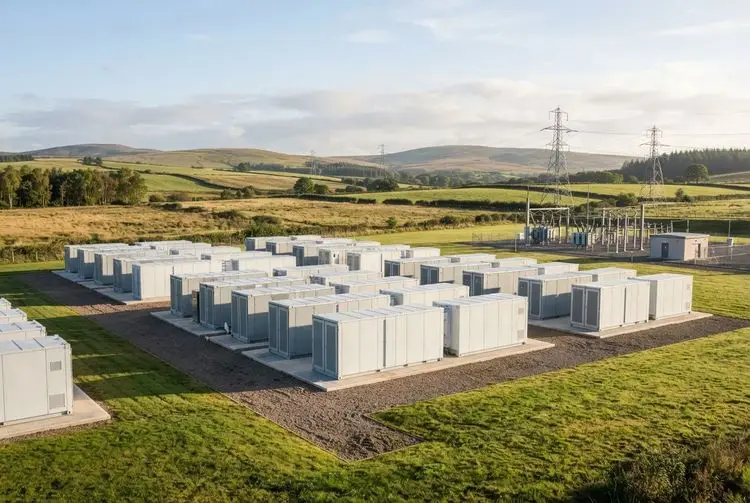
A battery energy storage system (BESS) that took more than three years to build has reached a significant threshold for the UK's energy transition. Statkraft has brought the first phase of its Neilston Greener Grid Park into commercial operation, marking the Norwegian developer's debut grid-forming storage asset in Britain. The 50MW facility sits within a much larger 750MW project footprint near Paisley, Scotland.
Grid-forming BESS technology differs from conventional grid-following storage in a critical way: rather than simply responding to the existing grid signal, it can actively generate and stabilise the alternating current waveform. This capability becomes increasingly valuable as the share of inverter-based renewables — solar and wind — grows and the grid loses the natural inertia once provided by spinning turbines. Neilston's entry into commercial operation therefore carries technical weight beyond its 50MW nameplate capacity.
Construction at the site began in August 2023, and the Scottish Government approved an expansion of the project to its full 750MW scale in August 2025. No timetable for delivering that full capacity has been announced. Kevin O'Donovan, Statkraft's UK and Ireland country manager, framed the project's significance in terms of both energy security and consumer costs: "Innovative projects like Neilston Greener Grid Park will help us to move away from fossil fuels to a low-carbon electricity system, stabilising consumer bills and strengthening Great Britain's energy security."
Statkraft's Expanding UK Storage Portfolio
Neilston is not an isolated bet. Statkraft's cumulative renewable energy investments in the UK now exceed £2 billion, and the company has been building out its storage pipeline on multiple fronts. Earlier this year it started operations at a 20MW BESS in Cushaling, and it secured a 32MW solar-plus-storage project in Cornwall. A second grid-forming BESS — the 50MW Coylton Greener Grid Park in Scotland — entered construction in July 2024 and is progressing through development.
O'Donovan underlined the broader infrastructure challenge facing the sector: "Urgent action is needed to transform our electricity grid and make it fit for the future." That urgency is reflected in the scale of the problem — the UK's grid connection queue stood at over 700 gigawatts before the National Energy System Operator (NESO) began pushing reforms to the connection process. The queue represents years of delayed projects and stranded capital for developers across the industry.
Welsh Pipeline Advances at Uskmouth
Separate momentum is building in Wales, where Ampeak Energy has received 55 battery units from e-STORAGE — a subsidiary of Canadian Solar — for its 240MWh Afon Wysg 1 project. Installation work is being carried out by Jones Bros Civil Engineering. Ampeak expects to energise the system before the end of this month, with full commercial operations targeted for the first quarter of 2027.
Afon Wysg 1 forms part of the broader Uskmouth Sustainable Energy Park, a site that Ampeak believes could ultimately support around 3.5 gigawatt-hours of BESS capacity across three projects. A second project, Afon Wysg 2, has already received planning permission and is sized at 250MW with a 1,250MWh capacity. Ampeak also intends to expand Afon Wysg 1 itself from 240MWh to 480MWh. David Taaffe, Ampeak's chief executive designate, said the team would move quickly once the initial phase is running: "We will then move to rapidly financially close the expansion to 480MWh which can be implemented with minimal disruption to the 240MWh operating asset."
Ørsted and the Wider UK Storage Picture
The pace of large-scale BESS commissioning across the UK is accelerating. Ørsted has completed a 300MW/600MWh battery storage facility near Norwich — its first operational BESS in the country. Meanwhile, the UK government has offered £28 million in grant funding targeted at ultra-long duration storage, a technology segment that remains commercially nascent but strategically important for a grid increasingly reliant on weather-dependent generation.
Policy attention is also intensifying at the infrastructure level. Plans for a new publicly-owned grid investment company have been announced, and debate continues around the proposed Great British Grid — a structural reform that could reshape how storage assets connect to and interact with the transmission network. For developers like Statkraft and Ampeak, the regulatory environment remains as consequential as the technology itself. Projects of the scale now entering operation in Scotland and Wales will need a grid architecture capable of absorbing and dispatching their output efficiently if the UK's clean energy ambitions are to be met on time.