
Agri-PV Offers Farmers Stable Income and Climate Protection
Agri-photovoltaics gives farmers extra income while protecting crops from climate extremes, first long-term studies show.
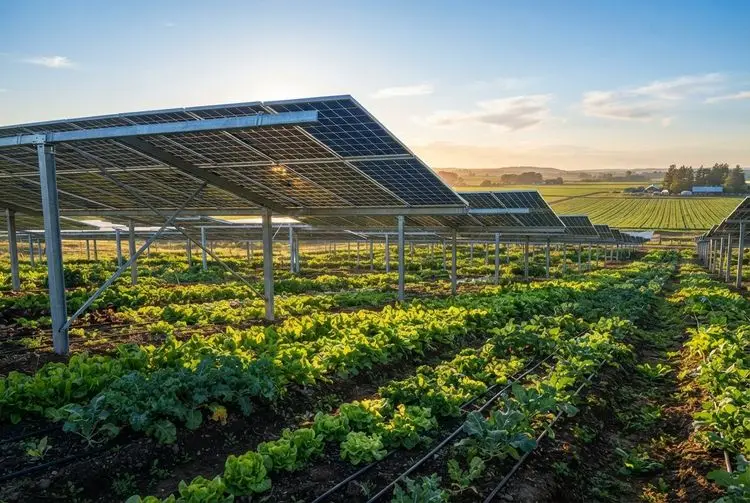
Agri-photovoltaics (agri-PV) is emerging as a compelling dual-use strategy for farmland, allowing solar energy generation and agricultural production on the same land. The approach gives farmers an additional stable source of income while addressing multiple challenges brought by climate change.
The shade and shelter provided by elevated solar modules enable farming under increasingly volatile weather conditions. Most crops cope well with the partial shading from photovoltaic modules, early results from long-term studies show. The first long-term study results on agri-PV are now available, providing the sector with data to support planning and investment decisions.
Land productivity and environmental benefits
Combining solar modules with crops or livestock can increase total land output compared to using the land solely for agriculture or solar. Agri-PV balances the local water cycle and protects soil against erosion — a growing concern as extreme weather events become more frequent. The modules shield plants from sunburn, late spring frosts, hailstorms and other extreme weather events that can devastate harvests.
For livestock operations, the elevated panels provide valuable shade, improving animal welfare. This dual benefit — energy generation plus enhanced agricultural resilience — makes the technology attractive for farmers looking to diversify their revenue streams without converting productive land away from food production.
Planning and construction requirements
Industry experts emphasise that success depends on getting the planning and construction process right from the start. Key factors include selecting the appropriate mounting technology for the specific crop or livestock application, and ensuring that construction methods avoid excessive soil compaction.
Careful construction planning is essential because compacted soil can reduce crop yields for years after installation. Builders must consider soil moisture conditions, machinery weight and the timing of installation to minimise damage to the ground. The choice between fixed-tilt, tracking or vertically mounted systems depends on farming requirements, local climate and the crops involved.
Industry events and resources
The topic is gaining prominence at major industry gatherings. Agri-PV will feature at Agritechnica 2025, the leading international trade fair for agricultural machinery, and at KEY 2026, the key energy transition exhibition. Solar Solutions Vienna and industry association Eurelectric are also engaging with the technology as deployment scales up across Europe.
For solar industry professionals, several technical decisions require attention: row spacing, module height above ground, and the light transmission characteristics of bifacial or transparent modules all affect both energy yield and crop performance. Installers must coordinate closely with farmers to understand seasonal operations, irrigation systems and machinery access routes.
Investors evaluating agri-PV projects should note that while capital costs tend to be higher than standard ground-mounted solar due to elevated mounting structures and wider row spacing, the additional revenue from continued agricultural production can improve overall project economics. Land lease costs are typically lower because the land retains its agricultural use.
Knowledge transfer and sector growth
A special report on agri-PV is now available as a free download, offering detailed guidance for farmers, installers and project developers. The report covers technology selection, construction methods and the latest findings from long-term research plots.
As the technology matures, the solar industry must develop standardised approaches for agri-PV design, permitting and grid connection. Policymakers are beginning to recognise agri-PV as a distinct project category deserving tailored support mechanisms.
For engaged homeowners and smaller rural landowners, agri-PV offers an opportunity to generate solar income while keeping land in agricultural use — a model that may prove more publicly acceptable than dedicating large areas exclusively to solar farms. The coming years will be critical as long-term data from the first commercial installations becomes available, allowing the industry to refine best practices for this promising dual-use approach.