
Brazil natural gas output to surge 80% by 2036, boosting power sector
New MME/EPE plan sees gas supply jump from 61 to 112 MMm³/day, with thermal demand rising over 70%.
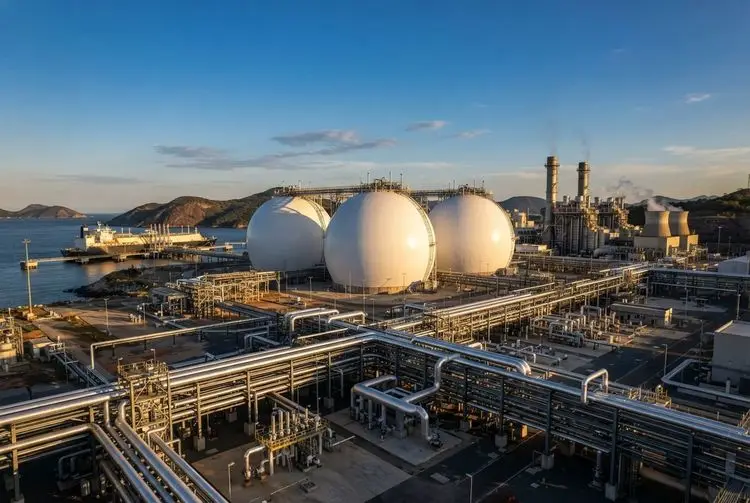
Brazil's natural gas production is set to expand by more than 80% over the next decade, rising from 61 million cubic meters per day (MMm³/day) in 2026 to 112 MMm³/day by 2036, according to the Ten-Year Energy Expansion Plan (PDE 2036) Natural Gas Notebook published by the Ministry of Mines and Energy (MME) and the Energy Research Company (EPE).
The growth trajectory will see total demand climb from 71 MMm³/day to 104 MMm³/day over the same period, representing an average annual increase of 3.8%. Peak demand is forecast to rise nearly 60%, from 154 MMm³/day to 244 MMm³/day, driven largely by thermal power generation.
Thermal power drives demand growth
Thermal power plants are expected to be the main driver of gas consumption growth. Thermal peak demand is projected to increase by over 70%, from 96 MMm³/day in 2026 to 164 MMm³/day in 2036. Average thermal consumption will rise from 14 MMm³/day to 25 MMm³/day over the same timeframe.
The plan notes that gas serves as a backup and complementary fuel for Brazil's power system, a role that becomes increasingly important as variable renewable energy sources expand. New thermal plants included in the 2026 Capacity Reserve Auction (LRCAP 2026) could spur additional LNG terminal development.
Demand from other sectors — including industrial, commercial and residential — is expected to grow from 40 MMm³/day in 2026 to 55 MMm³/day by 2036. The downstream sector alone is projected to consume 22 MMm³/day by the end of the forecast period.
Pre-salt remains dominant, Northeast share rises
Pre-salt fields will continue to supply the majority of national gas production, maintaining an average share of 74% through 2036. However, the Northeast region's contribution is set to rise significantly, from 19% in 2026 to 34% by 2036.
Two major offshore projects anchor this regional shift. The Raia project, located off Rio de Janeiro, is scheduled to begin production in 2028. The Sergipe Deep Waters (SEAP) project is expected to start in 2030. Both will connect into the integrated gas network.
By 2036, 81% of all gas produced will be connected to the integrated network, with the remaining 19% in isolated systems in Urucu and Maranhão, including the Parnaíba Basin.
Bolivian imports decline, LNG capacity expands
Gas imports from Bolivia via the GASBOL pipeline are projected to drop sharply, from 13 MMm³/day in 2026 to just 5 MMm³/day from 2030 onward. The GASBOL pipeline has a total capacity of approximately 30 MMm³/day, meaning significant spare capacity will open up as Bolivian supplies decline.
LNG import capacity is set to increase with the development of the Suape terminal in Pernambuco and the São Paulo Regasification Terminal (TRSP). Additional infrastructure projects include the Gás Sul Terminal in Santa Catarina and the UPGN Miranga processing unit in Bahia.
The integrated network's total supply — combining domestic production and imports — is forecast to grow from 132 MMm³/day to 175 MMm³/day, an increase of over 30%.
R$ 15.9 billion in investments needed
The PDE 2036 plan identifies R$ 15.9 billion in required investments across the gas supply chain. However, the plan emphasizes that utilization of the expanded production depends on parallel investments in transport and processing infrastructure.
Several infrastructure constraints must be addressed. The Northeast subsystem requires gas pipeline duplication and additional compression capacity. The Southeast needs expansions to handle increased pre-salt gas transfer volumes. The Central-West/South subsystem requires new pipelines and compressors for the GASBOL end stretch.
The National Integrated Plan for Natural Gas and Biomethane Infrastructure (PNIIGB) will detail alternatives for infrastructure integration to address these bottlenecks.
Implications for solar and renewables
For solar industry professionals, the expansion of natural gas capacity carries mixed implications. Gas-fired thermal plants serve as firm dispatchable capacity that can complement solar generation during periods of low irradiance and at night. The planned growth in gas infrastructure could support higher solar penetration by providing reliable backup.
At the same time, increased gas-fired generation capacity may compete with solar and storage in capacity auctions. The LRCAP 2026 auction, which could spur new LNG terminals and thermal plants, will be a key event to watch for competitive dynamics between gas and renewable-plus-storage solutions.
The PDE 2036 plan underscores that Brazil's energy transition will rely on natural gas as a bridge fuel, with thermal plants providing grid stability as variable renewables expand their share of the generation mix.