
BYD Debuts Solar, Storage and Robotic EV Charging Hub in Abu Dhabi
BYD integrates solar generation, battery storage, ultra-fast charging and a robotic arm at a single desert site.
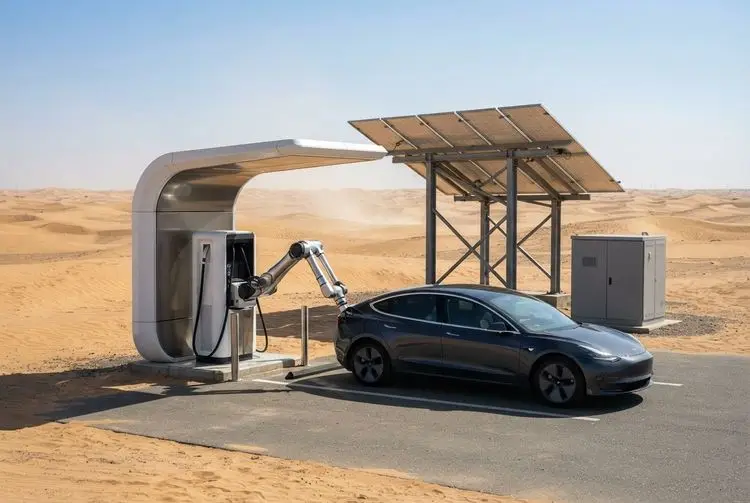
BYD has unveiled what it calls the world's first charging installation to combine solar power generation, battery energy storage, its ultra-fast FLASH Charging technology and a robotic arm that automatically plugs in electric vehicles. The site, located in the Abu Dhabi desert, marks a significant step toward sustainable, off-grid-capable EV charging infrastructure, the company said.
The project fulfills a vision set by BYD Chairman Wang Chuanfu in 2006, which called for three goals: using solar power to generate energy, storing that green energy in battery storage systems, and creating electric vehicles that can utilize this green energy. BYD said the Abu Dhabi site demonstrates how future EV charging hubs could operate in their most efficient, convenient and sustainable form, leveraging the region's intense sunlight to maximize renewable energy use.
FLASH Charging and robotic arm
At the heart of the system is BYD's FLASH Charging technology, rated at 1,500 kW from a single connector. The company unveiled the technology alongside the second-generation Blade Battery on March 5, 2026. BYD claims the system can take a battery from 10% to 70% state of charge in just five minutes and to 97% in nine minutes. Based on calculations by list.solar, this equates to 25 kWh delivered per minute at full 1,500-kW output, with a charging rate of 12 percentage points per minute up to 70%, slowing to 6.75 points per minute from 70% to 97%. For some BYD models, this puts charging time on par with filling a petrol or diesel car.
The robotic charging arm adds another layer of convenience. Using visual guidance and force feedback, it locates the charging port, opens its cover and inserts the connector automatically. Combined with BYD's Automated Valet Parking, a driver can lock the EV and walk away while the car drives itself to a free bay and charges without human intervention. Solar panels paired with battery storage can also support off-grid operation, ensuring that renewable energy is maximized even in remote locations.
BYD did not disclose the solar capacity, battery size or charger output at the Abu Dhabi site, nor did it specify when the robotic charger will reach customers or what it will cost. However, the company confirmed that the FLASH Charger is paired with a high-capacity storage system to avoid overstressing the local grid.
Global expansion plans
This integrated approach aligns with BYD's broader global expansion plans for FLASH Charging. The company aims to have at least 6,000 FLASH Charging stations live outside of China by the end of 2027, though it remains unclear how many will follow the same integrated format as the Abu Dhabi site.
Stella Li, Executive Vice President of BYD, commented: "For the first time, BYD is bringing its integrated Solar-Storage-FLASH Charging technology to the global stage. We are providing clean energy generation, energy storage and ultra-fast charging together, and we are making the charging experience smarter, simpler and more seamless for drivers around the world."
The Abu Dhabi launch is part of a broader energy storage push in the region. BYD Energy Storage has signed a contract with Masdar to supply 11.275 GWh to the Round-the-Clock project, which pairs 5.2 GW of solar with 19 GWh of batteries. BYD's share represents about 59% of the project's total battery capacity. This contract underscores the company's growing role in large-scale renewable energy storage, complementing its EV charging ambitions.
BYD Solar, the company's solar division, serves more than 100 countries and regions and employs over 300 R&D specialists with more than 200 patents. The UAE government has set a target of 50% electric vehicle share on UAE roads by 2050, providing a supportive policy backdrop for BYD's integrated charging solution.
Implications for the solar industry
For solar industry professionals, this development signals a significant convergence of solar generation, energy storage and EV charging infrastructure. The ability to operate off-grid and avoid overstressing local grids could make such hubs attractive in remote or grid-constrained areas. BYD's plans for 6,000 FLASH Charging stations outside China by 2027 suggest a substantial market opportunity for integrated solar-plus-storage solutions.
However, the lack of disclosed specifications and commercialization timelines means that widespread adoption will depend on further announcements and cost competitiveness. As the world transitions to electric mobility, BYD's Abu Dhabi project offers a glimpse of how solar energy, battery storage and ultra-fast charging can be combined to create a seamless, sustainable charging experience. Whether this integrated model becomes the standard for future charging hubs remains to be seen, but it underscores the growing role of renewable energy in powering transportation.