
Chinese solar imports transform Malawi's energy sector amid quality concerns
Chinese solar components flood Malawi as the nation seeks to cut its 95% hydro-power dependence.
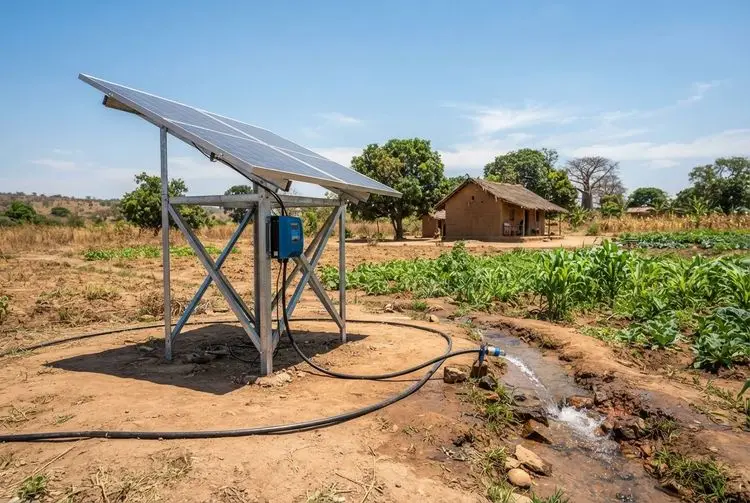
Malawi's solar energy sector is undergoing a rapid transformation driven by Chinese imports, with off-grid solutions now reaching millions of rural households. But experts warn that the influx of low-cost equipment demands stronger regulation.
A farmer in Kalembo village, Traditional Authority Chitukula in Lilongwe, is among those benefiting. Boma Chisenga uses a Chinese-made solar pump for irrigation, replacing the manual watering can he previously relied on.
"The use of solar has made farming easy. I am able to irrigate a large area because of this solar equipment you see here," Chisenga said.
A nation powered by imports
Malawi faces a severe electricity deficit. Only 25.9% of the country's approximately 22.8 million people have access to electricity. Of those, 11.3% are connected through the national grid, while 14.6% rely on off-grid solutions. The urban-rural divide is stark: 56.5% of urban households have grid electricity, compared to just 3.8% in rural areas.
Chinese solar components now dominate the off-grid market. According to the source material, 90% of off-grid solutions in Malawi come from China. These systems power homes, schools, hospitals and farms across the country.
The government is actively promoting solar to reduce Malawi's heavy reliance on hydropower, which currently accounts for 95% of generation capacity. The target is to cut that dependence to 76% within five years. The push comes as climate change causes drought and floods annually, disrupting rain-fed agriculture and hydro generation alike.
Quality concerns emerge
Michael Kaiyatsa of the Centre for Human Rights and Rehabilitation (CHRR) highlighted the dual nature of Chinese involvement.
"I think the growing role of Chinese companies in Malawi's solar energy sector is both an opportunity and a matter that requires careful consideration," Kaiyatsa said.
Edgar Kapiza Bayani of the Renewable Energy Industries Association of Malawi (REIAMA) called for government intervention.
"It is important that Government steps in to regulate what products can come into the country so that Malawians enjoy value for their money," Bayani said.
Experts stress the need for quality standards and regulation to prevent substandard products from undermining the sector's long-term viability.
Utility-scale and distributed solar
Malawi now generates over 100 MW of electricity from solar. The Salima solar power plant, built by Chinese company Chint, has a first-phase capacity of 10 MWp. A 3 MW solar PV carport system at Capital Hill was developed under a 2013 agreement between Malawi and China, with a project cost of $1.5 million.
Battery storage is also being deployed to address grid instability. A $20 million Battery Energy Storage System (Bess) was commissioned in Lilongwe in July 2026. The system, managed by the Electricity Generation Company (EGENCO) and the Electricity Supply Corporation of Malawi (ESCOM), is designed to stabilise the grid and manage fluctuations from renewable energy sources. Malawi is currently buying lithium-ion batteries from China.
Community-level impact
Distributed solar projects are reaching rural communities. Orifice Irrigation Water Supply (OIWS) has implemented over 200 solar projects since 2018. Community Energy Malawi (CEM) has completed over 14 projects with combined budgets exceeding US$3.5 million, impacting an estimated 300,000 people across 18 districts. CEM aims to connect 5,000 people by next year.
Energy Minister Jean Mathanga has promoted solar as a solution to the country's daily power blackouts, which affect farmers, health facilities and businesses. Limited generation capacity and a lack of storage have caused significant energy losses.
What to watch
For solar industry professionals, Malawi represents a growing but fragile market. The dominance of Chinese imports — from panels and pumps to lithium-ion batteries — keeps costs low but raises questions about quality assurance, warranty enforcement and long-term system performance.
The government's target to reduce hydro dependence from 95% to 76% within five years signals strong policy support for solar and storage. However, without a regulatory framework for product standards, the sector risks reputational damage from underperforming equipment.
Private sector investors, NGOs and individuals are all active in Malawi's solar market. The Bess system in Lilongwe and the Salima solar plant demonstrate that utility-scale projects are viable. But the real story may be in distributed solar: with 14.6% of the population already using off-grid solutions, the addressable market for quality solar home systems, pumps and mini-grids remains vast.
Xin Zhechou of the Chinese Business Forum in Malawi and Energy Pioneer are among the entities involved in the sector's development. The coming months will show whether regulation catches up with the pace of deployment.