
Tesla Files for $3.1B Texas Polysilicon Plant in Solar Manufacturing Push
The proposed refinery near Robstown would produce ultra-high-purity polysilicon for solar cells and ingots.
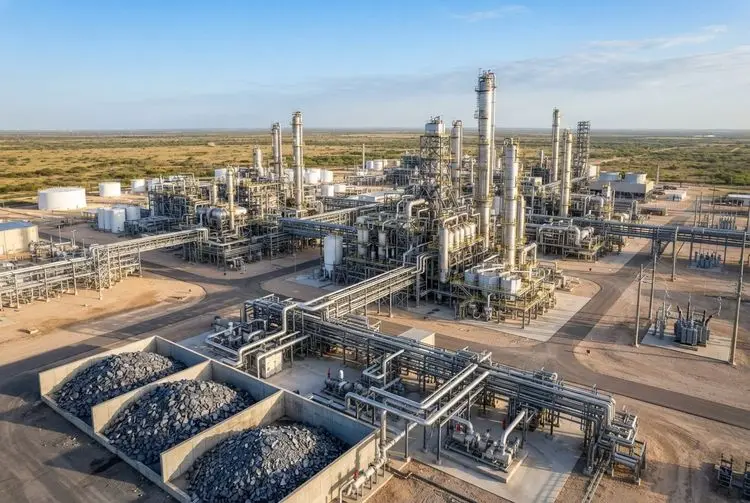
Tesla has applied for a Texas property tax limitation under the state's Jobs, Energy, Technology and Innovation (JETI) program for a proposed $3.1 billion polysilicon refinery near Robstown in Nueces County. The application, published by the Texas Comptroller of Public Accounts, describes the facility as "under consideration for development" and as the "upstream component of Tesla's vertically integrated domestic solar manufacturing platform."
Tesla told the Tuloso-Midway Independent School District that it would not build the plant in Texas without the incentive. The company stated that "in the absence of the agreement the applicant would not make the proposed investment in this state" and that it is assessing locations in other jurisdictions.
The plant would produce ultra-high-purity polysilicon for single-crystal silicon ingots and N-type, high-efficiency solar cells. Its equipment list includes a hydrochlorination and trichlorosilane synthesis unit, chlorosilane distillation and purification trains, silicon tetrachloride recycling loops and Siemens chemical vapor deposition reactors. The filing does not disclose the plant's production capacity.
An economic impact analysis prepared for Tesla by EY places construction between 2027 and 2030. Of the planned capital spending, $1.5 billion is earmarked for engineering and construction, $1.4 billion for equipment and $183 million for utility infrastructure, with more than 80% spent in 2028 and 2029. Tesla plans to hire 260 workers in 2030, rising to 515 once the plant is fully operational in 2032, at average total compensation of $130,000. Construction would support an average of 550 direct jobs a year, and EY estimates the project would generate about $63.5 billion in economic output in Texas through 2065.
Trade measures reshape feedstock market
Tesla noted in the filing that more than 90% of the world's solar-grade polysilicon is produced in China. The polysilicon filing lands as new U.S. trade measures reshape the feedstock market. Section 232 tariffs and minimum import prices on polysilicon, which also impose a 15% duty on imported ingots, wafers, cells and modules, take effect on Dec. 4. The minimum import prices are designed to force foreign suppliers to match U.S. production costs, raising the value of domestic feedstock in a market where U.S. polysilicon production remains limited. Solar manufacturer Toyo secured U.S. polysilicon supply to navigate trade barriers in January.
Under the EY schedule, the project's taxable value for school-district maintenance and operations taxes would be cut to zero from 2028 to 2030 and halved from 2031 through 2040. The Comptroller must review the application, and both the Office of the Governor and the school district's board must approve an agreement before it takes effect.
The filing follows Tesla's JETI application for Project Crystal Sun, a proposed solar cell and module factory in Fort Bend County with planned investment of about $10.1 billion, which cleared a key tax hurdle in September when the local school board backed its limitation. Tesla has been advancing a plan to build 100 GW of U.S. PV manufacturing capacity by 2028, a target that has drawn scrutiny over whether Elon Musk's solar ambitions are achievable. The company has taken a similar approach in storage, saying in 2025 that its 10 GWh lithium iron phosphate cell factory in Nevada was nearing completion as it reduced reliance on imported cells.
U.S. solar capex clusters in Texas, Carolinas and Midwest
Tesla's move comes amid a broader U.S. solar manufacturing build-out documented by Terawatt PV Research, which tracks about 40 companies actively producing silicon PV components in the United States, from polysilicon to modules, each with a different growth model out to 2030. While the landscape remains fragmented, there are signs a consolidated production-led approach could emerge, particularly if the sector can unite on a technology roadmap and the need for a domestic materials-based supply chain.
Capital expenditure trends from 2020 to 2026 reveal clustering into specific states and regions. Texas leads PV capex in 2026, with key contributions from Canadian Solar's module expansion in Mesquite near Dallas, the build-out of SpaceX's new manufacturing base in Bastrop east of Austin, SEG Solar's new module base in Tomball northwest of Houston, and T1 Energy's new cell factory outside Austin. Together these four companies account for about 90% of total PV capex in Texas during 2026, with nine other entities contributing the residual.
The next major spending region is the Carolinas, driven by Boviet Solar's cell factory in Greenville, North Carolina, First Solar's new module assembly factory in Gaffney, South Carolina, and ES Foundry's cell expansion in Greenwood, South Carolina. Six additional companies have meaningful 2026 capex allocations in the Carolinas, most significantly early spending from Suniva for its new cell factory in Laurens, South Carolina. Other Southeastern states include First Solar's existing factories in Trinity, Alabama, and New Iberia, Louisiana, built out mainly during 2023 to 2025, and Qcells' ingot-to-module Cartersville base northwest of Atlanta, Georgia, with spending concentrated in 2023 to 2025.
The Midwest states of Indiana, Michigan and Ohio round out capex significance, led by Canadian Solar's new cell factory in Jeffersonville, Indiana, Corning's ongoing capital deployment across co-located polysilicon and ingot/wafer bases in Saginaw County northwest of Detroit, and First Solar's spending at its three-plant cluster south of Toledo, Ohio.
Module production dominates current output
Because most investment since the Inflation Reduction Act of 2022 has gone into module assembly, detailed regional production analysis today is largely confined to modules. About 95% of solar module production in Texas during 2026 is forecast to come from factories within a 50-mile radius of Greater Houston and a 25-mile radius of Greater Dallas, representing more than one-quarter of all U.S. module production. Ohio's module output comes almost exclusively from First Solar's thin-film lines and Illuminate's silicon module assembly base, while the Southeast's volumes are dominated by Qcells in Dalton and Cartersville, Georgia, First Solar in Alabama, and Inox Clean Energy at the former Boviet Solar site in North Carolina, with seven other companies also producing modules across South Carolina, Georgia and Alabama in 2026.
Terawatt PV Research's company-specific rankings, based on weighted analysis of production volumes and manufacturing capex, place First Solar as the only AAA-rated company, with its thin-film process flow equal to the whole silicon-based value-chain. Corning is AA-rated through its polysilicon, ingot, wafer and module operations in Michigan and Arizona, and Canadian Solar is the other AA-rated company with meaningful production and capex contributions from its Texas module base and Indiana cell plant. Lower B- and C-rated bands are generally pure-play module producers such as SEG Solar, Illuminate and Waaree Energies, or cell-focused manufacturers such as Suniva and ES Foundry.
As more silicon-based companies backward integrate from modules to cells, more should reach the A to AAA bands from 2027 onward, and the pyramid will shift as legacy site contributions from JinkoSolar and Boviet Solar transition to new owners, with Inox Clean Energy expected to rise strongly once Boviet's new cell factory is sold to Inox in 2027.
Looking to 2027, the next stage of onshoring the silicon-based ecosystem will come from new capital released to increase domestic cell production volumes and to build key materials supply options for module production, including encapsulant films, backsheets, glass and frames. Ultimately, the long-term success of a U.S. solar ecosystem will depend not simply on leading companies committing capex and running factories at high volumes, but on operations being profitable with a stable policy outlook.