
COP31 Launches Global Rooftop Solar Pledge and Sports Solar Project
Five nations back doubling rooftop solar by 2030 as Turkish volleyball federation unveils 6 MW solar plant.
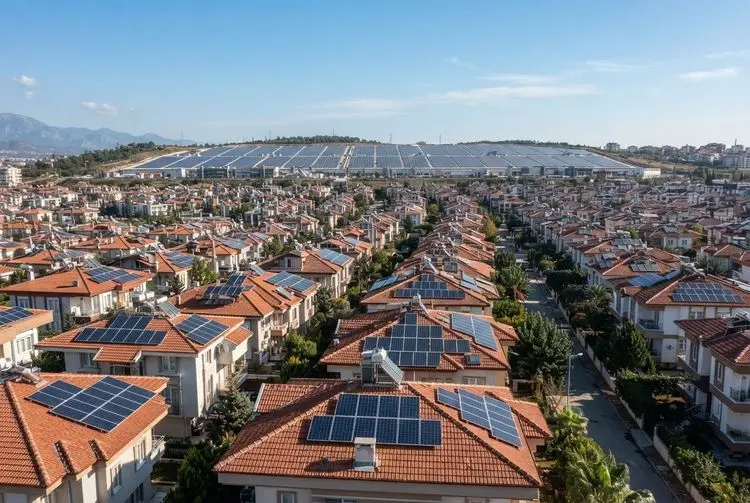
ANTALYA, Turkey — The COP31 climate conference in Antalya has produced two parallel solar energy initiatives: a multinational declaration to double global rooftop solar installations by 2030 and a 6 MW solar power plant partnership between the Turkish Volleyball Federation and appliance manufacturer Arçelik.
Five countries — Australia, Bangladesh, Kenya, Nigeria and Vanuatu — launched the Global Rooftop Solar Declaration on the second day of the talks, which are co-hosted by Turkey and Australia. The voluntary, non-binding pledge aims to increase the number of homes with rooftop solar panels from approximately 150 million today to at least 300 million by 2030.
Lawmakers from 21 additional countries, including the United Kingdom, South Africa and Sri Lanka, have endorsed the declaration. Indonesia's state-owned electric power company Perusahaan Listrik Negara has also signed on.
"This is the future of affordable energy," said Sonia Dunlop, CEO of the Global Solar Council. "This is the way we can help average working people insure themselves from future price rises to come."
Dunlop warned that the world faces "the greatest energy cost of living crisis the world has ever seen" and said the declaration offers a pathway to lower household electricity bills.
Pledges need policy follow-through
Industry leaders cautioned that voluntary commitments must be backed by concrete national policies. Bruce Douglas, CEO of the Global Renewables Alliance, said the declaration alone is insufficient.
"The pledge is a pledge," Douglas said. "We now need to see national policies and frameworks in place."
For rooftop solar targets to meaningfully reduce emissions, experts said governments must quickly implement policies to upgrade power grids and subsidize solar panels and batteries.
Electrification is a central theme of this year's talks. Turkey is pushing for electricity — preferably from renewable sources such as solar and wind — to account for 35% of global energy consumption by 2035.
"Electrification by itself is incredibly beneficial because of the efficiency gains. Renewables by themselves, again, very beneficial. Put the two together and it is really a killer combination," Douglas said.
Fossil fuel reliance persists
Despite the renewable energy push, the energy mix of host countries and major economies reveals continued dependence on fossil fuels. In Turkey, solar and wind account for nearly 23% of electricity generation, but coal remained the largest source at 33% last year, according to Turkey's Ministry of Energy and Natural Resources.
In Australia, one in three homes already has rooftop solar and more than 700,000 homes have batteries for energy storage. Yet coal still supplies more than 40% of Australia's electricity, and the country remains one of the world's largest coal exporters.
"Setting ambitious renewable targets without addressing grid capacity, storage and the continued role of coal risks undermining energy security, reliability and affordability," said Michelle Manook of FutureCoal, the industry-backed group formerly known as the World Coal Association.
China and India face similar tensions. Both countries have installed record amounts of renewable capacity but sometimes lose that energy due to insufficient transmission and storage infrastructure.
"Energy storage deployment must catch up with the speed of renewables deployment," said Nikit Abhyankar of the India Energy and Climate Center at the University of California, Berkeley. "Otherwise, it creates massive operational challenges for the grid, resulting in significant curtailment."
Turkish volleyball federation goes solar
In a separate initiative at COP31, the Turkish Volleyball Federation (TVF) presented a solar energy partnership with Arçelik that extends beyond conventional sponsorship. Under the agreement, Arçelik will build a solar power plant with an installed capacity of approximately 6 MW in Gümüşhane, Turkey.
The facility will generate electricity to cover the federation's energy needs, with surplus production providing an additional revenue stream. TVF President Mehmet Akif Üstündağ, national team players Derya Cebecioğlu and Dilay Özdemir, and Arçelik CEO Can Dinçer discussed the project at a panel titled "Powering the Game, Changing the World" on the conference's opening day.
"At Arçelik, we have continued producing and investing in our country for 71 years. Sustainability is at the center of how we do business," Dinçer said. "Together with the Turkish Volleyball Federation, we have developed a model that will deliver benefits beyond the sponsorship period."
Üstündağ described the initiative as a long-term investment in Turkish volleyball. "Turkish volleyball has reached the top in Europe and around the world through our national teams and clubs. However, our goals are not limited to sporting success," he said.
He noted that the federation's facilities consume significant amounts of electricity and that the partnership addresses a major operational expense. "Today, we are here, but tomorrow we may not be. This project, however, will continue. The lights in our facilities will remain on, and future generations of the Sultans of the Net and the Efes of the Net will continue to develop there," Üstündağ said, referencing the nicknames for Turkish volleyball players.
The federation has set its sights on an Olympic medal, with Üstündağ expressing hope for success at the 2028 Los Angeles Games.
Athletes on perseverance and role modeling
National team player Derya Cebecioğlu emphasized that long-term institutional support is essential in professional sports, where athletes face demanding schedules, injuries and surgeries. She thanked the federation for consistent backing through difficult periods.
"Everyone knows that we became European champions this year and won the Volleyball Nations League (VNL). However, these achievements did not happen in a single day," Cebecioğlu said, pointing to Turkey's runner-up finish at the world level two years earlier as evidence of the perseverance required.
Fellow player Dilay Özdemir highlighted the responsibility athletes carry as role models, particularly for young girls. "Knowing that young girls watching us are inspired by what we do increases our sense of responsibility and motivation. Being able to serve as role models for them means a great deal to us," she said.
Özdemir argued that creating opportunities for the next generation does not require extensive resources. "For sustainability, I think the most important things are a volleyball court, a ball and a coach who believes in young girls," she said.
COP31 runs through November 20. The conference follows a year of deadly climate-related disasters and growing concern that governments are not doing enough to curb global warming. Recent energy shocks from the Russia-Ukraine war and the Iran war have also accelerated interest in renewables. Industry observers will be watching whether the pledges made in Antalya translate into concrete action on the ground.