
SPONSORED

Portable Solar Generators 2026: 13 Kits Compared for Backup Power

New comparison of 13 solar generator kits reveals real-world charging times, panel efficiency and safety advantages over gas.
•• 6 Min
Portable Solar Generators 2026: 13 Kits Compared for Backup Power

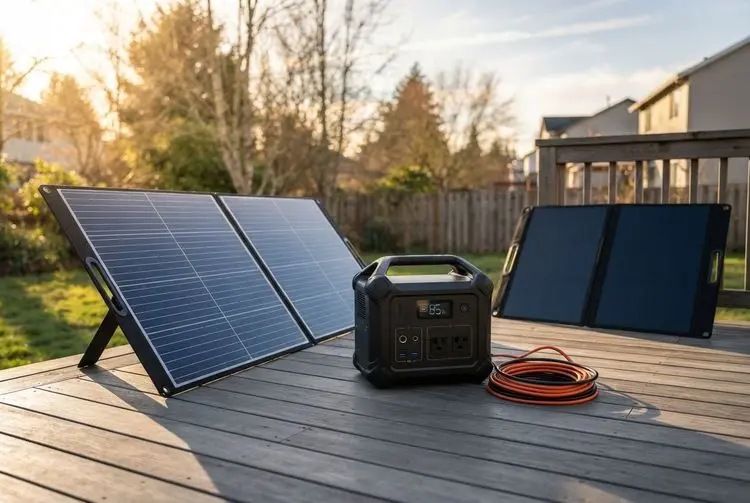
A comprehensive comparison of 13 portable solar generator kits published on 7 November 2026 shows wide differences in charging speed, panel quality and total cost. The guide, compiled from brand US stores, compares complete kits that pair a portable power station with folding solar panels.

Every kit in the comparison has a station that accepts more solar input than its included panels can supply. The panels cover between 11 and 50 percent of the station's maximum solar input, meaning users can later add more panels to charge faster.

Real-world solar yields vary sharply by season and location

The analysis uses solar yield data from NLR PVWatts v8 and the EU Joint Research Centre's PVGIS 5.3. A 400-watt panel delivers 1.5 to 2.1 kilowatt-hours per day across different US cities in June. In December, the same panel produces only 0.34 to 1.6 kWh per day.

New York City illustrates the seasonal gap: a 400 W panel yields 1.69 kWh per day in June but only 0.96 kWh per day in December. The difference is far more extreme in Kyiv, where a 400 W panel delivers 1.88 kWh per day in June and just 0.34 kWh per day in December — only 18 percent of the summer output.

Seattle sees December output at 30 percent of June levels, while Phoenix retains 85 percent. Madrid's December yield is 64 percent of June. Berlin receives 0.35 kWh per day from a 400 W panel in December, London 0.47 kWh per day.

For a 1 kWh station paired with a 200 W panel, charging takes about 1.1 to 1.2 days in New York during June. In December, the same setup needs roughly 2.1 days. Jackery's FAQ states "around 6.6h" for charging a 1 kWh station with a 200 W panel under ideal conditions.

Panel quality matters: better panels deliver 83–91 percent of rated output

Independent testing by OutdoorGearLab in July 2026 found that better folding panels deliver 83 to 91 percent of their rated output. Weak panels achieve only 67 to 70 percent. The EcoFlow 400 W panel manual states it "usually generates 320W–350W" — well below its 400 W rating.

Panel efficiency varies significantly between brands. The Anker PS200 panel weighs 4.8 kg and achieves 41.6 W per kg with 18.3 percent efficiency. The EcoFlow 220 W panel weighs 7.0 kg and delivers 31.4 W per kg. The Goal Zero Boulder 100 manages only 10.5 W per kg.

The promobil test found the Jackery SolarSaga 200W delivers 625 Wh per 100 W of rating, while the weakest panel in the test managed only 431 Wh per 100 W. Anker SOLIX claims "up to 10% more power" for its panels.

Safety and cost advantages over gas generators

Battery-based solar generators produce no carbon monoxide. That is a critical safety advantage: the US Consumer Product Safety Commission reports that 93 Americans died from CO poisoning caused by portable generators in 2022. Since 2012, portable generators have caused 892 CO deaths, accounting for 41 percent of all consumer-product CO deaths. In 2022, 59 percent of CO deaths occurred between November and February, and 64 percent happened at home.

The fuel cost for gas generators in November 2026 ranges from $0.68 to $1.08 per kWh, based on a US average gasoline price of $4.153 per gallon. A 220 W panel in New York generates roughly 289 kWh per year, worth between $197 and $312 of gasoline.

California will require zero-emission generators from model year 2028 under its Small Off-Road Engine rules. The EPA authorised California's rules on 6 January 2025; Congressional resolutions to block them have not passed. A federal CO rule for generators was proposed in April 2023 but had not been finalised as of November 2026. The CPSC stated in 2022 that the voluntary UL 2201 standard would avert nearly all CO deaths.

Kit pricing and bundle savings

Bundle savings range from $49 to $576 across the 13 kits. The smallest kit is the BLUETTI Elite 30 V2 with a 100 W panel at $489.99, offering 288 Wh capacity and a 600 W inverter at 4.3 kg. The BLUETTI Elite 100 V2 with a 200 W panel costs $699 for 1,024 Wh.

The EcoFlow DELTA 3 Classic with a 220 W panel is priced at $729, while the DELTA 3 Plus with the same panel costs $919. The Anker SOLIX C1000 Gen 2 with a PS200 panel ranges from $799.99 to $849.99. The Jackery HomePower 1000 v2 with a SolarSaga 200 W panel sells for $939.

At the higher end, the Goal Zero Yeti 1500 with a Boulder 100 panel costs $1,709.95. The EcoFlow DELTA 3 Max Plus with two 160 W panels is $1,599, matching the Anker SOLIX C2000 Gen 2 with a PS400 panel at $1,599.99.

The largest kits include the EcoFlow DELTA 3800 Gen4 with four 160 W panels at $2,599 early-bird, the BLUETTI Apex 300 with two 350 W panels at $2,599, and the Jackery HomePower 3600 Plus with two 200 W panels at $2,549. The Anker SOLIX S5000 with two 400 W panels tops the list at $3,499.99, offering 5,024 Wh, a 4,500 W inverter and 10,000 cycles to 60 percent.

Battery technology and warranties

Every 1 kWh station in the comparison now uses lithium iron phosphate cells rated for 4,000 to 6,000 cycles. The Jackery HomePower 1000 v2 and EcoFlow DELTA 3800 Gen4 both claim 6,000 cycles to 70 percent. The Anker S5000 offers 10,000 cycles to 60 percent.

Panel warranties range from one year for EcoFlow and BLUETTI to five years for Anker and Jackery. The 2024 edition of the guide contained incorrect information on Li-ion cycles and average home use, which the 2026 edition has corrected.

Charging times for larger stations

Charging times scale with station size. The BLUETTI Elite 30 V2 (288 Wh) fills in 0.7 days in New York during June and 1.2 days in December. The BLUETTI Apex 300 needs 0.9 days in June and 1.6 days in December. The Jackery HomePower 3600 Plus requires 2.1 days in June and 3.7 days in December. The Goal Zero Yeti 1500 takes 3.6 days in June and 6.3 days in December.

The average US power outage lasted 269 minutes in 2025, down from 663 minutes in 2024, according to EIA data. Ukraine, facing blackouts from Russian strikes every winter since 2022, has exempted solar panels and lithium-ion batteries from import duties and VAT until 1 January 2029.

The EcoFlow manual describes a "1+1=1 scenario" for its panel configuration, referring to how panels in series add voltage while cold temperatures can raise voltage further. Panels in parallel add current, but the input has a current limit. Bifacial panels offer a real gain typically below 10 percent worldwide, according to a 2018 study.

Portable Solar GeneratorSolar Generator ComparisonSolar Backup PowerPortable Power StationSolar Panel EfficiencyLfp BatteryZero-Emission Generator

Most Popular News

  1. Greenhushing rises as solar costs fall and grid access becomes king
  2. MIT study: Excess renewable energy could power factories and data centers
  3. IHCL switches on 500-kW solar plant at Taj Fort Aguada in Goa
  4. Adaptive water cooling stabilizes hybrid solar collector across three climates
  5. Section 232 solar tariffs take effect Dec 4, reshaping US supply chain

Disclaimer


Important notice regarding existing conflicts of interest:

We expressly point out that conflicts of interest exist in connection with this publication:

1. Stock Market Media Ltd. and persons closely associated with it hold shares in the companies recommended here and intend to sell them within the scope of, and at any time during, this recommendation. This constitutes a clear and specific conflict of interest.

2. The publisher of this publication and the responsible editors receive financial remuneration for its preparation. This, too, constitutes a clear and specific conflict of interest.

3. Please also note the further statements on existing conflicts of interest in the disclaimer below, inter alia under no. 2.

Important information and mandatory disclosures pursuant to the German Securities Trading Act (Wertpapierhandelsgesetz, WpHG) and pursuant to the German Financial Investment Ordinance (Finanzanlageverordnung, FinAnV).

Stock Market Media Ltd. has notified the German Federal Financial Supervisory Authority (Bundesanstalt für Finanzdienstleistungsaufsicht, “BaFin”), pursuant to the WpHG, of its activity as a producer of investment strategy recommendations within the meaning of Article 3(1) point 34 of Regulation (EU) No 596/2014 or of investment recommendations within the meaning of Article 3(1) point 35 of Regulation (EU) No 596/2014 (formerly “financial analyses”). The obligations of Stock Market Media Ltd. are governed primarily by §§ 85, 86 WpHG, Regulation (EU) No 596/2014 and Delegated Regulation (EU) 2016/958.

Information on the producer(s) of this publication:
Mr Roberto Gonçalves de Albuquerque, as analyst and editor-in-chief, is responsible for the preparation of the texts and contents of this publication. The publisher is Stock Market Media Ltd., 405 Kings Road, Flat 600, London; SW10 0BB, United Kingdom, represented by its Director Roberto Gonçalves de Albuquerque.

Important notes on the preparation of this publication:
This publication contains both facts and factual information on the companies discussed and purely subjective value judgements, interpretations, estimates, projections, forecasts and price targets. We endeavour to distinguish these from one another as transparently as possible in order to avoid misleading statements. Research, preparation and wording are carried out using common digital and AI-supported tools; the review of the content and the editorial responsibility lie with us. The essential bases and standards of our value judgements and valuations of the shares discussed are based on the following approach:

Assessment and valuation of companies according to conventional valuation methods (fundamental valuation approach)

  • Assessment of the potential of the company's future development (growth approach) and projection onto the corresponding valuation potential (price potential analysis) as well as a possible valuation of the company's shares on the basis of potential profit expectations (P/E ratio projection)
  • Assessment of the best-case scenario expected by us in the event of the company's absolute success (blue-sky potential approach)
  • Effect on the share price of the increased awareness of the recommended share expected by us, resulting from a strong rise in demand on the market (particularly decisive in the case of illiquid shares or shares recommended newly or for the first time) on account of the publications (mostly buy recommendations) published by us or by third parties (multiplier / momentum effect, hype), and thereby a disproportionately rising return/share price with a correspondingly rising risk
  • Technical analysis of the share price in accordance with common methods of analysis, mostly for the prediction of price signals (buy or sell signal, breakout of the share, determination of price targets, support or resistance areas, expected minimum movements or minimum counter-movements, prediction of signal points (if-then), etc.), for the most part building on the expected mass psychology (technical approach).

Conventional valuation approaches often cannot be meaningfully applied to young companies or companies that do not yet generate revenue. In valuing such companies we therefore tend to rely on the potential analysis calculated by us and on the assessment of the demand for such shares on the capital market. Ultimately, the market decides on the share price of a company. If extensive recommendations of a share give rise to excessive demand for it, it is possible that the share price will rise at an above-average rate on high trading volume. Although this leads to extreme opportunities for profit, it correspondingly increases the risk of a bubble forming, with a corresponding fall in price. The increased volatility of the share in such situations gives rise to above-average opportunities for profit and loss, both in both trading directions and in the case of recurring counter-movements. Such market developments are also an important part of our trading recommendations and valuation approaches.

This publication deals exclusively with securities of above-average volatility with high potential for profit and also for loss.

Note on sources of information:
The reliability of sources of information is examined by us in detail before they are used and is subjectively assessed by us according to their credibility and significance. In doing so, we decide by our own standards which sources we consider relevant, too conservative or too optimistic. Ultimately, we determine our recommendations on the basis of our personal assessments. In obtaining information we draw on numerous publicly accessible sources such as press releases, ad hoc announcements, company announcements, company presentations, publications and articles on the company discussed, common financial media in Germany and abroad as well as company or sector analyses by third parties.

Our publications use exclusively publicly available information and sources as well as information disseminated by the company itself.

Note on existing conflicts of interest:
We hereby point out that shareholders, editors, employees and persons or companies involved in the preparation of this publication, as well as principals (third parties) commissioning the publication of Stock Market Media Ltd., hold, directly or indirectly, at the time of this publication, interests in securities which are discussed in the respective publication, and are therefore interested in an increase in price and/or turnover, i.e. also in increased trading liquidity, since it is intended to sell these securities in direct connection with this publication and to participate in rising prices and turnover. An increase in the price of the shares of the companies presented may lead to an increase in the assets of these persons. In any case, the share price of the company may be significantly influenced by the discussion of the company. In particular, the share price of the companies discussed is also materially influenced by securities transactions. This applies in particular where the companies concerned are ones whose shares do not have a broad market capitalisation and for which only a narrow market exists. Here, even small order volumes can have considerable effects on prices. However, they are also interested in the price of the company discussed falling if they wish to acquire its shares more cheaply. By law, this gives rise to a conflict of interest, to which we hereby expressly draw attention.

Stock Market Media Ltd. and its employees are furthermore remunerated for the preparation, electronic distribution and publication of this publication as well as for other services. By law, this gives rise to a conflict of interest, to which we hereby expressly draw attention.

This remuneration may be paid by the company about which Stock Market Media Ltd. publishes information, by third parties affiliated with these companies or by other third parties pursuing an interest with regard to the companies discussed in connection with this publication. By law, this gives rise to a conflict of interest, to which we hereby expressly draw attention. This arises, first of all, from the fact that Stock Market Media Ltd. could make its statements in the interest of its principal. Stock Market Media Ltd. and/or companies affiliated with it have entered into an agreement, for a fee, with the company in question or with its shareholders for the preparation of the editorial coverage. By law, this gives rise to a conflict of interest, to which we hereby expressly draw attention.

Note on the handling of internal organisational duties:
Owing to the small size of the publisher's business, internal control of the compliance processes of the employees and other parties contributing to this publication is limited.

Competent supervisory authority:
Stock Market Media Ltd. has notified BaFin of its activity pursuant to § 86 WpHG.