
Section 232 solar tariffs take effect Dec 4, reshaping US supply chain
New price floors and tariffs on polysilicon derivatives will halt most crystalline silicon module imports.
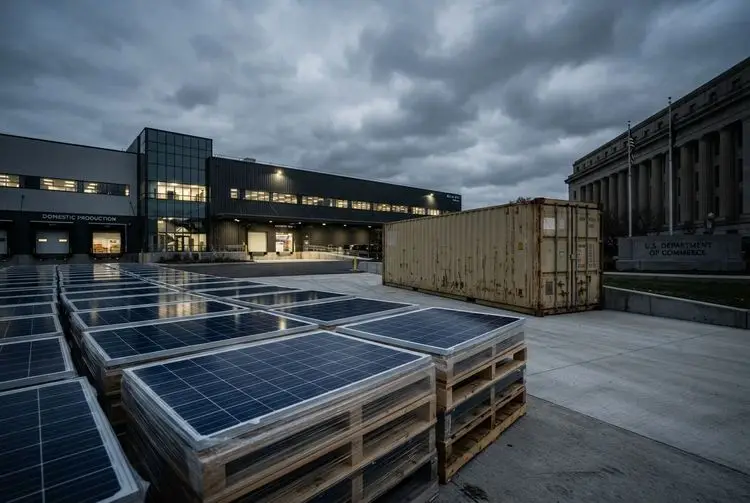
The Trump Administration's Section 232 proclamation on solar manufacturing supply chains takes effect December 4, 2026, replacing expired safeguard duties with a comprehensive framework of minimum import prices and tariffs that industry analysts say will largely halt crystalline silicon module imports into the United States.
The proclamation, signed August 6 and based on a Department of Commerce national security investigation, introduces stage-by-stage Minimum Import Prices (MIPs) that act as hard price floors at the first arm's-length U.S. sale. Raw polysilicon carries a MIP of $21/kg (approximately $0.037/W), ingots and wafers a MIP of $100/kg (approximately $0.12/W), solar cells a MIP of $0.22/W, and solar modules a MIP of $0.38/W.
In addition to the MIP framework, a 15% ad valorem tariff applies to polysilicon derivatives, stacking on top of existing Section 301 and antidumping/countervailing duties. Raw polysilicon is exempt from the 15% ad valorem duty. U.S. Customs and Border Protection will assess a volumetric tariff if the entered value falls below the applicable MIP threshold.
No broad exemptions for Southeast Asia
Unlike previous trade actions, the Section 232 proclamation grants no broad country-wide exemptions for Southeast Asian manufacturing hubs. The United Kingdom receives a reduced rate of 10%, while the European Union, Japan, South Korea, Taiwan, Switzerland and Liechtenstein face a rate cap of 15%.
Failure to submit MIP certification triggers an automatic specific tariff equal to the full MIP value. Importers with materially inaccurate certifications risk permanent debarment. The Commerce Department can unilaterally raise MIP thresholds upward only, and the U.S. Trade Representative may negotiate managed trade volume quotas.
Commerce tracks imports electronically by tariff code and importer of record. Post-sale rebates, bundling arrangements and affiliated-entity transactions are specifically targeted by the enforcement framework.
Anti-stockpiling enforcement already underway
Anti-stockpiling enforcement began September 22, and between 30 and 50 importers have already been blocked from entering covered products. Paying for or shipping goods before December 4 does not insulate shipments if they have not cleared CBP entry by the effective date.
"Developers need to confirm IOR historical volumes with suppliers," said Christian Roselund, senior analyst at Intertek CEA. The analyst noted that fixed-term supply contracts signed before August 6 may qualify for MIP resale exemptions.
U.S. solar equipment inventories expanded 126% in Q2 2026, with roughly 40 GW of stockpiled modules now in the market. Spot prices for modules surged toward approximately $0.46/W during autumn 2026.
Domestic cell gap remains critical
The U.S. now has 65.5 GW of operational module assembly capacity, meeting roughly 70% of annual installation demand. However, domestic cell capacity stands at just 3.2 GW, and over 90% of the cells used in U.S. factories are imported.
Post-232 module pricing quotes range from the high $0.30s to low $0.50s per watt. U.S.-assembled modules using imported cells are priced at $0.42-$0.43/W, while modules using imported wafers reach $0.50-$0.53/W. Vertically integrated manufacturers hold a structural margin advantage under the new framework.
T1 Energy is building a $510 million, 2.1 GW cell plant in Rockdale, Texas, slated for early 2027 production. New U.S. ingot, wafer and cell factory announcements are likely limited before 2028-2030, analysts said.
Thin-film pricing climbs, PPA costs rise
U.S. thin-film module pricing climbed 5%-10% since the proclamation was signed, with thin-film carrying a balance-of-system cost penalty of $0.03-$0.07/W compared to crystalline silicon.
North American power purchase agreement prices rose 4.9% quarter-over-quarter in Q3 2026, according to LevelTen Energy data. The Solar Energy Industries Association, American Council on Renewable Energy and American Clean Power Association warned of cost increases, while domestic manufacturers welcomed the rules.
Commerce is expected to issue a tariff rebate and onshoring waiver program. Greenfield manufacturers will likely need advanced permitting, construction starts and audits to qualify. Domestic manufacturers are pushing for dollar-for-dollar relief.
Contracting strategies shift
"Thin-margin projects need re-modeling before switching hardware," said Aaron Hall, director of market intelligence at Anza. Multi-party change-in-law and change-in-tariff clauses are recommended for 2027-2028 contracts.
Projects targeting domestic-content bonus credits under the Inflation Reduction Act face higher post-232 cell costs. The Science Based Targets Initiative has set a January 31, 2027 procurement window for compliant solar procurement.
Section 45X manufacturing credits and tolling agreements could push domestic module pricing toward a $0.30/W floor. Domestic module capacity is trending toward double annual demand by late 2027, which could create downward pressure on pricing once cell supply constraints ease.
Joseph C. Johnson of Intertek CEA noted that developers should verify whether their supply contracts include provisions that address the new tariff regime. Sabah Bayatli of OCI Energy and executives at Silfab Solar have been among those tracking the policy's implementation closely.