
MIT study: Excess renewable energy could power factories and data centers
New research models how 10% surplus solar and wind output can be redirected to industrial users.
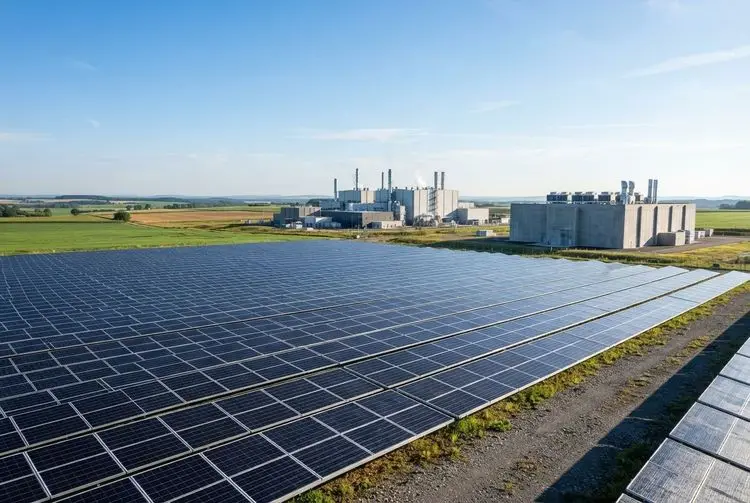
A study published this week in the journal Joule by researchers at MIT and Georgia Tech projects that a future US grid running on 80% solar and wind power would generate roughly 10% more electricity than the grid can use or store. That excess energy, the authors argue, could be diverted to power manufacturing plants and data centers.
Curtailment — the deliberate reduction of solar and wind output — is already a routine tool grid operators use to balance supply and demand. When renewable generation exceeds what the grid can absorb or batteries can store, operators simply shut down panels or turbines. The practice wastes clean electricity and, as a Zenobe report notes, "drives up bills for consumers, and wastes precious renewable energy."
The storage bottleneck
Energy storage remains the primary constraint. Current lithium-ion battery systems offer roughly four hours of discharge capacity, sufficient for evening peaks but inadequate for multi-day or seasonal surpluses. Long-term storage technologies, such as flow batteries or hydrogen, are not yet commercially viable at scale.
Solar and wind production patterns also conflict with demand patterns. Spring and fall, when heating and cooling loads are moderate, often see the largest renewable surpluses. These excess periods can last for hours at a time. Insufficient network infrastructure further limits the ability to redirect that energy to where it is needed.
Modeling the surplus
The MIT and Georgia Tech study models a scenario in which 80% of US electricity comes from solar and wind. Under that assumption, the researchers found that roughly 10% of total generation would exceed what the grid can use or store. The excess is not evenly distributed — it concentrates in specific seasons and times of day.
Jessika Trancik of MIT, who worked on the study, said the research was motivated by growing electricity demand. "In this era where there is a need for additional electricity, where demands are growing to support data centers and other end users, we wanted to understand what this excess electricity will potentially look like so we can design processes to benefit from these excesses," Trancik said.
Trancik is affiliated with the MIT Institute of Data Systems and Society (IDSS). The study aims to provide reliable modeling of excess energy availability, helping system designers build processes that can run when surplus power is available.
What it means for solar professionals
For solar developers and project operators, the findings underscore a growing tension: as renewable penetration rises, curtailment rates will climb unless new demand sources emerge. The study suggests that co-locating or time-shifting industrial loads — such as data centers, electrolysis for green hydrogen, or materials processing — could absorb that otherwise wasted energy.
A Zenobe report framed the challenge clearly: "The key challenge is how to harness that extra energy, sending it to places where demand is high, or storing it for still and sunless days."
Designing around excess
The research is not a forecast of what will happen, but a tool for planning. By modeling when and how much excess energy will be available, the authors hope to help industries design flexible operations that can ramp up during surplus periods and scale back when the grid is tight.
For investors and project financiers, the study points to a potential revenue stream: selling otherwise curtailed power at low cost to industrial off-takers. Power purchase agreements (PPAs) structured around surplus availability could improve project economics, particularly in regions with high solar penetration and frequent curtailment events.
The broader context
The US solar industry has grown rapidly, but curtailment rates have risen alongside deployment. In California, for example, the Independent System Operator (CAISO) regularly curtails hundreds of gigawatt-hours of solar generation annually during spring months. Similar patterns are emerging in Texas and the Southwest.
Without new demand sources or cost-effective long-duration storage, those curtailment volumes will increase. The MIT and Georgia Tech study offers a roadmap for turning a grid problem into an industrial opportunity — if the industry can design systems flexible enough to follow the sun and wind.