
German solar output on track to hit record 100 TWh in 2026
Germany's solar generation is approaching 100 TWh this year, cementing photovoltaics as a pillar of the power mix.
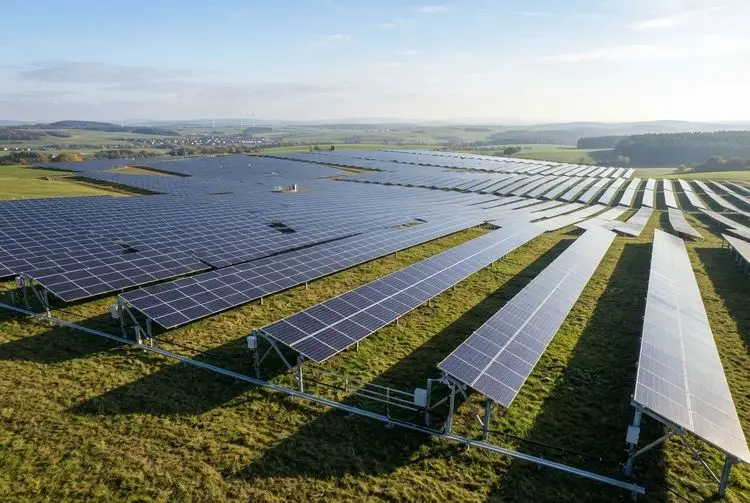
Germany's solar energy output is on course to reach a record 100 TWh in 2026, according to industry data cited in a roundup of national news on November 15. By September 27, solar generation had already reached 90.2 TWh, surpassing the 90 TWh total for the full year 2025.
For context, solar output stood at just 2.2 TWh twenty years ago. Photovoltaics now accounts for 17.8 percent of Germany's power generation, up from a marginal share in the early 2000s.
Carsten Körnig, managing director of the German Solar Association (BSW-Solar), said: "Photovoltaics has developed from a niche technology into a cornerstone of our electricity supply."
The milestone comes as wind power remains Germany's top energy source, with coal in second place. The rapid expansion of solar capacity reflects a broader shift in the country's energy mix, driven by falling module costs and policy support under the Renewable Energy Sources Act (EEG).
Budget crisis looms as spending hits record levels
While the solar industry celebrates a banner year, Germany's federal budget faces severe strain. Economics experts from the Ifo Institute and the Kiel Institute for the World Economy (IfW Kiel) have warned of a serious budget crisis.
The 2027 federal budget includes €210 billion in new debt. Core budget spending is set to reach a record €561 billion, with net borrowing in the core budget alone at €123 billion.
Clemens Fuest, president of the Ifo Institute, said: "This budget policy cannot be sustained in the long term." The Bundesrechnungshof (Federal Court of Auditors) has also raised concerns about fiscal sustainability.
For solar industry professionals, the budget situation carries implications for future subsidy programmes and tax incentives. The EEG surcharge was abolished in 2022, but direct government funding for research, grid expansion and storage deployment could face pressure if austerity measures are introduced.
Microsoft outage renews calls for digital sovereignty
A global Microsoft 365 outage that hit Outlook, Teams and Copilot has reignited debate about Germany's reliance on a single cloud provider. The incident grounded US flights for four hours — the longest disruption since 9/11 — and had a minor impact on Lufthansa's operations.
Ralf Wintergerst, president of the Bitkom digital association, warned: "Anyone who makes themselves unilaterally dependent on a single source for central digital technologies risks production downtimes and competitive disadvantages in an emergency."
Christopher Kunz, a cybersecurity expert quoted by Heise Online, added: "because we are not only at the mercy of Microsoft's technical competence, but also the goodwill of the US government."
Manuel Atug, chair of the AG Kritis cybersecurity working group, has repeatedly called for greater diversification in critical infrastructure. For the solar industry, which increasingly relies on cloud-based monitoring, trading platforms and grid integration software, the outage highlights the risk of single-vendor lock-in.
Political developments: AfD nominates candidate, Greens approve coalition
The far-right Alternative for Germany (AfD) has nominated former national footballer Thomas Berthold as its candidate for the German presidency. Berthold, who won the World Cup with Germany in 2000 and earned 64 caps for the national team, will stand in the presidential vote scheduled for January 30.
The AfD won the most seats in the September 20 state election but cannot form a government, as all other parties refuse to cooperate with it. The party holds 32 seats in the state parliament.
In Mecklenburg-Western Pomerania, the Green Party has approved a coalition agreement. The coalition holds 39 seats in the 71-seat state parliament. Manuela Schwesig (SPD) continues as minister-president.
Volkstrauertag commemorations and antisemitism warning
Germany marked Volkstrauertag on November 15, the national day of mourning for war dead and victims of Nazi persecution. President Frank-Walter Steinmeier and Austrian President Alexander Van der Bellen spoke at commemorative events.
Steinmeier, patron of the German War Graves Commission, expressed solidarity with the Jewish community. "For all those to whom our country, its constitution and the values it enshrines mean something, there can be only one answer to such antisemitism: to stand side by side with Jewish people in our country," he said.
Bundestag President Julia Klöckner added: "Democracy is the antidote here. But it is not an heirloom. It wastes away when we do not constantly renew its promise of basic rights and freedom."
Last year, Steinmeier added victims of persecution based on sexual identity to the official commemoration. The Jewish Museum Berlin marks its 25th anniversary this year; the Jewish Museum prize was first awarded in 2002.
Protests and public order
Police in Berlin have filed 28 criminal charges against demonstrators from the Gen Z regelt movement. The group, which protests school conditions, military funding and other issues, saw 1,200 people march in Berlin on November 14 — far exceeding the 100 who registered. Police deployed 700 officers; three people were injured.
A larger protest is expected on November 20, with 15,000 people registered to march in Berlin.
Bavaria: Aiwanger memorial and sheep migration
A memorial service for Hubert Aiwanger, the former Free Voters leader who died at age 55, was held in Munich on November 4. Speakers included Bavarian Minister-President Markus Söder, Landtag President Ilse Aigner and Aiwanger's daughter Tanja Schweiger.
In a lighter note, 600 sheep migrated through Nuremberg to their winter pastures, following a 10 km route. The annual transhumant tradition highlights the continued coexistence of agriculture and urban life in the Bavarian city.
Outlook for solar
With solar output on track to exceed 100 TWh for the first time, Germany's photovoltaic sector enters 2027 with strong momentum but facing headwinds on grid capacity, storage deployment and potential budget constraints. BSW-Solar has called for faster permitting and more investment in battery storage to absorb peak generation and stabilise the grid.