
Peru's 29 GW Solar Pipeline Faces Harsh Reality Check
Of 29,000 MW in development, under 10% will be built, says COES president.
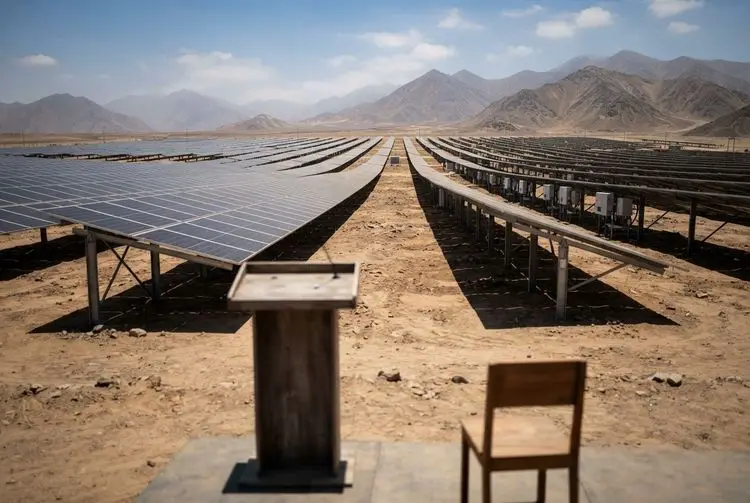
Peru's energy pipeline stands at a remarkable 29,000 MW of projects under development, yet the country's grid operator warns that less than ten percent of that capacity will ever reach commercial operation. The warning came during the FES Perú 2026 event in Lima, where industry leaders debated long-term tender rules and the missing regulatory framework for battery energy storage.
César Butrón, president of COES — the Economic Operation Committee of Peru's National Interconnected System — delivered a sobering assessment. "Of the 29,000 MW in projects under development, not even 10% will be built," he told attendees. Of the total pipeline, only 5,831 MW has obtained definitive concession status, while COES projects a realistic implementation scenario of 3,000 to 3,500 MW by 2030.
Eight energy companies presented collective capacity plans totaling 10,395 to 10,445 MW. Orygen and Fenix Power each reported 3,000 MW portfolios. Kallpa Generación holds 1,680 MW, with 980 MW coming from four wind projects and 700 MW from three solar plants. Celaris Energy targets 1,200 MW by 2030, split evenly between 600 MW of wind and 600 MW of solar, with 40 percent — 480 MW — expected by 2028. The company plans investments of $1 billion to $1.2 billion.
Tender rules divide the industry
Peru's Ministry of Energy and Mines (MINEM) has prepared draft tender regulations under Law No. 32249, and the regulatory impact analysis received a favorable evaluation. But the question of whether long-term tenders should favour new plants or allow existing generation to compete has split the sector.
Guillermo Grande, CEO of EDF Peru, argued firmly for new-build-only tenders. "Long-term tenders need to be for new projects only," he said. EDF Peru is advancing a 365 MW hydro project through permitting, has a 200 MW hydro project called El Jaraza, and a 165 MW project called Chunayaku Bajo. The company also holds supply contracts for 11 cities in Peru's isolated systems.
Irwin Frisancho, Commercial Manager at Kallpa Generación, took the opposing view. "We must allow competition, let existing energy compete with new energy and price; the resulting better price will benefit the regulated user." The debate matters because regulated users account for 45 percent of demand, while unregulated customers make up 55 percent.
Missing BESS framework
A second critical gap emerged during the event: Peru lacks any remuneration mechanism for battery energy storage systems (BESS). Current estimates place the need for batteries at 250 to 300 MW for primary frequency regulation, with total storage requirements reaching approximately 500 MW.
Industry participants noted that zero-price periods caused by solar concentration can trigger acceleration of bank debt, making storage an urgent requirement for project bankability. Transmission restrictions and administrative delays add further headwinds to the development pipeline.
The system currently operates with virtually no reserve capacity, and marginal costs are rising. Many distributors have supply agreements expiring in 2030 and 2031, creating a window for new contracting structures.
Contract duration proposals
MINEM's draft regulations propose several contract categories. Long-term contracts would run 10 to 15 years, with a three- to six-year period between signing and supply start, capped at 65 percent of distributor demand. Medium-term contracts of four to five years would cover up to 40 percent of demand. Short-term contracts range from one month to three years, with a 35 percent demand ceiling.
Acciona Energía proposed extending long-term contracts to 15 or 20 years and raising the contracted demand range to 60 to 80 percent, arguing that longer tenors improve financing conditions for new projects.
Other companies outlined their near-term plans. Inland Energy and Luz del Sur have a combined pipeline of 650 to 700 MW, with 350 MW targeted over the next three years. The Santa Teresa 2 hydro project adds 280 MW. Grupo Enhol's ILLA photovoltaic plant will contribute 400 MW. Yinson Renewables holds a 100 MW solar asset in Matarani. The Majes Sol de Verano Phase 1 is already under construction, with commercial operation expected in the first quarter of 2027.
Peru needs an additional 3,000 MW of capacity over the next five years and approximately 2,000 kilometres of new transmission lines. Without clear long-term contracting rules and a storage remuneration framework, the gap between the 29,000 MW pipeline and what actually gets built may remain wide.