
PV modules underdeliver as nameplate gap widens, Kiwa PVEL finds
Flash-test data on 9,828 modules shows most panels fall short of nameplate ratings since 2022.
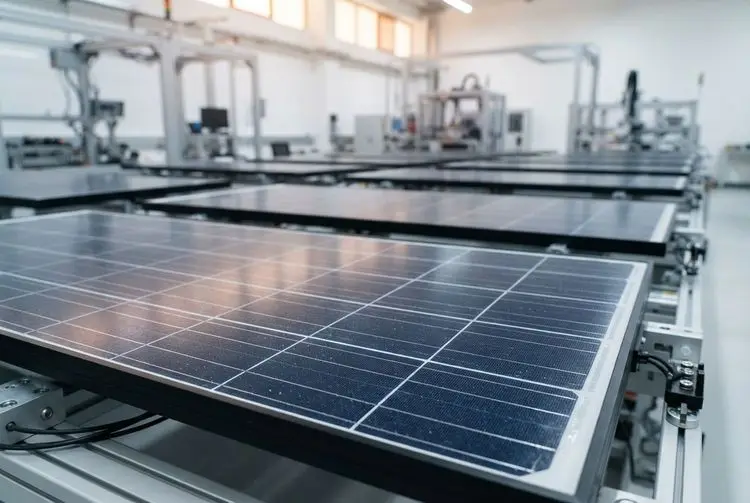
A comprehensive flash-test analysis by Kiwa PVEL reveals that most photovoltaic modules deliver less power than their nameplate rating, with the gap widening during the industry's recent economic downturn. The testing laboratory examined 9,828 module samples between January 2022 and September 2026, measuring actual power output under standard test conditions (STC: 1,000 W/m² irradiance, 25°C cell temperature, air mass 1.5).
Nameplate ratings use 5 W binning steps, meaning manufacturers assign modules to power classes in 5 W increments at the end of the production line. Generic open-circuit voltage (Voc) and short-circuit current (Isc) values are assigned per power bin. The discrepancies between nameplate and measured power stem from measurement accuracy limitations, the binning process itself, and manufacturer risk management strategies.
Best agreement in mid-2023 to mid-2024
The closest alignment between nameplate and actual power occurred between the third quarter of 2023 and the second quarter of 2024, when the median deviation sat near 0 percent. During this period, modules on average delivered exactly what their labels promised.
The situation deteriorated markedly from the third quarter of 2024 onward. The median deviation fell to -2 percent between Q3 2024 and Q3 2025, meaning half of all tested modules underdelivered by at least 2 percent relative to their nameplate rating. This period coincides with the deepening of the industry downturn that began in Q4 2023 and worsened through Q4 2024 and into Q3 2025.
A partial recovery appeared after the fourth quarter of 2025, with the median deviation improving to approximately -1 percent. While still negative, the narrowing gap suggests some stabilisation in manufacturing quality and testing consistency.
Technical and economic implications
Negative Pmax (maximum power) deviations directly reduce project economics. A module that consistently delivers 2 percent less power than its nameplate rating cuts energy yield across the entire system lifetime, lowering revenue from power purchase agreements and extending payback periods.
Negative Isc deviations can lead to wiring oversizing issues. If actual short-circuit current is lower than the nameplate value used for system design, cables and protection equipment may be over-specified, adding unnecessary cost. Conversely, positive Voc deviations introduce safety risks. When actual open-circuit voltage exceeds the nameplate value, inverters and system voltage thresholds may be pushed beyond their design limits.
Kiwa PVEL's data shows a peak in positive Voc deviation during the fourth quarter of 2023 and the first quarter of 2024, a period that also saw laser-enhanced contact optimisation (LECO) enter mass production for TOPCon cells in late 2023. LECO is a process that improves contact quality between metal electrodes and silicon, and its rapid scale-up may have contributed to voltage variability as manufacturers adapted to the new technique.
China's new efficiency standard
China has moved to address module performance transparency with the release of mandatory efficiency standard GB47834-2026, published in June 2026 and set to take effect on 1 January 2027. The standard applies to n-type crystalline silicon modules and establishes minimum efficiency requirements. As the world's largest solar manufacturing base, China's regulatory moves carry significant weight for global module supply chains.
The standard's enforcement date of January 2027 means manufacturers have until the end of this year to align production with the new requirements. Industry observers will watch whether the standard narrows the gap between nameplate and actual power output for modules produced in China, which account for the vast majority of global PV supply.
What the data means for buyers
For project developers and EPC contractors, the Kiwa PVEL data underscores the importance of independent flash testing before accepting module deliveries. Relying solely on nameplate ratings risks overestimating system output by 1 to 2 percent on average, with individual batches potentially showing larger deviations.
The 5 W binning system itself introduces inherent uncertainty. A module binned at 550 W, for example, could have a true STC power anywhere from 547.5 W to 552.5 W depending on the manufacturer's binning tolerance and measurement equipment accuracy. When combined with the industry-wide tendency toward negative deviation, prudent system design may require conservative assumptions about actual module performance.
The partial recovery seen after Q4 2025 offers some encouragement, but the median deviation remains negative. Whether the industry can return to the near-zero median seen in mid-2023 to mid-2024 will depend on manufacturing discipline, quality control improvements, and the impact of new standards like GB47834-2026.