
Rajasthan Mandates Land Conversion as Saudi Arabia Launches 3.2 GW Tender
India tightens land rules, ReNew commits billions, and Saudi Arabia opens Round 8.
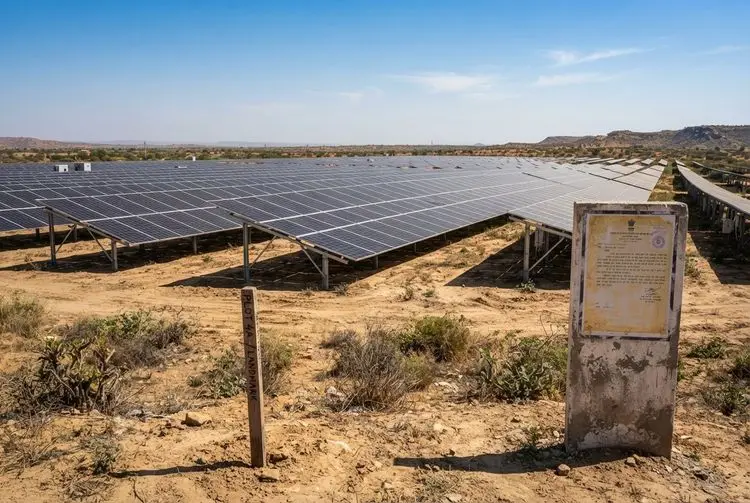
Global renewable energy markets moved on three distinct fronts this week, with India's regulatory landscape tightening for wind and solar developers, Saudi Arabia advancing its utility-scale procurement program, and a major Indian developer deepening its multi-gigawatt footprint in Andhra Pradesh. Together, the developments illustrate both the momentum and the friction points shaping the sector as it scales toward 2030 targets.
Rajasthan Reverses Course on Agricultural Land Conversion
The Rajasthan government has made the conversion of agricultural land mandatory for renewable energy projects, reversing a provision introduced by the previous Vasundhara Raje government in 2014. The new Rajasthan Land Revenue (Use of Agricultural Land for Non-agricultural Purposes in Rural Areas) Rules, 2026, were notified on Sept. 29 and took effect Nov. 2, according to ET Energyworld Solar.
The rules cover solar and wind power projects, biomass and biogas plants, hydro projects, pumped storage projects and battery storage, among others. Under the new framework, landowners must submit an online application to the sub-divisional officer along with necessary documents. The government has also introduced penalties of up to four times the prescribed premium for unauthorized non-agricultural use.
While the government exempted the industry from land conversion charges — set at 0.5 percent of the DLC rate — industry representatives said the approval process remains "very tedious." The move has raised apprehensions over increased red tape, project delays and its impact on ease of doing business.
Under the earlier arrangement, land-use conversion for solar projects was optional. Developers or landowners could seek conversion if required for other purposes, such as financing. Banks were often reluctant to extend loans against agricultural land for industrial projects, making conversion necessary in such cases. Those setting up solar projects without such requirements could retain the agricultural classification of their land.
The change could particularly affect farmers who have been leasing out unproductive and barren agricultural land to solar developers, potentially making the process more cumbersome for both landowners and developers. The industry's concern centers on whether the mandatory requirement will slow project pipelines at a time when India is pushing to accelerate renewable capacity additions.
ReNew Pledges ₹29,500 Crore for Andhra Pradesh Projects
On the investment side, ReNew has made an in-principle commitment to invest ₹29,500 crore in two clean energy projects in Andhra Pradesh. The commitment was made during a meeting between Andhra Pradesh Minister for IT and Electronics Nara Lokesh and ReNew Chairman and CEO Sumant Sinha on the sidelines of the CII Partnership Summit in Visakhapatnam.
The proposed investments include ₹12,500 crore for a 2 GW pumped storage project and ₹17,000 crore for a green ammonia and e-fuel project. Lokesh congratulated ReNew on its ₹11,000 crore polysilicon and metallurgical-grade silicon project and invited the company to collaborate with the solar cell prototyping center being established by IIT Tirupati and the University of New South Wales.
ReNew entered Andhra Pradesh in 2015 with a 24 MW wind farm at Kalyandurg and currently operates 717 MW of wind power and 60 MW of solar capacity across 10 locations in the state. Its other investments include a ₹22,000 crore hybrid power project at Guntakal, comprising 1.8 GW of solar capacity, 1 GW of wind power and 2 GWh of battery storage.
The company is also developing a 1,000 MW green data center at Makavaripalem in Anakapalli district with an investment of ₹85,200 crore, expected to generate 1,880 jobs. The State Investment Promotion Board approved the project on Aug. 12, 2026, while 433.30 acres were allotted to ReNew AP Green Data Center Pvt Ltd through a government order dated Aug. 21, 2026. Another project is a ₹4,200 crore ingot and wafer manufacturing facility with a capacity of 6.5 GW at Rambilli, for which the foundation stone was laid in August 2026.
Lokesh said ReNew's expansion reflected its confidence in Andhra Pradesh, which is working to strengthen its clean energy ecosystem across renewable power, storage and manufacturing. The state government said it would extend support to ensure timely progress of investments.
The 31st CII Partnership Summit, held in Visakhapatnam on Nov. 12 and 13, brought together delegates from nearly 58 countries. Organized by the Confederation of Indian Industry, the Department for Promotion of Industry and Internal Trade and the Andhra Pradesh government, the summit is expected to attract investments of up to ₹11 lakh crore and generate 2.5 lakh jobs.
Saudi Arabia Opens Round 8 With 3.2 GW, Including 1.9 GW Solar
In the Middle East, Saudi Power Procurement Company — known as Principal Buyer — released a request for qualification for Round 8 of the National Renewable Energy Program on Nov. 11. The round covers 3,200 MW: two solar PV projects totaling 1,900 MW and one 1,300-MW wind farm, according to list.solar.
The solar sites are the 900-MW Tumair Solar PV IPP in Riyadh province and the 1,000-MW East Al-Amoah Solar PV IPP in Aseer province. The wind project is the 1,300-MW Al-Mozeraah Wind IPP in Makkah province. All three will be structured as independent power projects. The public notice does not specify a submission deadline, qualification criteria or a tariff ceiling.
Round 8 is the smallest of the last three NREP tenders. The Round 7 RFQ in September 2025 covered 5,300 MW, while Round 6, launched on Sept. 24, 2024, offered 4,500 MW, including 3,000 MW of utility-scale solar at four sites. Based on list.solar calculations, solar PV accounts for 59.4 percent of Round 8's capacity (1,900 MW out of 3,200 MW). The round offers 39.6 percent less capacity than Round 7 and 1,100 MW less solar than Round 6.
Principal Buyer cites 1.04 cents per kWh at the Shuaiba project as the world's lowest solar production cost. The agency handles predevelopment studies, tenders projects and signs power purchase agreements and storage services agreements with developers. In August, it signed four battery storage agreements totaling 2,000 MW of four-hour capacity, with investment exceeding SAR4.35 billion ($1.16 billion).
NREP aims for renewables and energy storage to reach around 50 percent of the energy mix by 2030, subject to demand growth. Principal Buyer has not published a timetable for Round 8. In Round 6, qualified developers were announced on Nov. 24, 2024, two months after the RFQ.
Diverging Signals for the Global Sector
The three developments present a mixed picture for industry participants. Rajasthan's mandatory land conversion requirement introduces a new procedural layer that developers say could slow project timelines, even as the state waives conversion charges. ReNew's commitments in Andhra Pradesh signal continued appetite for large-scale integrated projects spanning generation, storage and manufacturing, supported by state-level facilitation. Saudi Arabia's Round 8, while smaller than its two predecessors, reinforces the kingdom's steady procurement cadence and its focus on achieving record-low solar costs.
For solar and wind developers, the common thread is the growing importance of land, permitting and offtake frameworks in determining where capital flows. While Saudi Arabia's centralized procurement model provides clarity on scale and structure, India's state-level regulatory shifts — such as Rajasthan's new rules — can introduce uncertainty that developers must factor into project economics. ReNew's multi-billion-dollar commitments in Andhra Pradesh suggest that states offering streamlined approvals and integrated support remain attractive despite broader regulatory headwinds.