
SPONSORED

Solar power banks and chargers 2026: What works and what doesn't

Built-in solar panels on power banks are too slow for primary charging, a 14-model comparison finds.
•• 6 Min
Solar power banks and chargers 2026: What works and what doesn't

Solar-powered charging has become a staple of the portable power market, but a new comparison of 14 models — eight power banks, two hybrids and four foldable panels — reveals a clear gap between marketing claims and real-world performance.

The analysis, published by list.solar News on 9 November 2026, replaces a May 2024 list of 13 marketplace products. Prices were taken from brand stores on 7 November 2026, and specifications came from manufacturer websites. No bench-testing was conducted.

The built-in panel problem

The central finding is straightforward: built-in solar panels on power banks are too slow to serve as a primary charging source. Xtorm, a European manufacturer, describes its own products as a "backup power source rather than a primary charger."

The numbers back that up. A 1W panel — typical for single-slab models where manufacturers do not publish wattage — would take between 11 and 58 days to refill a 10,000 mAh bank, depending on location. In Phoenix, which receives 6.67 peak sun hours per day, the task would take 11 days. In Seattle during December, with just 1.28 peak sun hours daily, it would stretch to 58 days.

Xtorm estimates that a 5W panel filling a 10,000 mAh bank in optimal sun takes 12 to 17 hours. A 28W panel cuts that to about four hours.

Renogy, whose E.POWER 16000 accepts solar input at 5V and 300 mA (1.5W), "advises against charging behind a window because output may be low." Xtorm adds that "panels work much less efficiently behind glass or a windshield."

The recommended setup

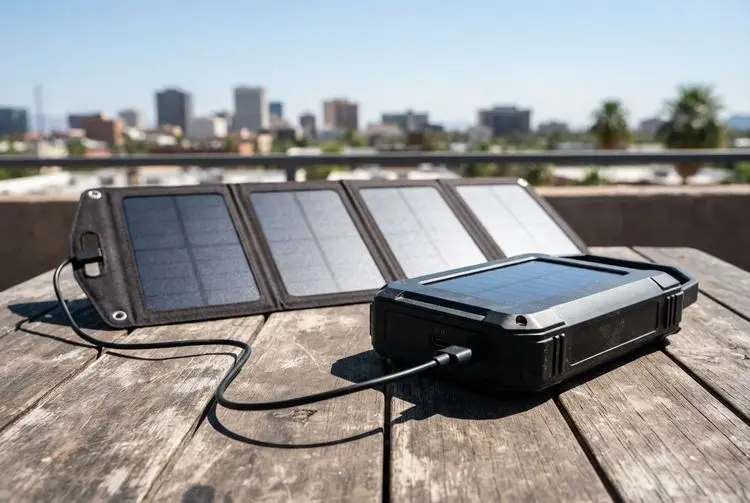
The comparison recommends a foldable panel of 20W or more paired with an ordinary power bank. Foldable panels have no battery of their own — output stops when the sun stops — but their larger surface area delivers useful charging speeds.

Among the foldable panels tested, the BigBlue SolarPowa 28 stands out as a value option at $84.99. It delivers 28W with 21.5-23.5% efficiency. The BigBlue SolarPowa X60, at $109.99, comes in at under $2 per rated watt and offers 45W USB-C Power Delivery.

The Jackery SolarSaga 40 Air, priced at $129, provides 40W at 0.9 kg with a three-year warranty. Goal Zero publishes charge times for each pairing, a level of transparency not matched by all competitors.

Best built-in bank: ToughTested ROC10

For buyers who want an all-in-one unit, the ToughTested ROC10 offers the best built-in bank specifications at $59. It features 20W USB-C PD output, 15W Qi wireless charging, IP65 weather resistance and a five-year warranty — the longest in the comparison.

The ToughTested ROC16, at $69, holds 16,000 mAh at $1.17 per Wh. The ToughTested Solar24, priced at $99, holds 24,000 mAh (88.8 Wh) and weighs 998 g packaged.

Other built-in bank models include the BLAVOR PN-W05 at $69.99 with 10,000 mAh and 20W USB-C PD, and the FEELLE Wireless 10000 at $37.99 with a 5W Qi pad. The Hiluckey Hi-S225P, on sale at $46.99, offers 27,000 mAh at 99.9 Wh — 47 cents per Wh, less than half the next-cheapest option. Hiluckey is the only manufacturer among the eight power banks to state its built-in panel wattage: 6W.

Hybrids and premium options

BioLite's SolarPanel 10+ and SolarPanel 5+ are described as proper panels with a small battery attached. The 10+ costs $149.95 with a 10W panel and 3,200 mAh battery. The 5+ costs $99.95 with a 5W panel and the same 3,200 mAh capacity.

Goal Zero's Nomad 10, at $99.95, delivers 10W at 510 g with a two-year warranty.

The FEELLE 10000, at $39.99, requires 15-20 hours in direct sun at best to reach full charge.

Safety and recalls

The comparison arrives against a backdrop of significant safety concerns. Between June 2024 and October 2026, the US Consumer Product Safety Commission (CPSC) issued 14 recalls covering 2.6 million power banks. Anker alone recalled 1.64 million units across two recalls in June and September 2025.

The HAIARA W5 PRO generated 600 fire and thermal incident reports from 11,000 units sold. None of the 14 models on the comparison page appear in any recall.

The CPSC advises keeping damaged or recalled lithium batteries out of household trash and recycling. Users should check serial numbers at cpsc.gov before using an older power bank.

Regulatory landscape

The regulatory environment for portable lithium batteries is tightening. The Section 301 duty on Chinese lithium-ion non-EV batteries rose from 7.5% to 25% in January 2026, though the effect on shelf prices is hard to isolate.

Airlines are imposing stricter rules. American Airlines and Delta enforce a 100 Wh per-bank limit. The International Air Transport Association (IATA) ceiling of 100 Wh takes effect from 1 January 2027. Emirates bans all power bank use on board, and the Lufthansa Group has banned use and charging since January 2026.

IATA guidance identifies induction power banks as an emerging concern. Every battery product in the comparison sits under 100 Wh. The Hiluckey Hi-S225P reaches 99.9 Wh by American Airlines' formula.

The US power bank safety standard UL 2056 has been updated: the ANSI/CAN/UL 2056:2024 edition took effect on 22 October 2026. Cell-level safety is covered by IEC 62133-2, and transport compliance requires UN 38.3 certification.

What to watch

For solar industry professionals and engaged homeowners, the key takeaway is that integrated solar banks remain a niche product. The combination of small panel area, low conversion rates and variable sunlight makes them unsuitable as a primary power source for any device with meaningful battery capacity.

An iPhone 17 battery holds about 14 Wh, a Galaxy S25 about 15.1 Wh, and an iPhone 17 Pro Max about 19.6 Wh. Even topping up a phone from a built-in solar bank can take a full day in good conditions. Anker Japan states that its 10,000 mAh PowerCore Solar 10000 reaches at most 50% after 14 hours in clear sky. That model is now sold out, and the Anker US 20,000 mAh page returns a 404 error — Anker currently has no solar bank in its line-up.

The Xiaomi 10,000 mAh bank achieves a 74% conversion rate at 5V. Xiaomi recommends charging between 32-113°F (0-45°C), noting that a dark bank left in direct sun can exceed the upper limit.

For installers and investors, the foldable panel plus separate bank approach offers the best performance-to-cost ratio. The BigBlue SolarPowa 28 at $84.99 and the BigBlue SolarPowa X60 at $109.99 represent the strongest value in the comparison. The Jackery SolarSaga 40 Air at $129 adds a three-year warranty and light weight.

Three additional panels were listed but not available for immediate delivery on 7 November: the EcoFlow 45W Type-C (pre-order, USB-C only at 15W), the Renogy E.Flex 30W (backordered, 20W USB-C PD) and the Nitecore FSP30 (backordered). European readers are directed to the Xtorm XR203, Xtorm SolarBooster 28W and Sunslice Photon.

Prices across the 10 models with a battery range from $37.99 to $149.95. The comparison carries no affiliate links.

Solar Power BankSolar ChargerFoldable Solar PanelToughtested Roc10Bigblue SolarpowaPower Bank RecallAirline Battery LimitPortable Solar Charging

Most Popular News

  1. Statera Energy reaches financial close on 290MW BESS in East Devon
  2. Ireland RESS 6 awards 1.3GW solar PV in record auction round
  3. Indian banks ease rooftop solar loan norms under PM Surya Ghar scheme
  4. Brazil battery auction faces dispute over R$94 billion cost allocation
  5. GoodWe sees storage surge as Brazil moves to Fixed-Time Tariff

Disclaimer


Important notice regarding existing conflicts of interest:

We expressly point out that conflicts of interest exist in connection with this publication:

1. Stock Market Media Ltd. and persons closely associated with it hold shares in the companies recommended here and intend to sell them within the scope of, and at any time during, this recommendation. This constitutes a clear and specific conflict of interest.

2. The publisher of this publication and the responsible editors receive financial remuneration for its preparation. This, too, constitutes a clear and specific conflict of interest.

3. Please also note the further statements on existing conflicts of interest in the disclaimer below, inter alia under no. 2.

Important information and mandatory disclosures pursuant to the German Securities Trading Act (Wertpapierhandelsgesetz, WpHG) and pursuant to the German Financial Investment Ordinance (Finanzanlageverordnung, FinAnV).

Stock Market Media Ltd. has notified the German Federal Financial Supervisory Authority (Bundesanstalt für Finanzdienstleistungsaufsicht, “BaFin”), pursuant to the WpHG, of its activity as a producer of investment strategy recommendations within the meaning of Article 3(1) point 34 of Regulation (EU) No 596/2014 or of investment recommendations within the meaning of Article 3(1) point 35 of Regulation (EU) No 596/2014 (formerly “financial analyses”). The obligations of Stock Market Media Ltd. are governed primarily by §§ 85, 86 WpHG, Regulation (EU) No 596/2014 and Delegated Regulation (EU) 2016/958.

Information on the producer(s) of this publication:
Mr Roberto Gonçalves de Albuquerque, as analyst and editor-in-chief, is responsible for the preparation of the texts and contents of this publication. The publisher is Stock Market Media Ltd., 405 Kings Road, Flat 600, London; SW10 0BB, United Kingdom, represented by its Director Roberto Gonçalves de Albuquerque.

Important notes on the preparation of this publication:
This publication contains both facts and factual information on the companies discussed and purely subjective value judgements, interpretations, estimates, projections, forecasts and price targets. We endeavour to distinguish these from one another as transparently as possible in order to avoid misleading statements. Research, preparation and wording are carried out using common digital and AI-supported tools; the review of the content and the editorial responsibility lie with us. The essential bases and standards of our value judgements and valuations of the shares discussed are based on the following approach:

Assessment and valuation of companies according to conventional valuation methods (fundamental valuation approach)

  • Assessment of the potential of the company's future development (growth approach) and projection onto the corresponding valuation potential (price potential analysis) as well as a possible valuation of the company's shares on the basis of potential profit expectations (P/E ratio projection)
  • Assessment of the best-case scenario expected by us in the event of the company's absolute success (blue-sky potential approach)
  • Effect on the share price of the increased awareness of the recommended share expected by us, resulting from a strong rise in demand on the market (particularly decisive in the case of illiquid shares or shares recommended newly or for the first time) on account of the publications (mostly buy recommendations) published by us or by third parties (multiplier / momentum effect, hype), and thereby a disproportionately rising return/share price with a correspondingly rising risk
  • Technical analysis of the share price in accordance with common methods of analysis, mostly for the prediction of price signals (buy or sell signal, breakout of the share, determination of price targets, support or resistance areas, expected minimum movements or minimum counter-movements, prediction of signal points (if-then), etc.), for the most part building on the expected mass psychology (technical approach).

Conventional valuation approaches often cannot be meaningfully applied to young companies or companies that do not yet generate revenue. In valuing such companies we therefore tend to rely on the potential analysis calculated by us and on the assessment of the demand for such shares on the capital market. Ultimately, the market decides on the share price of a company. If extensive recommendations of a share give rise to excessive demand for it, it is possible that the share price will rise at an above-average rate on high trading volume. Although this leads to extreme opportunities for profit, it correspondingly increases the risk of a bubble forming, with a corresponding fall in price. The increased volatility of the share in such situations gives rise to above-average opportunities for profit and loss, both in both trading directions and in the case of recurring counter-movements. Such market developments are also an important part of our trading recommendations and valuation approaches.

This publication deals exclusively with securities of above-average volatility with high potential for profit and also for loss.

Note on sources of information:
The reliability of sources of information is examined by us in detail before they are used and is subjectively assessed by us according to their credibility and significance. In doing so, we decide by our own standards which sources we consider relevant, too conservative or too optimistic. Ultimately, we determine our recommendations on the basis of our personal assessments. In obtaining information we draw on numerous publicly accessible sources such as press releases, ad hoc announcements, company announcements, company presentations, publications and articles on the company discussed, common financial media in Germany and abroad as well as company or sector analyses by third parties.

Our publications use exclusively publicly available information and sources as well as information disseminated by the company itself.

Note on existing conflicts of interest:
We hereby point out that shareholders, editors, employees and persons or companies involved in the preparation of this publication, as well as principals (third parties) commissioning the publication of Stock Market Media Ltd., hold, directly or indirectly, at the time of this publication, interests in securities which are discussed in the respective publication, and are therefore interested in an increase in price and/or turnover, i.e. also in increased trading liquidity, since it is intended to sell these securities in direct connection with this publication and to participate in rising prices and turnover. An increase in the price of the shares of the companies presented may lead to an increase in the assets of these persons. In any case, the share price of the company may be significantly influenced by the discussion of the company. In particular, the share price of the companies discussed is also materially influenced by securities transactions. This applies in particular where the companies concerned are ones whose shares do not have a broad market capitalisation and for which only a narrow market exists. Here, even small order volumes can have considerable effects on prices. However, they are also interested in the price of the company discussed falling if they wish to acquire its shares more cheaply. By law, this gives rise to a conflict of interest, to which we hereby expressly draw attention.

Stock Market Media Ltd. and its employees are furthermore remunerated for the preparation, electronic distribution and publication of this publication as well as for other services. By law, this gives rise to a conflict of interest, to which we hereby expressly draw attention.

This remuneration may be paid by the company about which Stock Market Media Ltd. publishes information, by third parties affiliated with these companies or by other third parties pursuing an interest with regard to the companies discussed in connection with this publication. By law, this gives rise to a conflict of interest, to which we hereby expressly draw attention. This arises, first of all, from the fact that Stock Market Media Ltd. could make its statements in the interest of its principal. Stock Market Media Ltd. and/or companies affiliated with it have entered into an agreement, for a fee, with the company in question or with its shareholders for the preparation of the editorial coverage. By law, this gives rise to a conflict of interest, to which we hereby expressly draw attention.

Note on the handling of internal organisational duties:
Owing to the small size of the publisher's business, internal control of the compliance processes of the employees and other parties contributing to this publication is limited.

Competent supervisory authority:
Stock Market Media Ltd. has notified BaFin of its activity pursuant to § 86 WpHG.