
Solar O&M hiring surges as skill demands shift dramatically
Operations and maintenance jobs now account for 12.2% of all U.S. solar positions, up from 5.8%.
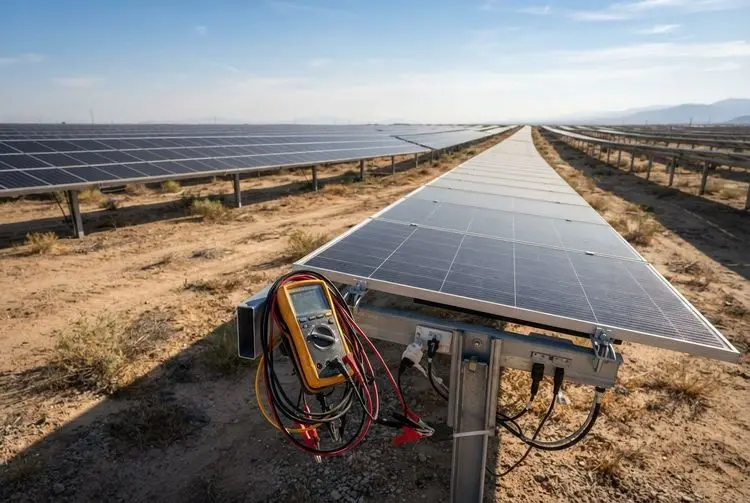
The solar industry's operations and maintenance (O&M) subsector is experiencing a pronounced hiring surge, with O&M job postings rising from 5.8% of all solar positions between 2020 and 2022 to 12.2% in the 2024 to 2026 period. That shift, documented in an analysis of 4,525 U.S. solar job listings archived from 2020 through 2026, signals a maturing market where the installed base demands increasing attention.
Researchers at Solar Roles and the Interstate Renewable Energy Council (IREC), drawing on data from the National Solar Jobs Census, examined 387 O&M posting-text groups to understand what employers are looking for. The findings reveal a workforce in transition: O&M is the only solar subsector where hiring became more difficult in 2024, with 23% of O&M employers reporting severe hiring difficulty.
Electrical skills dominate, but licenses are rare
Electrical skills appear in 84% of O&M job descriptions, making them the most commonly requested qualification. Yet only 9% of postings enforce an electrician license as a mandatory requirement. Of the 148 posting groups that mention an electrician license at all, 72 list it as preferred, 36 note that the requirement depends on the state, and just 36 enforce it as mandatory.
A Palmetto posting, for example, requires an electrical license only in Massachusetts, illustrating how state-specific regulations shape hiring criteria. The gap between electrical skill demand and license enforcement suggests employers value practical electrical knowledge more than formal credentialing.
Multi-skilled technicians in high demand
Employers are not looking for narrow specialists. The analysis found that 61.5% of O&M postings mention at least four of seven identified skill areas. The seven areas include safety procedures, digital tools and software, inverter experience, mechanical system skills, battery and energy storage expertise, high and medium voltage capabilities, and electrical skills.
Safety procedures appear in 68% of postings, with lock-out/tag-out protocols frequently specified. Digital tools and software are mentioned in 63% of postings, inverter experience in 56%, mechanical system skills in 44%, battery and energy storage expertise in 43%, and high or medium voltage capabilities in 26%.
The broad skill demand reflects the reality of field work. An Onward Energy listing describes a single worker handling AC and DC systems, SCADA systems, and commissioning tasks — a job profile that requires versatility across electrical, digital, and mechanical domains.
Two distinct technician profiles emerge
The data reveals two distinct O&M technician profiles: utility-scale and distributed or residential service. Utility-scale postings prioritize mechanical systems at 70%, compared to just 22% for service roles. High and medium voltage capabilities appear in 41% of utility-scale postings versus 11% for service.
Service postings, by contrast, emphasize battery storage expertise at 55%, compared to 30% for utility-scale roles. Digital tools and software appear in 69% of service postings versus 53% for utility-scale. These differences reflect the distinct technical environments: large-scale solar farms require heavy electrical and mechanical infrastructure, while distributed systems demand more digital monitoring and storage integration.
Physical demands and travel requirements
O&M field work comes with significant physical requirements. Travel is required in 64% of postings, heavy lifting is mandated in 48%, a valid driver's license is called for in 43%, and working at heights is required in 40%. These figures underscore that O&M remains a hands-on, mobile profession.
The physical demands, combined with the broad technical requirements, help explain why 23% of O&M employers reported severe hiring difficulty in 2024. Employers cite a lack of experience, training, or technical skills as the primary barrier to filling positions.
What this means for the solar industry
The shift from 5.8% to 12.2% of solar jobs being O&M positions reflects the growing operational phase of the U.S. solar fleet. As more capacity comes online, the need for skilled technicians to maintain, troubleshoot, and repair systems will continue to grow. The industry faces a challenge: finding workers who combine electrical knowledge with mechanical, digital, and safety skills, while also being willing to travel and work in physically demanding conditions.
For solar industry professionals and investors, the O&M hiring surge signals a structural shift. The build-out phase is giving way to a long operational phase where workforce development in O&M will be critical to maintaining fleet performance and project returns.