
Solar power lifts rural Tajikistan but upfront costs remain high
Rural Tajik families adopt solar technology, yet high upfront costs and grid limitations slow widespread uptake.
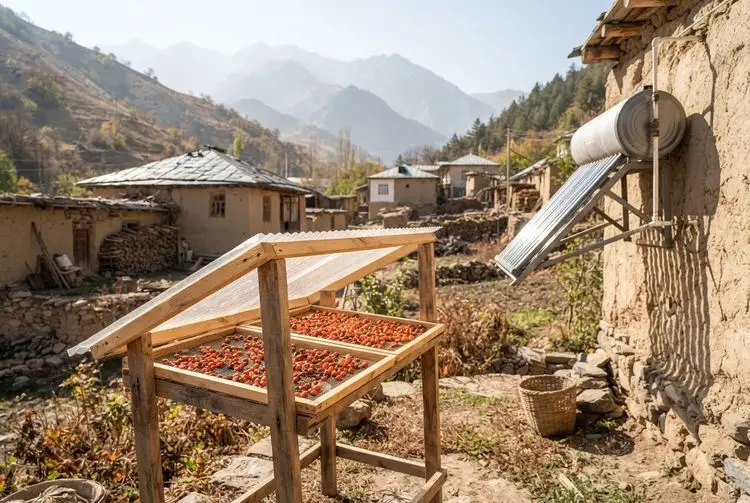
Rural households across Tajikistan are increasingly turning to solar energy to cope with frequent power outages and rising firewood prices, but high upfront costs and a lack of service infrastructure remain major barriers to broader adoption, according to local environmental organisations and a 2025 study by the National Academy of Sciences.
In the village of Labijay, Qaratogh jamoat, Tursunzoda, families use solar panels, solar cookers and solar dryers for everyday tasks. Mizhgona Azizova, a resident involved with the environmental group Little Earth and supported by the Global Greengrants Fund, described the pressure on local forests. "The forests around us are not endless and are no longer as dense as they used to be," she said. Firewood has long been the primary fuel for cooking and drying, but deforestation is accelerating as demand grows.
Solar dryers have delivered measurable improvements. Drying rosehips, a traditional autumn activity, previously took one month using open-air methods. With a solar dryer, the same process now takes just three days. In August 2024, a workshop in Labijay built four solar dryers, demonstrating the technology's potential for local food preservation and income generation.
In the nearby city of Hisor, Mavlyuda Ahmadova uses a 150-litre solar water heater provided through the Youth Environmental Center. "This matters a lot for our family — we always have hot water," she said. The system replaces electric water heating, which is unreliable during grid outages.
Cost remains the critical barrier
Despite these successes, the price of solar equipment puts it out of reach for most rural families without project support. A 5 kW solar system cost over 60,000 somoni in 2018. By 2026, that price had fallen to between 25,000 and 30,000 somoni — a significant reduction, but still far beyond what an average household can afford.
Shavkat, a resident of Shaykhmuzafar village in Tursunzoda who runs a small business called Nerui Oftob, earns around 4,000 somoni per month. A basic backup solar kit costs approximately 5,000 somoni — more than his monthly income. A full 5 kW system would cost six to seven months of his earnings. Shavkat uses a solar-powered incubator with a capacity of 50 eggs, but expanding his operations would require a larger investment he cannot currently make.
The 2025 National Academy of Sciences study identified high upfront costs as the main barrier to solar adoption in rural Tajikistan. The study also pointed to a lack of service infrastructure for installation and repair. Even when households can afford panels, finding qualified technicians to install or maintain them remains difficult.
Grid connection rules and hybrid system challenges
Another technical hurdle affects households connected to the grid. Grid-tied solar systems automatically shut down during power outages for safety reasons. This means that when the grid fails — which happens frequently in rural areas — the solar system stops working too. Autonomous or hybrid systems that can operate independently require expensive battery storage, adding thousands of somoni to the total cost.
The Tajik government adopted Resolution No. 449 in summer 2026, setting rules for connecting household solar systems to the grid. The regulation aims to standardise the connection process, which previously lacked clear guidelines. Industry observers say clear rules are a necessary first step, but without financial support mechanisms, most rural households will still be unable to invest.
Mustafa Valiyev from the Dousti district in Khatlon province and Yury Skochilov, a specialist working with local environmental projects, have both noted that project-supported equipment distribution reaches only a fraction of the population. Environmental organisations such as Little Earth and the Youth Environmental Center provide systems at reduced cost, but these programmes depend on external funding.
Broader context for the solar industry
For solar industry professionals, the situation in Tajikistan illustrates a pattern seen across Central Asia: rapidly falling module prices are making solar technically viable, but the upfront cost barrier remains stubborn in low-income rural markets. The 5 kW system price drop from over 60,000 somoni in 2018 to 25,000–30,000 somoni in 2026 represents a decline of more than 50 percent, yet it still exceeds annual household income for many families.
The lack of service infrastructure also presents a market opportunity. Installers and maintenance providers are scarce, meaning that companies able to establish service networks in rural areas could capture a first-mover advantage. Battery storage, while expensive, is essential for hybrid systems that provide backup during grid outages — a feature that rural customers value highly.
Government Resolution No. 449 could unlock some demand by providing legal clarity for grid connection, but without accompanying financing programmes — such as subsidised loans or pay-as-you-go models — adoption is likely to remain limited to households that receive project support.
This article is part of the Central Asia Climate Campaign 2026, funded by the German Federal Ministry for Economic Cooperation and Development (BMZ) via MediaNet and n-ost. Artificial intelligence was used in the preparation of this article.