
Spain's 3.9 GW data center boom faces viability and grid hurdles
Spain projects 3.9 GW data center capacity by 2030, but most announced projects remain unbuilt.
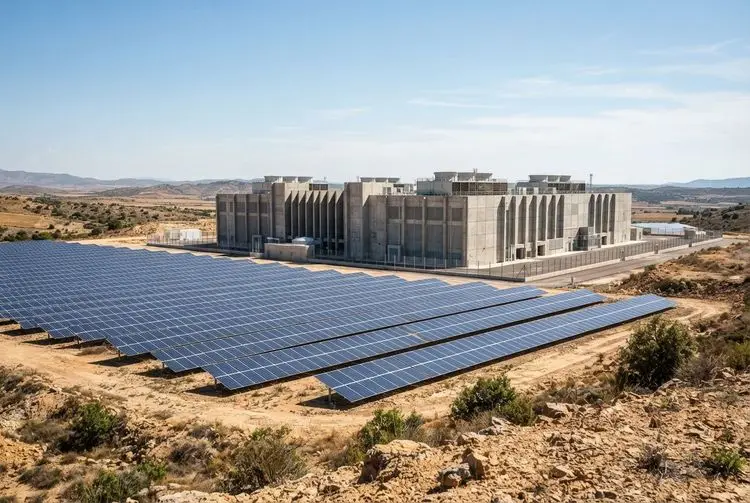
Spain is preparing for a major data center expansion driven by artificial intelligence, with 3.9 GW of capacity projected towards 2030. However, a wide gap between announced projects and operational facilities is raising doubts about which developments will actually be built.
Red Eléctrica data shows that data centers have been granted 6,329 MW of grid access, representing 34.2% of the national total. Industrial supplies received 5,838 MW. Yet none of the data center grid capacity is currently operational.
According to SPAINDC, the Spanish Association of Data Centers, the country will have 439 MW of operational IT capacity by the end of 2025. The association projects that figure will reach 2,537 MW by 2030 — well below the 3.9 GW headline figure and far below the 6,329 MW that has secured grid access.
The gap between paper and reality
José Luis Friebel, an industry expert at InfraXmedia, said the demand is real but warned that not all announced projects will materialize.
"The demand driven by the cloud and, exponentially, by the training and inference of artificial intelligence models is absolutely real, structural, and global," Friebel said. "In any market in a phase of rapid expansion, it is common to observe a certain 'advertisement effect' or opportunistic movements around land and power reserves."
Friebel identified four indicators to distinguish real projects from paper projects: solvency, pre-leasing, supply chain readiness, and electrical maturity. These criteria help assess whether a data center announcement has the financial backing and technical planning to reach completion.
Data centers operate on investment planning horizons of 15 or 20 years. Typical power purchase agreement (PPA) contracts for data centers run 10 or 15 years — a structure that makes them attractive offtakers for renewable energy developers.
Grid pressure and political debate
The surge in grid access requests has sparked political debate ahead of Spain's November 29 elections. A PSOE representative asked whether Spain wants industry or data centers, while the PP defended digital investments.
Spain has advantages over established data center markets such as Frankfurt, London, Amsterdam, Paris and Dublin. However, Portugal, Italy and the Nordic countries could attract investment with faster grid connection timelines.
MITECO, the Ministry for Ecological Transition, has published a draft decree requiring data centers to back up 80% of their consumption with new renewable energy capacity. After receiving comments on the draft, MITECO relaxed some requirements. Friebel noted that exclusive obligations could reduce Spain's competitiveness.
Major projects and investment flows
Amazon Web Services has announced a €33.7 billion program in Aragon through 2035, representing the largest single data center commitment in Spain. The MERLIN-EDGED Zaragoza-WIND complex plans 144 MW of computing power with a €1.225 billion investment.
Madrid leads in data center activity due to business concentration and connectivity. Aragon is consolidating as the main hub, driven by available land, renewable energy resources and institutional coordination. Opportunities are emerging in Catalonia, the Basque Country and Andalusia towards 2027.
Opportunities for the solar industry
For solar developers and energy marketers, data centers represent a significant demand source. Friebel described the sector as the ideal offtaker.
"For generating and marketing companies, the data center sector represents the ideal offtaker: it offers 10 or 15 year contracts with the highest creditworthiness in the market and a flat, constant and highly predictable consumption profile 24 hours a day, 365 days a year," he said.
Data centers consume power constantly, making them ideal baseload offtakers for renewable generation. Conventional PPAs are expected to evolve into hybrid contracts that combine renewable supply with firm capacity. Capflex Energía is analyzing renewable project acquisitions specifically to serve data center PPAs.
The powered land model — land with permits, fiber connectivity and firm electrical capacity — is gaining traction. Additional opportunities exist in liquid cooling, high-density electrical distribution and energy services.
Infrastructure challenges remain
Spain faces significant infrastructure hurdles to realize its data center ambitions. More transmission infrastructure, additional substations and streamlined permitting processes are needed to connect projects to the grid.
The first edition of the AI Cities Summit Europe will take place February 3-4, 2027 in Zaragoza, underscoring the city's growing role in Spain's digital infrastructure landscape.
For solar industry professionals, the data center boom represents a substantial new demand corridor — but only if the grid can deliver and the projects prove real.