
SPONSORED

Charleston Church Plans Solar Resilience Hub After Gas Crisis

A West Virginia church turns to solar and battery storage after a 2023 gas line disaster left over 1,000 without heat.
•• 3 Min
Charleston Church Plans Solar Resilience Hub After Gas Crisis

A church in Charleston's West Side is developing a solar-powered resilience hub after a 2023 infrastructure failure left more than 1,000 residents without gas and heat for days in near-freezing temperatures.

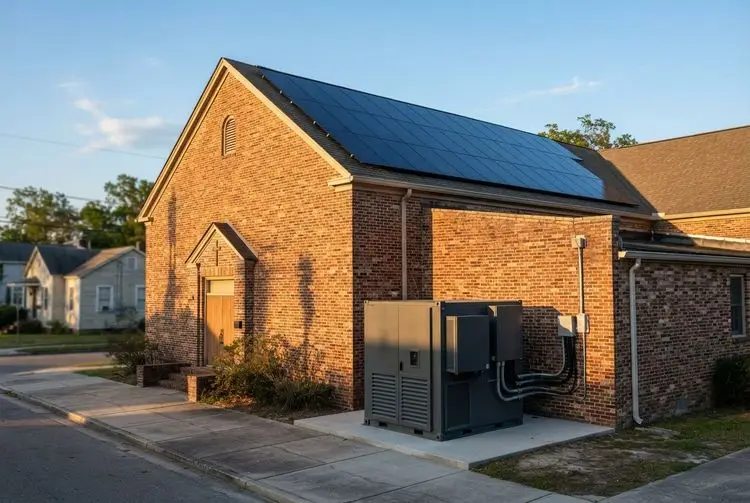
Bishop Dr. Robert L. Haley III of A More Excellent Way Life Center Church is leading the effort to install solar panels, battery storage and clean water systems at the church building. The hub would serve as a community refuge during emergencies — a role Black churches in the region have historically filled during crises.

"Our goal is to restore that hope, let the community know that somebody's listening to their call and that if we band together, we can make the West Side a better place," Haley told Black By God (BBG).

The crisis that sparked the plan

On Nov. 10, 2023, a water line burst into 46 miles of gas mains across Charleston's West Side. Over 1,000 people lost gas service and heating as temperatures hovered near freezing. The city declared a State of Emergency on Nov. 15, 2023.

The gas company and water authority never agreed on which line ruptured first. For residents, the disaster exposed decades of neglected utility infrastructure in the West Side. The community rallied to help each other before official government responses arrived.

Haley said the biggest loss on the West Side is hope — hope that conditions will improve.

Solar resilience for a changing landscape

The resilience hub would pair photovoltaic generation with battery energy storage systems (BESS) to keep critical services running during grid outages. Clean water access is also part of the plan.

The church needs to raise approximately $350,000 for the hub. Haley expressed concern about putting the church into debt, reflecting a broader financial challenge facing many Black congregations.

"In the black community in the United States, church attendance has dropped, so that's a problem," Haley said. The COVID-19 pandemic accelerated the shift to online attendance, further straining church finances.

The West Side and East End have been identified as pilot sites for resilience infrastructure. The project involves multiple partners including Protogen Energy, the Appalachian Solar Finance Fund, Accelerate West Side and Abraham Mwaura.

Broader context for solar professionals

For solar industry observers, the Charleston project represents a growing trend: community-scale solar-plus-storage systems designed specifically for emergency resilience rather than purely for electricity bill savings. These installations serve a dual purpose — reducing operational costs for the host facility while providing backup power when the grid fails.

A FEMA memo cited in the planning process aims to reduce state and local dependency on federal disaster response. This aligns with a broader push toward distributed energy resources that can operate independently of central grids. However, FEMA and federal programs face potential downsizing, which could affect funding pathways for similar projects.

West Virginia's political landscape has historically protected fossil fuel interests, creating both challenges and opportunities for solar deployment. The state's solar market remains small compared to sunbelt states, but resilience applications like this one demonstrate a value proposition that transcends traditional solar economics.

The church building itself was constructed with brick to withstand storms, making it a natural community refuge. The solar hub could also train local residents and create jobs, according to planning documents, while reducing the church's own utility costs.

Cameron Hamilton of the National Emergency Management Association and the Red Cross have been involved in resilience planning discussions. The project's multi-stakeholder approach — combining faith-based organizations, solar developers, emergency management professionals and community groups — offers a replicable model for other underserved communities.

For installers and investors, the Charleston hub illustrates how solar-plus-storage can address infrastructure equity gaps. Communities with aging gas and water networks face recurring service disruptions that solar resilience hubs can mitigate. The $350,000 fundraising target for a single church-based hub provides a reference point for similar projects in other markets.

Haley's church is now working to secure the funding needed to move from planning to construction. The project's success could influence how other communities — particularly those served by historically Black churches — approach solar resilience in an era of strained federal disaster response systems.

Solar Resilience HubCommunity Solar-Plus-StorageCharleston West Virginia SolarChurch Solar Battery BackupBess Emergency PreparednessAppalachian Solar Finance FundProtogen EnergyBlack Church Solar

Most Popular News

  1. Italy Awards 16 GWh Storage as European Solar M&A Shifts Strategy
  2. Deye Launches Two-Module Optimizer as Analysts Slam US Solar Policy
  3. India adds 11.2 GW rooftop solar in nine months, up 127.5%
  4. PVT collector with graphite-paraffin storage achieves 48.7% efficiency
  5. Flexell Space and ALATYR partner on solar for orbital data centers

Disclaimer


Important notice regarding existing conflicts of interest:

We expressly point out that conflicts of interest exist in connection with this publication:

1. Stock Market Media Ltd. and persons closely associated with it hold shares in the companies recommended here and intend to sell them within the scope of, and at any time during, this recommendation. This constitutes a clear and specific conflict of interest.

2. The publisher of this publication and the responsible editors receive financial remuneration for its preparation. This, too, constitutes a clear and specific conflict of interest.

3. Please also note the further statements on existing conflicts of interest in the disclaimer below, inter alia under no. 2.

Important information and mandatory disclosures pursuant to the German Securities Trading Act (Wertpapierhandelsgesetz, WpHG) and pursuant to the German Financial Investment Ordinance (Finanzanlageverordnung, FinAnV).

Stock Market Media Ltd. has notified the German Federal Financial Supervisory Authority (Bundesanstalt für Finanzdienstleistungsaufsicht, “BaFin”), pursuant to the WpHG, of its activity as a producer of investment strategy recommendations within the meaning of Article 3(1) point 34 of Regulation (EU) No 596/2014 or of investment recommendations within the meaning of Article 3(1) point 35 of Regulation (EU) No 596/2014 (formerly “financial analyses”). The obligations of Stock Market Media Ltd. are governed primarily by §§ 85, 86 WpHG, Regulation (EU) No 596/2014 and Delegated Regulation (EU) 2016/958.

Information on the producer(s) of this publication:
Mr Roberto Gonçalves de Albuquerque, as analyst and editor-in-chief, is responsible for the preparation of the texts and contents of this publication. The publisher is Stock Market Media Ltd., 405 Kings Road, Flat 600, London; SW10 0BB, United Kingdom, represented by its Director Roberto Gonçalves de Albuquerque.

Important notes on the preparation of this publication:
This publication contains both facts and factual information on the companies discussed and purely subjective value judgements, interpretations, estimates, projections, forecasts and price targets. We endeavour to distinguish these from one another as transparently as possible in order to avoid misleading statements. Research, preparation and wording are carried out using common digital and AI-supported tools; the review of the content and the editorial responsibility lie with us. The essential bases and standards of our value judgements and valuations of the shares discussed are based on the following approach:

Assessment and valuation of companies according to conventional valuation methods (fundamental valuation approach)

  • Assessment of the potential of the company's future development (growth approach) and projection onto the corresponding valuation potential (price potential analysis) as well as a possible valuation of the company's shares on the basis of potential profit expectations (P/E ratio projection)
  • Assessment of the best-case scenario expected by us in the event of the company's absolute success (blue-sky potential approach)
  • Effect on the share price of the increased awareness of the recommended share expected by us, resulting from a strong rise in demand on the market (particularly decisive in the case of illiquid shares or shares recommended newly or for the first time) on account of the publications (mostly buy recommendations) published by us or by third parties (multiplier / momentum effect, hype), and thereby a disproportionately rising return/share price with a correspondingly rising risk
  • Technical analysis of the share price in accordance with common methods of analysis, mostly for the prediction of price signals (buy or sell signal, breakout of the share, determination of price targets, support or resistance areas, expected minimum movements or minimum counter-movements, prediction of signal points (if-then), etc.), for the most part building on the expected mass psychology (technical approach).

Conventional valuation approaches often cannot be meaningfully applied to young companies or companies that do not yet generate revenue. In valuing such companies we therefore tend to rely on the potential analysis calculated by us and on the assessment of the demand for such shares on the capital market. Ultimately, the market decides on the share price of a company. If extensive recommendations of a share give rise to excessive demand for it, it is possible that the share price will rise at an above-average rate on high trading volume. Although this leads to extreme opportunities for profit, it correspondingly increases the risk of a bubble forming, with a corresponding fall in price. The increased volatility of the share in such situations gives rise to above-average opportunities for profit and loss, both in both trading directions and in the case of recurring counter-movements. Such market developments are also an important part of our trading recommendations and valuation approaches.

This publication deals exclusively with securities of above-average volatility with high potential for profit and also for loss.

Note on sources of information:
The reliability of sources of information is examined by us in detail before they are used and is subjectively assessed by us according to their credibility and significance. In doing so, we decide by our own standards which sources we consider relevant, too conservative or too optimistic. Ultimately, we determine our recommendations on the basis of our personal assessments. In obtaining information we draw on numerous publicly accessible sources such as press releases, ad hoc announcements, company announcements, company presentations, publications and articles on the company discussed, common financial media in Germany and abroad as well as company or sector analyses by third parties.

Our publications use exclusively publicly available information and sources as well as information disseminated by the company itself.

Note on existing conflicts of interest:
We hereby point out that shareholders, editors, employees and persons or companies involved in the preparation of this publication, as well as principals (third parties) commissioning the publication of Stock Market Media Ltd., hold, directly or indirectly, at the time of this publication, interests in securities which are discussed in the respective publication, and are therefore interested in an increase in price and/or turnover, i.e. also in increased trading liquidity, since it is intended to sell these securities in direct connection with this publication and to participate in rising prices and turnover. An increase in the price of the shares of the companies presented may lead to an increase in the assets of these persons. In any case, the share price of the company may be significantly influenced by the discussion of the company. In particular, the share price of the companies discussed is also materially influenced by securities transactions. This applies in particular where the companies concerned are ones whose shares do not have a broad market capitalisation and for which only a narrow market exists. Here, even small order volumes can have considerable effects on prices. However, they are also interested in the price of the company discussed falling if they wish to acquire its shares more cheaply. By law, this gives rise to a conflict of interest, to which we hereby expressly draw attention.

Stock Market Media Ltd. and its employees are furthermore remunerated for the preparation, electronic distribution and publication of this publication as well as for other services. By law, this gives rise to a conflict of interest, to which we hereby expressly draw attention.

This remuneration may be paid by the company about which Stock Market Media Ltd. publishes information, by third parties affiliated with these companies or by other third parties pursuing an interest with regard to the companies discussed in connection with this publication. By law, this gives rise to a conflict of interest, to which we hereby expressly draw attention. This arises, first of all, from the fact that Stock Market Media Ltd. could make its statements in the interest of its principal. Stock Market Media Ltd. and/or companies affiliated with it have entered into an agreement, for a fee, with the company in question or with its shareholders for the preparation of the editorial coverage. By law, this gives rise to a conflict of interest, to which we hereby expressly draw attention.

Note on the handling of internal organisational duties:
Owing to the small size of the publisher's business, internal control of the compliance processes of the employees and other parties contributing to this publication is limited.

Competent supervisory authority:
Stock Market Media Ltd. has notified BaFin of its activity pursuant to § 86 WpHG.