
Deye Launches Two-Module Optimizer as Analysts Slam US Solar Policy
New 1,600-W optimizer cuts hardware count in half, while RE+ panel calls manufacturing roadmap fragmented.
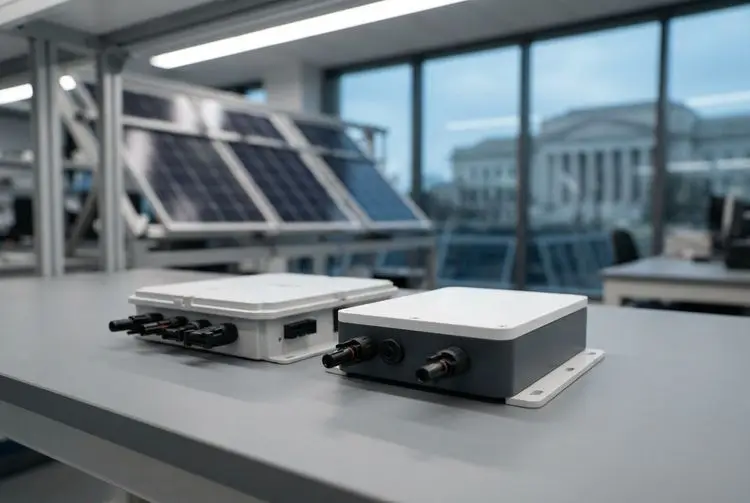
Chinese inverter manufacturer Deye has introduced a photovoltaic optimizer that serves two solar modules simultaneously, while a panel of industry analysts at RE+ 2026 delivered a sharp critique of U.S. solar manufacturing policy, describing it as fragmented and lacking a coherent strategy for onshoring upstream production.
Deye announced the SUN-OPTMZ01-STR2-20A optimizer and the companion SUN-OPTMZ01-COMM4-20A concentrator on November 24, 2026. The products target residential and commercial and industrial (C&I) rooftop applications. The optimizer is rated for up to 1,600 W of PV input, and pairing two modules per unit means installers need 50% fewer optimizers compared to a one-per-module layout.
However, a footnote in the product documentation reveals a significant limitation. When two modules connect to a single unit, they share one maximum power point tracker (MPPT). Module-level tracking only applies when a single module is connected. The concentrator manages up to 80 optimizer units over DC cables and transmits each unit's yield, voltage, current and temperature data to Deye Cloud, the company's solar monitoring platform, over Wi-Fi.
Specifications and Limitations
The optimizer's specifications include 800 W per module when two share one unit. That matches the module rating of Tigo's single-module TS4-X optimizer, according to list.solar calculations. At 80 V, 20 A reaches 1,600 W; at the 120-V top of the range, the power cap rather than current limits output. A single concentrator supports at most 128 kW of PV input, or 160 modules on 80 optimizers. For a 20-kW roof of 500-W modules, 20 optimizers would be needed instead of 40.
Deye did not disclose prices, target markets or a shipping date, so no cost-per-watt calculation can be made. The company's documents name no UL listing or U.S. rapid-shutdown code; the datasheet lists IEC, not UL, certification. The optimizer carries a 10-year warranty, compared with 25 years for Tigo's TS4-A-2F and TS4-X. Deye said the paired design cuts both equipment and installation costs, without providing a figure.
The release puts the over-temperature cutoff at 70°C to 90°C, while the datasheet says 70°C to 85°C — a discrepancy between the two documents. The optimizer datasheet, dated November 20, is available on Deye's download page. No datasheet for the concentrator had been posted as of November 25.
Tigo Energy sells a comparable two-module device, the TS4-A-2F, rated up to 1,400 W (700 W per channel). It is UL and IEC certified and carries a 25-year warranty, but it handles rapid shutdown only and does not optimize. Wood Mackenzie ranked Deye first in distributed storage inverters, and its product list leads with hybrid and string inverters.
Analysts Criticize U.S. Manufacturing Policy
At RE+ 2026, a panel of three experts participated in a session titled "Hot Takes, Hard Numbers: The Future of U.S. Solar Manufacturing According to Leading Analysts." The panel included Alex Barrows, head of PV analytics at CRU Group; Elissa Pierce, a solar module supply chain analyst at Wood Mackenzie; and Christian Roselund, Intertek CEA research manager for policy. Jade Jones, SEIA manufacturing and supply chain senior director, moderated.
Since the Inflation Reduction Act passed in 2022, U.S. solar module nameplate capacity has grown from less than 10 GW to a reported 80.6 GW, according to SEIA. This growth has been driven largely by the Advanced Manufacturing Production Credit under Section 45X of the U.S. tax code. However, upstream manufacturing capacity for crystalline silicon ingots, wafers and cells lags severely behind China, with only about 10 GW each in operating facilities — creating a major imbalance in the module assembly supply chain.
Barrows described recent U.S. policy as "a piecemeal mishmash of AD/CVD cases, 45X, 232, [and] various other tariffs." He pointed specifically to Section 45X as the policy that has driven most domestic manufacturing expansion, a view shared by the other panelists.
"There's really no denying that 45X was the most important policy driver," Pierce said. But she added that tariffs have been "an important piece" to support domestic manufacturing.
Roselund pushed back on that idea, arguing that tariffs imposed following antidumping and countervailing duty (AD/CVD) investigations have done little more than raise prices for upstream components and cause manufacturing to move around the world to places not subject to the added duties. "Those who have suggested that the AD/CVD cases are an effective way to onshore don't really have any evidence to support that," he said. "I think there's a lot of evidence in the opposite: that actually it just simply chased manufacturing around the globe."
Roselund also criticized tariffs imposed in 2018 under Section 201 of the 1974 Trade Act and those set to take effect in December under Section 232 of the Trade Expansion Act of 1962. "The challenge that we come to [with tariffs]… is when you live in a world of globally interconnected supply chains, if you tariff the upstream component that manufacturing is dependent on, you don't support manufacturing," he said.
Pierce said she looked forward to future guidance from the Commerce Department on parts of the Section 232 plan that were not well defined in the initial document. "If you're actively building upstream manufacturing facilities in the U.S., you should get some kind of exemption or discount to those tariffs so that you can import the components you need in order to bring those factories online at scale and ramp them up," she said.
Barrows called Section 232 "a good example of where U.S. policy is sort of ugly and mishmashy," adding that after a year of waiting, "it came out and we all had a whole bunch of questions around how it's going to work that still aren't answered."
India's Predictable Roadmap Praised
Barrows praised India's Approved List of Models and Manufacturers (ALMM) framework as a clear, well-signposted roadmap with deadlines for modules (April 1, 2024, ALMM List-I), cells (June 1, 2026, ALMM List-II), and ingots and wafers (June 1, 2028, ALMM List-III). "I really like the Indian approach of [having] a clear roadmap," he said. "I think it's a pity that the U.S. did not take that approach."
Roselund agreed, contrasting India's strategy with what he called a "chaotic jumble of policies that are utterly unpredictable in the United States." He noted that India's predictable policies have given it larger module and cell manufacturing capacity than the U.S., though India still struggles to bring ingot and wafer production online before 2028.
Market Impacts and Future Outlook
Roselund said U.S. module buyers "have had to get used to worse product," with their "best sources of supply progressively cut off." Options include modules made with older PERC cell technology, imported products costing more than 40 cents per watt following the Section 232 proclamation, or premium domestic TOPCon modules.
Barrows noted a "safe bet premium" in the U.S. market, where traceability and intellectual property risks matter more than price and efficiency. "In the U.S., you can run a PERC line. There's kind of nowhere else in the world that you can get away with that," he said.
Pierce added: "Sometimes it's just the price you have to pay to compete with a country that's been doing this at such [a] larger scale for decades. We're really coming from behind here."
Looking ahead, Pierce said Wood Mackenzie expects about 30 GW of domestic solar cell capacity by 2030 but little growth in polysilicon or wafer manufacturing due to insufficient incentives. Barrows expressed optimism that 45X credits will be extended and Commerce will issue sensible import rules, predicting by 2030 mostly U.S. modules using imported cells and wafers, with some new ingot and wafer factories. Roselund expects a 45X extension but not until 2029 — too late to incentivize near-term investment but potentially preventing a mass industry die-off when credits expire.
Both analysts noted that building new factories requires "patient capital" willing to wait five years or more and expertise that mostly comes from China. As Roselund concluded, the road to onshoring solar manufacturing in both the U.S. and India still runs through China.