
West Virginia solar microgrids face policy barriers despite resilience needs
Community solar-plus-storage projects could aid energy justice in Chemical Valley, but state laws block progress.
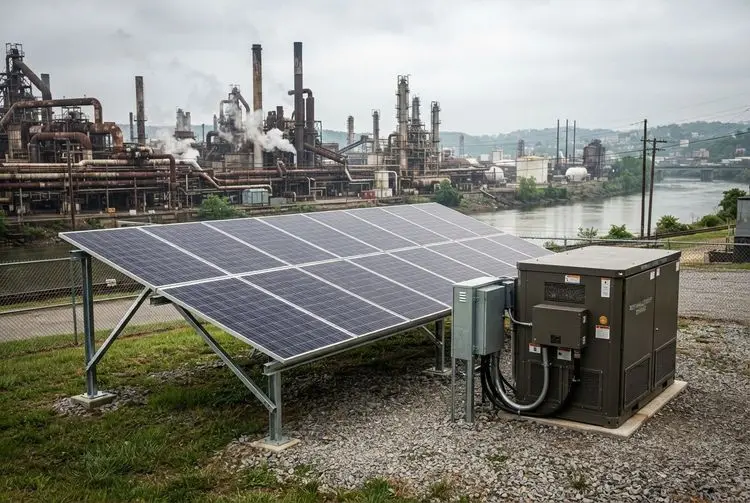
West Virginia's West Side Charleston sits in Chemical Valley along the Kanawha River, a region where neglected utility infrastructure has repeatedly caused disasters for frontline communities. Now, advocates are pushing solar-plus-storage microgrids as a mutual aid solution — but state policy and financing hurdles stand in the way.
Autumn Long directs the Appalachian Solar Finance Fund, which works to bring clean energy to underserved communities in the region. She sees distributed solar and battery storage as a practical resilience tool for neighborhoods that the utility system has left behind.
"When our utility systems fail, having local on-site power is one foundational element to be able to ride through that kind of systemic failure or disaster with a little less pain and suffering," Long said.
A history of systemic failure
The Kanawha County region has experienced repeated crises. The 2014 Elk River chemical spill left 300,000 residents without potable water. In 2016, flooding triggered a state of emergency in 44 of West Virginia's 55 counties. The West Virginia State Resiliency Fund was created that same year but was never funded.
Health data underscores the stakes. Black Americans are five times more likely to visit an emergency room for asthma caused by air pollution. Nearly 15% of Black adults in West Virginia have been diagnosed with asthma. Almost 12% of Kanawha County residents suffer from COPD, compared to the national average of 9%.
West Virginia also carries the highest average utility costs in the nation. Monthly bills average $715. The state's Public Service Commission approved a 5.6% rate hike in August 2026. A Distribution System Improvement Charge, or DSIC, surcharge funds aging infrastructure replacement while bypassing the traditional rate-case process.
Community solar bill stalled
Del. Evan Hansen, who founded the environmental consulting firm Downstream Strategies and ran for office after the 2014 Elk River spill, has led the effort to pass community solar legislation in West Virginia. House Bill 4111, which would enable community solar projects, remains stuck in committee.
"Any kilowatt hour of electricity generated by solar is one less kilowatt hour that might be generated by coal. That's what it's all about. The coal industry wants nothing except coal," Hansen said.
The policy gap has real consequences. A church like More Excellent Way Life Center in Charleston can install solar panels on its own roof, but West Virginia code prevents that church from powering multiple homes in the surrounding neighborhood through a microgrid. The state's microgrid law was designed for industrial self-generation, not community resilience.
The tax credit clock is ticking
Federal solar investment tax credits under the Inflation Reduction Act of 2022 are set to sunset on December 31, 2027. After that date, a solar-plus-storage microgrid project becomes roughly 40% more expensive, according to industry estimates. That deadline adds urgency for communities that cannot currently build under state law.
Local banks in West Virginia also lack clean energy financing products, making it difficult for homeowners and community institutions to access capital for solar installations even when federal incentives are available.
HB 2014 and the microgrid carve-out
West Virginia's microgrid policy landscape shifted in 2022 when the legislature held a special session in September to create a microgrid carve-out for Berkshire Hathaway. The company had proposed a $500 million titanium melt plant with a 106-megawatt solar array.
In April 2025, the legislature passed HB 2014, a data center microgrid bill. Critics note that the bill removed renewable energy requirements for microgrids and preempted local authority over microgrid projects. The legislation also allows non-disclosure agreements for elected officials, reducing transparency.
The Project Carmel data center, located next to a hospice in Jefferson and Berkeley counties, has drawn particular scrutiny from community members who cite a lack of local input in the approval process.
What resilience could look like
For solar industry professionals, West Virginia illustrates a broader tension: federal incentives and community demand for resilience exist, but state-level policy can block deployment. The Inflation Reduction Act promised renewable energy funding, but a new administration has cut renewable energy programs, adding further uncertainty.
"Power is only one part of the hierarchy of needs alongside water and shelter, but if you don't have access to power, there's a lot of things that are simply not possible," Long said.
The Ohio River Valley Participatory Fund and the University of Tennessee have been involved in research and community engagement around energy justice in the region. But without enabling legislation, financing products, and community trust, solar microgrids remain out of reach for the West Side Charleston neighborhoods that need them most.
The coal industry's political influence in West Virginia continues to shape energy policy. Hansen's framing is direct: every solar kilowatt-hour displaces a coal-fired one. For communities in Chemical Valley, the question is whether the legislature will allow that displacement to happen before the tax credit window closes.