
U.S. solar manufacturing boom masks upstream gap as policy lacks roadmap
Module capacity surged from under 10 GW to 80.6 GW, but ingot, wafer and cell production lags far behind.
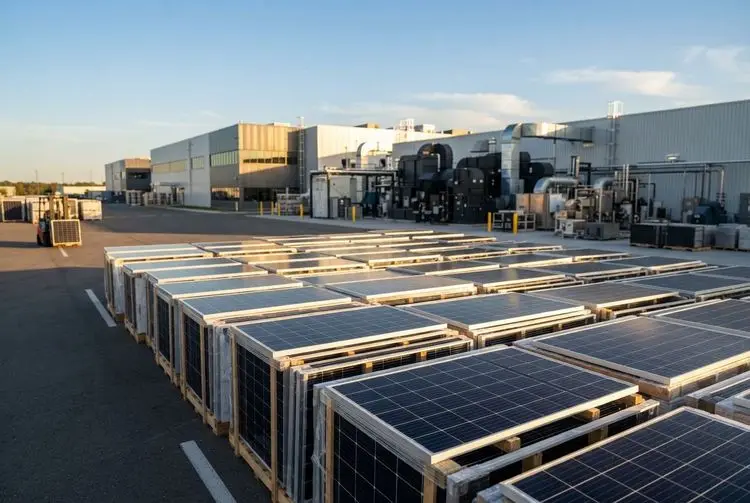
The United States has added solar module manufacturing capacity at a breakneck pace, but the country's upstream supply chain remains a fraction of what is needed — and industry analysts say current trade policy is not providing a clear path forward.
Domestic module nameplate capacity has jumped from under 10 GW four years ago to 80.6 GW today, according to the Solar Energy Industries Association (SEIA). That rapid buildout was driven primarily by the Section 45X Advanced Manufacturing Production Credit, part of the Inflation Reduction Act passed in 2022.
Yet upstream capacity tells a different story. Operating ingot, wafer and cell capacity in the U.S. stands at roughly 10 GW each — a fraction of the module assembly base and a bottleneck that leaves domestic manufacturers reliant on imported cells.
Trade policy called 'a piecemeal mishmash'
Speaking at a RE+ 2026 panel titled "Hot Takes, Hard Numbers," Alex Barrows of CRU Group described the current U.S. trade framework as "a piecemeal mishmash of AD/CVD cases, 45X, 232, [and] various other tariffs." The Section 232 tariffs, set for December 2026, were characterized as "ugly and mishmashy" by panelists.
Anti-dumping and countervailing duty (AD/CVD) tariffs have been a recurring tool for the Commerce Department, but their effectiveness in building domestic manufacturing is disputed. Christian Roselund of Intertek CEA said: "Those who have suggested that the AD/CVD cases are an effective way to onshore don't really have any evidence to support that."
Panelists noted that AD/CVD actions have tended to chase manufacturing around the globe rather than bring it to the United States. U.S. buyers are left with access to older PERC technology — lines that can still run in the U.S. but are being phased out elsewhere.
India's ALMM as a contrasting model
India's Ministry of New and Renewable Energy (MNRE) has taken a different approach with its Approved List of Models and Manufacturers (ALMM) framework, which sets clear deadlines for domestic content. The ALMM List-I deadline for modules was April 1, 2024. List-II, covering cells, is set for June 1, 2026. List-III, for ingots and wafers, follows on June 1, 2028.
"I really like the Indian approach of [having] a clear roadmap," Barrows said. The sequential deadlines give manufacturers visibility into what is required and when — something the U.S. currently lacks for upstream onshoring.
Upstream capacity forecast and the 45X question
Wood Mackenzie forecasts roughly 30 GW of domestic cell capacity by 2030. That would be a significant increase from today's roughly 10 GW, but still well short of the 80.6 GW module base if the U.S. aims to produce cells domestically for most of its module assembly.
The 45X tax credit has been the primary driver of the module buildout, and an extension is widely expected. Roselund indicated that extension may not come until 2029, creating uncertainty for investors considering cell, wafer or ingot factories that require patient capital and five-year-plus return horizons.
China's role and the cost of imports
China remains central to the global solar supply chain, and the expertise needed to build new factories in the U.S. mostly comes from China. Key materials such as silver paste also rely on Chinese suppliers. Panelists noted that imported modules after Section 232 tariffs can cost over 40 cents per watt, a price point that underscores the challenge of competing with domestic production.
Elissa Pierce of Wood Mackenzie and Jade Jones of SEIA also participated in the panel discussion, which examined the gap between the U.S. module assembly boom and the lack of a predictable policy roadmap for upstream manufacturing.
What to watch
For solar industry professionals, the key question is whether the U.S. can develop a structured timeline for domestic cell, wafer and ingot production similar to India's ALMM approach. Without such a roadmap, the 80.6 GW of module capacity may remain dependent on imported cells — and vulnerable to the same trade disputes that have characterized the sector for years.
The 45X extension timeline, the outcome of Section 232 tariffs set for December 2026, and the pace of cell factory announcements will be the metrics to track. Patient capital, clear policy signals and access to Chinese expertise will all factor into whether the U.S. can close the upstream gap.