
T1 Energy Locks In 1.58 GW Texas Module Offtake Deals
T1 Energy has secured more than 1.58 GW of module offtake from G1_Dallas for 2027-2028 deliveries, alongside a Commerce waiver for cell imports.
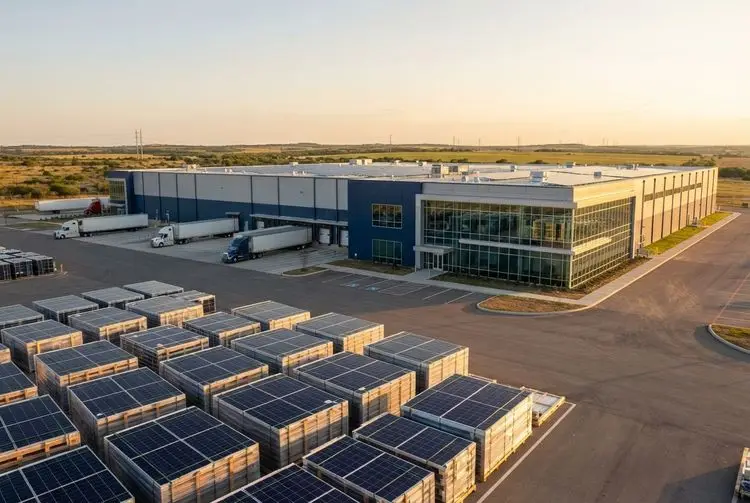
T1 Energy disclosed on October 30 module offtake agreements covering more than 1.58 GW, with deliveries scheduled from its G1_Dallas factory in 2027 and 2028. The contracts cover TOPCon (tunnel oxide passivated contact) modules, and part of the volume will be taken by subsidiaries of independent power producer Avantus. T1 did not disclose the remaining customers, pricing, contract values or how the volume splits between the two delivery years.
Measured against nameplate capacity, the commitments equal roughly 32% of G1_Dallas's 5-GW annual module output, or about 3.8 months of production at full rate, according to calculations published by list.solar. For a manufacturer still ramping domestic assembly, that represents meaningful commercial traction.
Avantus is a substantial counterparty. The developer has built more than 7 GW of projects that are operating or under construction across the Western United States and Texas, and its development pipeline is expected to deliver approximately 13 GW of solar capacity.
Blended Cell Supply Underpins the 2027 Deliveries
The modules covered by these agreements will pair imported cells with cells made at G2_Austin, the cell fabrication plant T1 began building in Rockdale, Texas, in December 2025. That combination reflects a practical constraint: G1_Dallas cannot run on Texas-made cells alone until G2_Austin scales beyond its first phase.
Phase 1 at G2_Austin is designed for 2.1 GW of annual cell capacity, enough to cover about 42% of G1_Dallas's module nameplate, per list.solar's calculations. First cell output from that phase is expected in the first quarter of 2027 — the same period in which deliveries under the new offtake contracts begin.
T1 expects the modules it offers in 2027 to contain more than 60% domestic content. That figure carries weight as federal procurement rules and trade policy increasingly favor domestically sourced components.
The new deals build on earlier momentum. In August, T1 agreed to supply Clearway Energy Group with 641 MW of modules built with cells from the Austin fab. Combined with the October 30 announcement, T1's recent offtake disclosures total approximately 2.2 GW.
Chairman and Chief Executive Officer Dan Barcelo described TOPCon as one of the most advanced crystalline-silicon module technologies in commercial production.
Commerce Grants Waiver for 1.725 GW of Cell Imports
On October 22, T1 said it had received a waiver from the Department of Commerce permitting imports of up to 1.725 GW of solar cells to feed module assembly at Wilmer, Texas, just south of Dallas.
The waiver followed an emergency rule from Commerce aimed at preventing an import surge ahead of Section 232 tariffs, with a December 4 deadline across the solar supply chain. The department has imposed strict monitoring and volume caps on foreign polysilicon, wafers, cells and modules entering the United States.
The mechanism captures the balancing act facing domestic manufacturers: they need enough cell supply to keep module lines running while federal rules tighten on imported components. T1's success in obtaining a 1.725 GW allowance suggests the company has navigated that landscape effectively, at least in the near term.
Political Visibility Alongside Commercial Progress
The White House's X account reposted a T1 Energy message on October 28 promoting the administration's Texas visit and its support for the company's two facilities. The original post stated: "T1 is building G2_Austin, an advanced photovoltaic manufacturing facility in Texas, with an estimated 2.1 GW Phase 1 capital expenditure in excess of $500 million. G2_Austin is expected to create an estimated 1,500 high-paying advanced manufacturing jobs with a $120 million payroll in Milam County, Texas, while helping to reshore a critical industry."
Breitbart and other outlets aligned with the White House amplified both the post and the repost, widening its reach in political and policy circles. T1 has maintained sustained engagement with the administration: in May 2025 it joined administration officials on a trip to Saudi Arabia to discuss investment needs for the G2 solar cell facility, and roughly a year ago its CEO met administration officials in Washington, D.C., to discuss the company's plans.
T1 is one of a small group of manufacturers expanding U.S. module capacity. First Solar began producing modules at its Gaffney, South Carolina, facility in October, and the administration marked an October 28 plant opening ceremony there. At that event the U.S. Commerce Secretary said: "We need power across all of the possibilities. We love natural gas, we love oil, we love solar, we love coal also. All four need to power America."
Execution now hinges on completing G2_Austin's first phase on schedule, ramping cell output to reduce reliance on imports and meeting commitments to Avantus and Clearway Energy Group. Whether T1 holds domestic content above 60% in its 2027 modules depends on how quickly that fab reaches meaningful production volumes — while the Commerce emergency rule and its volume caps keep the regulatory picture fluid.