
Arizona election results open new path for solar policy reset
Re-elected Governor Hobbs and AG Mayes, plus new ACC commissioners, shift the balance on solar regulation.
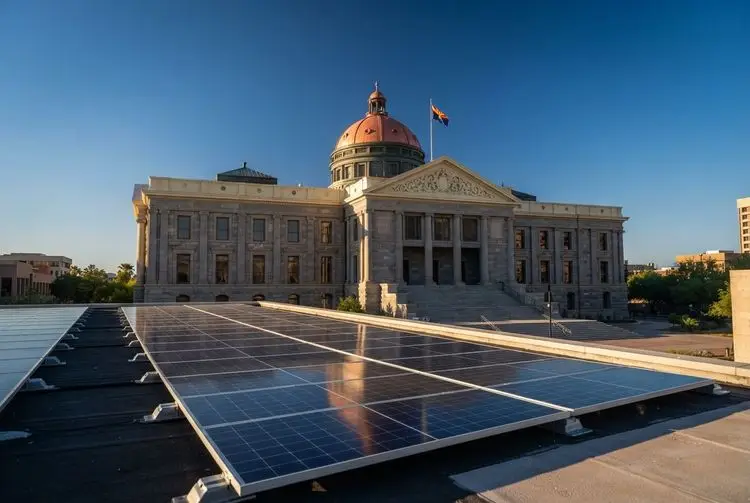
Arizona's November 2026 election delivered a clean sweep for candidates aligned with solar and clean energy interests, setting the stage for a potential policy reset at the Arizona Corporation Commission (ACC).
Governor Katie Hobbs won re-election, and Attorney General Kris Mayes — a former ACC commissioner and Vote Solar board member — also secured another term. Voters elected two new ACC commissioners, Clara Pratte and Jonathon Hill, reshaping the five-member panel that holds near-total authority over the state's investor-owned utilities.
The ACC is not a typical regulatory body. Under Article 15 of the Arizona Constitution, it functions as a fourth branch of government. Its decisions carry the weight of law and cannot be overridden by the legislature or the governor. That independence makes every commission election a high-stakes event for the solar industry.
What the ACC controls
The ACC sets utility rates, approves solar export values, and reviews multi-billion-dollar capital expenditures, resource plans and grid expansion projects for Arizona Public Service (APS), Tucson Electric Power and UniSource Energy Services. It prescribes electricity classifications, approves base rates and sets grid fees — all decisions that directly affect the economics of rooftop solar and utility-scale projects.
Vote Solar led a voter education campaign ahead of the election, focusing on the ACC's role in shaping Arizona's energy landscape. The group's regional director for the West, Itzel Rios-Vega, framed the outcome as an opportunity.
"With electricity costs continuing to rise, Arizona leadership has an opportunity to take meaningful steps toward making clean energy more affordable and accessible," Rios-Vega said.
Solar export rates under pressure
The ACC's recent track record on solar compensation has been a source of tension for the industry. In August 2026, the commission cut the solar export rate by 10% for APS and UniSource customers, bringing the rate to 5.5 cents per kilowatt-hour. That reduction is the latest in a series of cuts that have slashed the export rate by 56.9% cumulatively since 2018, when it stood at 12.9 cents/kWh.
Arizona law caps annual export rate reductions at 10%, meaning the August cut was the maximum allowed. For solar installers and homeowners, the steady decline in export compensation has eroded the financial case for new rooftop systems, particularly when paired with rising grid fees.
Grid access charge struck down
In a separate but related development, the Arizona Court of Appeals struck down APS's grid access charge in June 2026. The charge had been set at $2 to $3 per month and was slated to rise to $6. The court's ruling removed a cost that solar advocates argued unfairly penalized customers who generate their own power.
The grid access charge was part of a broader utility push to recover fixed costs from solar customers, a trend that has played out in multiple states. The appellate decision does not permanently bar such charges, but it signals judicial skepticism toward fees that single out solar adopters.
What to watch next
Power demand across Arizona is rising rapidly, driven by data centers, manufacturing and population growth. That load growth creates pressure on the ACC to approve new generation and transmission — and opens the door for solar and storage to play a larger role in utility resource plans.
The new commission makeup, combined with a supportive governor and attorney general, could shift the balance on key dockets. Industry observers will watch for signals on export rate policy, grid fee proposals and the pace of renewable energy procurement in upcoming ACC proceedings.
The election results do not guarantee immediate policy changes. The ACC operates through formal rulemaking and adjudicative proceedings, and new commissioners must build expertise on complex rate cases. But the political alignment creates a more favorable environment for solar advocates than the state has seen in recent years.
For solar professionals and investors, Arizona remains a market to watch closely. The combination of strong solar resource, rising electricity demand and a potentially friendlier regulatory climate could make the state a bright spot in the US solar landscape — provided the new commission follows through on the opportunity its election has created.