
BYD Debuts Integrated Solar, Storage and Robotic Charging in Abu Dhabi
BYD has switched on a fully integrated solar, storage, flash charging and robotic facility in the Abu Dhabi desert.
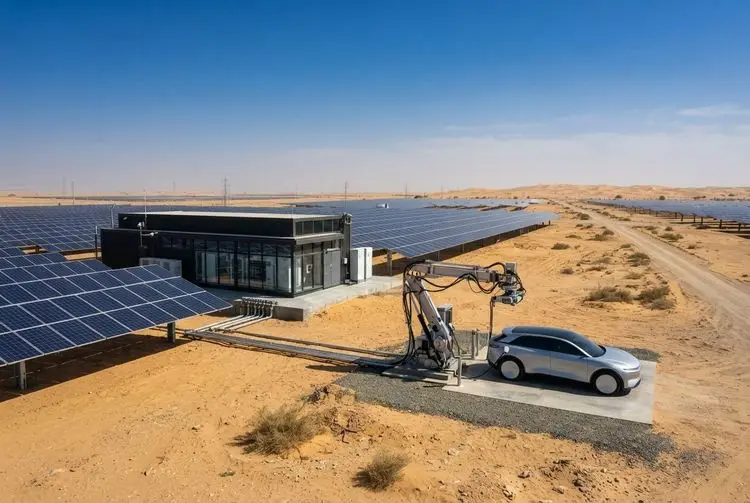
BYD has commissioned what it describes as the world's first fully integrated solar generation, battery storage, ultra-fast flash charging and robotic charging facility in the Abu Dhabi desert. The Chinese manufacturer, founded in 1994 as a rechargeable battery maker and now the world's largest EV producer since 2025, says the installation marks a milestone in its push to become an all-in-one provider of new energy solutions.
The project's core is BYD's Solar-Storage-Charging (SSC) system, which links on-site photovoltaic generation directly to battery storage and the company's proprietary Flash Charging technology. Rather than drawing power from the grid, the facility captures local solar energy, stores it in batteries, and delivers it to electric vehicles when needed. BYD notes that this integrated approach allows the system to operate independently from the grid, a feature particularly relevant for remote regions where grid access is limited or where electricity networks are under strain.
Flash Charging and robotic automation
BYD's Flash Charging technology is central to the installation's value proposition. The company advertises charging times of five minutes to go from 10% to 70% state-of-charge, and nine minutes to reach 97% from 10%. Reducing charging times, alongside increasing range, remains one of the most effective levers to convince drivers to switch from internal combustion engines to EVs, and BYD positions Flash Charging as its direct answer to that challenge.
Robotics handle the physical connection. Instead of requiring a driver to retrieve a charging cable and connect it manually, a robotic arm uses visual guidance and force-feedback technology to identify the charging port, open its cover, and insert the connector. BYD intends to integrate the robotic charging with Automated Valet Parking, allowing drivers to exit the vehicle, lock it, and walk away while the car autonomously navigates to a designated charging space. In locations where temperatures regularly climb well above comfort levels, eliminating the need for drivers to stand outside connecting heavy cables may be a genuine advantage.
A desert proving ground
The Abu Dhabi desert location was chosen deliberately. The area offers intense sunlight, high temperatures, and scarce rainfall — conditions that provide abundant solar resource while simultaneously presenting some of the harshest operating conditions for energy infrastructure. High temperatures, dust, and limited rainfall create a demanding test bed for both solar generation and charging equipment, making the installation a proving ground for the durability and reliability of BYD's integrated approach.
Strategic context
The project is the latest expression of a corporate vision BYD chairman Wang Chuanfu first outlined in 2006: the "Three Green Dreams" of generating clean electricity from solar power, storing that energy in batteries, and using it to power electric vehicles. Nearly two decades later, the Abu Dhabi installation represents perhaps the clearest physical expression of that idea — solar panels generate energy, batteries store it, and electric vehicles consume it, all within a single integrated system.
BYD's renewable energy division has been built over the past two decades and now operates in more than 100 countries and regions, supplying photovoltaic cells and complete energy systems. The company's broader portfolio includes automobiles, rail transit, new energy, and electronics, with over 30 industrial parks in China, the United States, Canada, Japan, Brazil, Hungary, and India. BYD Auto, founded in 2003, rose through the ranks on the back of technological advancements including the Blade Battery, DM-i and DM-p hybrid technology, and the Super e-Platform.
Deployment plans
The Abu Dhabi installation also signals how far EV charging technology has progressed. Concepts that once sounded ambitious, such as ultra-fast charging and large-scale battery storage, are increasingly becoming commercial realities. BYD has announced plans to deploy 6,000 FLASH Charging stations worldwide by the end of 2027, significantly expanding access to its ultra-fast charging technology. Whether every site will eventually incorporate solar generation, battery storage, and robotic charging remains unclear, but the Abu Dhabi project offers a strong indication of the direction BYD wants the industry to travel.
For solar industry professionals, installers, investors, and engaged homeowners, the project highlights a growing convergence between solar generation, battery storage, and EV charging infrastructure — a trend that could reshape how charging networks are planned and deployed in sun-rich but grid-constrained regions worldwide.