
Dominican Republic Launches 200 MW BESS Tender; First Solar Cuts Guidance
Resolution SIE-141-2026-LCE targets 200 MW/800 MWh of storage at existing contracted solar and wind plants, with awards due February 25, 2027.
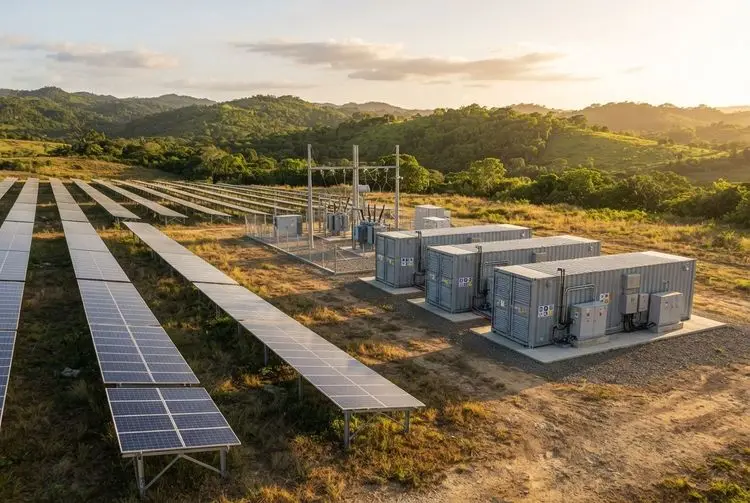
The Dominican Republic's Superintendency of Electricity (SIE) has opened a tender for up to 200 MW of power and 800 MWh of battery energy storage (BESS), with the award scheduled for February 25, 2027. The procedure, formalized under Resolution SIE-141-2026-LCE, is restricted to existing solar photovoltaic (PV) and wind plants that hold long-term contracts with the distribution companies EDENORTE, EDESUR or EDEESTE.
The 200 MW / 800 MWh capacity is grouped into a single block, equivalent to four hours of storage at nominal power. Storage added at any single installation may not exceed 50% of the net nominal capacity of the associated renewable park — a 100 MW solar plant could therefore not host more than 50 MW of batteries. Equipment must be new and installed inside existing park facilities, in line with connection, operation and safety requirements.
Fifteen-year contracts, separate from existing agreements
Winners will sign a new supply contract backed by battery-stored energy that sits alongside, rather than inside, their existing renewable generation agreement. The original contract keeps its prices and obligations, while the new instrument governs the additional storage commitments. Pricing relies on an offered and awarded discount referenced to the energy price of the existing contract and applied only to billing under the new storage contract; admissible reference costs must be fixed before economic offers are opened, subject to validation by the regulatory body.
The supply period runs 180 months (15 years), and developers get a maximum of 12 months to install the systems and obtain commercial operating authorization. The SIE has granted an exceptional waiver on certain phases and deadlines of the schedule to allow execution within the planned timeframe, and the rules permit bidders to request an early start of supply once the Certificate of Start of Commercial Operation is issued.
Technical compliance follows Resolution SIE-178-2025-MEM and the provisions covering auxiliary frequency and voltage regulation services, with resolutions SIE-136-MEM-2024 and SIE-131-2026-MEM also cited in the framework. Eligibility is limited to operational non-dispatchable renewable projects that do not already have batteries; brand-new renewable projects and installations already fitted with storage are excluded.
Curtailment near 14% drives the push
The tender had been trailed publicly before it was formalized. Ricardo Guerrero, Vice Minister of Electric Power, confirmed at the Future Energy Summit (FES) Caribbean 2026 that the government was working on a storage tender, and Joel Santos Echavarría, Minister of Energy and Mines, told Energía Estratégica during the 11th Energy Week in Santo Domingo in October that a 200 MW procedure for operating plants was in preparation as part of a wider portfolio of electricity contracts.
The rationale is visible in the system data Santos presented at that event. Dominican solar and wind capacity climbed from 555 MW in 2020 to more than 2,000 MW, and renewables now supply roughly 26% of the energy injected into the system. Curtailment averaged around 14% in the first months of 2026, with some days approaching 40% cuts. The government targets at least 800 MW of storage by 2028 and has announced a further tender for 600 to 900 MW of new renewable generation with associated storage. Storage lets the system shift existing renewable output toward peak demand on the National Interconnected Electric System (SENI) without building new parks.
First Solar: higher margins, thinner order book
On the manufacturing side, First Solar reported third-quarter 2026 results on October 29 after the Nasdaq close, posting sharply lower sales alongside higher net income, earnings per share and adjusted EBITDA. The Phoenix, Arizona-based company attributed the revenue drop mainly to lower volumes of modules sold to third parties and reduced revenue from terminated customer contracts.
Cost of sales fell faster than revenue, lifting gross margin to an exceptional level. First Solar books the 45X credit — a federal tax credit for U.S.-made modules and components — as a reduction of cost of sales, which mechanically inflates margins on U.S.-manufactured product and complicates comparisons with competitors that do not receive it. Earnings also benefited from reduced under-utilization of foreign plants, the end of discounts on credit sales and a tax charge close to zero or positive for the quarter; in the prior quarter, expected refunds of IEEPA tariffs had helped cost of sales.
The contractual order book contracted quarter over quarter and remains well below its year-earlier level. Management under CEO Mark Widmar describes the approach as deliberately selective, favoring project-by-project contracts, improved pricing following Section 232 and stronger contractual protections over multi-year framework agreements. Developers are pushing purchases into later years of the book, the company says, because of grid connection difficulties, local opposition to data centers, the wait for final FEOC rules and uncertainty over minimum import prices. Subsidiaries of the BP group are among counterparties to terminated contracts.
Profits are not yet converting into cash: the non-current government receivable including 45X credits rose sharply, operating cash flow was negative over nine months, inventories and trade receivables grew, and customer advances recognized in revenue declined. Debt is almost fully repaid and net cash has fallen below the level at the end of the previous fiscal year, although the year-end net cash forecast is unchanged. First Solar cut guidance for sales, volumes, adjusted EBITDA and capital expenditure, and launched a share buyback program.
Elsewhere in the sector, Maryland opened $200 million in grants for solar and battery storage, and China passed a symbolic threshold in wind and solar installed capacity.