
Energy Security Drives Record 4,800GW Global Renewables Push
IEA report finds energy security, not climate policy, now the main driver of renewable capacity growth worldwide.
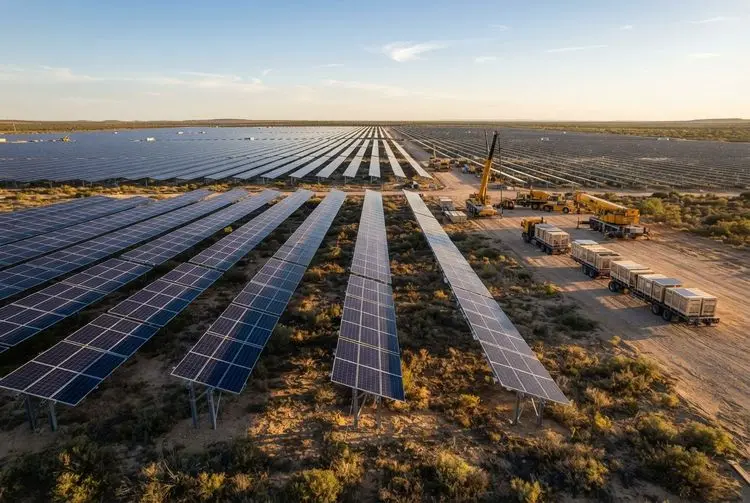
The International Energy Agency (IEA) projects global renewable capacity will increase by approximately 4,800 GW between 2026 and 2031 — 60 percent more than was added in the previous six-year period. The figure marks an unprecedented acceleration, driven primarily by energy security concerns rather than environmental policy.
According to the IEA report published on November 6, the energy crisis has fundamentally shifted government priorities. Countries around the world are now prioritising domestic power generation and reducing exposure to volatile imported fuel markets. Without the expansion of renewables since 2010, global fossil fuel demand in 2025 would have been 8 percent higher.
"Previously, environmental concerns were the policy priority behind the growth of renewables, whose falling costs have made them a competitive option in many markets – but today, it's mainly energy security that is driving renewables' expansion as more and more countries seek to reduce their exposure to imported fuels," said Fatih Birol, Executive Director of the IEA. The IEA has called the current energy security challenge the largest in history.
China and India Lead the Expansion
China dominates the global growth picture, accounting for 53 percent of all renewable capacity additions between 2026 and 2031. However, the country's expansion is slowing as it shifts from fixed tariff support mechanisms to competitive auctions. This transition is causing severe strain on the domestic solar manufacturing sector: over 90 percent of major Chinese solar PV makers reported losses in 2026, and more than 70 bankruptcies among Chinese developers have occurred since 2024.
India emerges as the second-largest growth driver. Its capacity expansion is projected to reach 2.6 times the level of the previous six-year period, with India's share of global renewable growth now standing at nearly 8.5 percent. The IEA attributes India's success to strong government policies and deliberate efforts to diversify supply chains.
Birol emphasised the importance of supply diversification. "The golden rule for energy security is diversification," he said. The IEA warns that the concentration of manufacturing in a single country poses risks to global supply chains — a concern that extends beyond solar PV to wind turbines, battery storage and grid components.
Grid Investment and Integration Challenges
The rapid build-out of renewable generation capacity brings system integration challenges. The IEA stresses that grid investment must keep pace with capacity additions. Without adequate transmission and distribution infrastructure, new renewable plants may face curtailment or negative electricity prices.
"This could lead to serious issues such as curtailment or negative electricity prices," Birol warned. The IEA calls for reforms to speed up grid connection of renewables, alongside greater investment in energy storage and demand-side flexibility to balance supply and demand.
The European context reflects these priorities. The EU Arctic strategy calls for more investment in renewables and critical minerals. Portugal, for example, holds significant untapped potential in tidal and wave power. Meanwhile, the European Bank for Reconstruction and Development (EBRD) has approved a $30 million loan to modernise Moldova's capital city power grid, underscoring the need for infrastructure upgrades across emerging markets.
What This Means for Solar Industry Professionals
For the solar industry, the IEA's projections confirm a sustained multi-year growth trajectory, but one that is increasingly contingent on grid readiness, market design and supply chain resilience. Installers and project developers should watch for reforms in grid connection procedures and growing demand for battery energy storage systems (BESS) to accompany new solar capacity.
Manufacturers face a bifurcated market: booming global demand on one side, and intense pricing pressure and consolidation — particularly among Chinese producers — on the other. For investors, the risk of negative electricity prices in markets with high renewable penetration underscores the value of merchant revenue hedging and co-located storage.
The IEA's message is clear: energy security is now the lasting structural driver for renewables. The 4,800 GW target is within reach, but only if governments match generation growth with grid investment, storage deployment and regulatory reform.