
India's solar supply chain must prioritise quality over speed
India's rapid solar expansion hinges on uncompromised quality in its growing domestic supply chain.
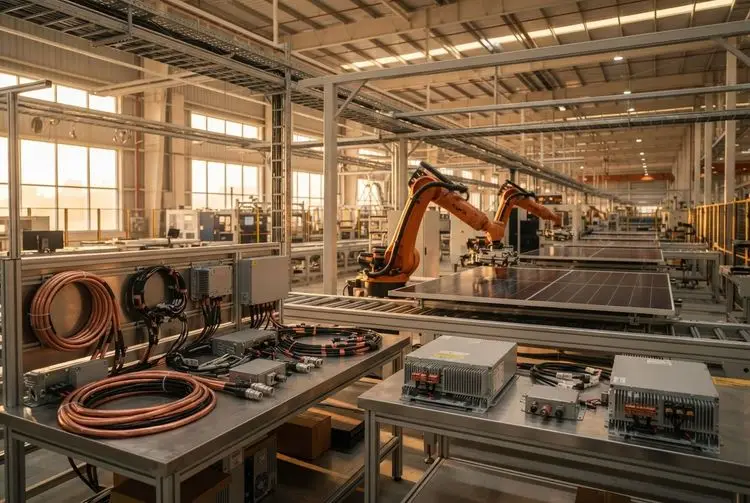
India is scaling up its solar manufacturing ecosystem at unprecedented speed, but industry leaders warn that quality must keep pace with capacity additions. The country targets 500 GW of renewable capacity in the near term, while NITI Aayog projects a requirement of 1,800 GW by 2047.
Pankaj Kumar, Co-Founder and Director of Quant Solar, told ETEnergyWorld that supply chain integrity is non-negotiable. "No matter how big we become in our supply chain, quality cannot be compromised," Kumar said during the Bharat Renewable Energy Summit and Expo 2026 in New Delhi.
The warning comes as new entrants flood the Indian solar market. These aggressive players are scaling quickly, but Kumar noted that the initial phase may not be commercially rewarding. Cost optimisation in Indian solar has already reached global benchmarks, he said, but the focus now must shift to long-term reliability.
Government support beyond modules
Subsidies and policy support for solar in India have traditionally centred on module manufacturing. Kumar argued that government support must also extend to other supply chain components, including cables and inverters. These balance-of-system elements are equally critical for project performance and longevity.
"Some initial support will be required from the government so that the initial push is there. After that, it becomes a self-sustaining model," Kumar said. His comment reflects a broader view among Indian solar manufacturers that targeted incentives can kickstart domestic production in segments where Indian industry still lags behind global peers.
Just seven to ten years ago, significant gaps existed in India's solar supply chain. Since then, domestic manufacturing has grown substantially, but certain components still depend heavily on imports. Bridging these gaps, Kumar indicated, requires both policy continuity and private-sector investment in research and development.
Floating solar and the PMSSY push
Quant Solar is a floating solar technology company and an early mover in India's floating solar segment. The company is working toward gigawatt-scale manufacturing capacity, though Kumar did not specify a timeline.
India's PMSSY policy — the PM Suresh Sarovar Yojana — targets 5,000 MW of floating solar capacity. This scheme creates a dedicated market for floating PV installations on reservoirs and water bodies, a segment where Quant Solar has established a foothold. The policy framework is expected to drive demand for specialised floating structures, anchoring systems and marine-grade cabling.
Floating solar offers advantages for land-constrained states and reduces water evaporation from reservoirs. It also pairs well with existing hydropower infrastructure, enabling hybrid renewable plants that can smooth output. For India, where land acquisition for ground-mounted solar projects remains a bottleneck, floating PV represents a scalable alternative.
R&D and innovation as capacity enablers
Kumar stressed that research and development, alongside innovation, are crucial for building India's targeted capacity. As the country moves from 500 GW toward the longer-term 1,800 GW goal, incremental improvements in cell efficiency, module durability and system integration will determine whether projects deliver their expected returns over 25-year lifespans.
Industry observers note that India's solar manufacturing ecosystem has matured rapidly. Domestic cell and module production now covers a significant share of local demand, and several companies have announced backward integration into ingot and wafer production. However, the same level of maturity has not yet been achieved across the full value chain.
For solar industry professionals and investors, Kumar's remarks underscore a key risk: if quality assurance fails to keep pace with capacity expansion, the resulting underperformance or early degradation of systems could erode investor confidence. The cost of remedying poor-quality installations far exceeds the upfront savings from cheaper components, a lesson learned in other rapidly scaling solar markets.
The Bharat Renewable Energy Summit and Expo 2026, where Kumar spoke, served as a platform for discussing these challenges. As India pursues its ambitious renewable energy targets, the debate between speed and quality — and the role of government support in balancing both — will remain central to the industry's trajectory.