
SPONSORED

Global Energy Storage to Hit 535 GWh in 2026 as Solar Hybrids Surge

BloombergNEF forecasts 45% capacity jump as BYD launches solar-powered flash charging in UAE.
•• 5 Min
Global Energy Storage to Hit 535 GWh in 2026 as Solar Hybrids Surge

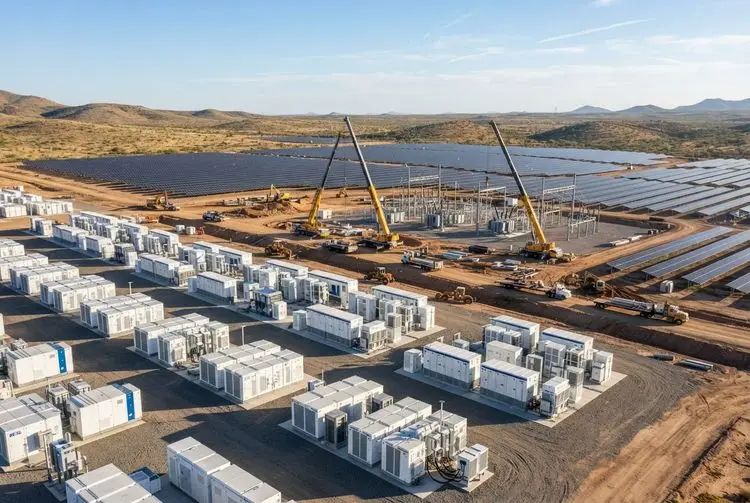
The global energy storage market is set for another record-breaking year in 2026, with new installations reaching 188 GW/535 GWh — a 45% increase in capacity compared to 2025 — according to the latest analysis from BloombergNEF (BNEF). China, the United States and Australia will account for 62% of new deployment, though the geographic base of the storage boom is widening rapidly.

China continues to lead despite the expiration of a mandate linking storage to new renewable projects. New support mechanisms have filled the gap, including a firm capacity requirement for certain stand-alone solar and wind projects and a national target of 300 GW of storage by 2030. In the United States, tax incentives and surging demand from data centers are driving growth. India is emerging as a significant new player, with tender awards expected to push new installations above 6 GW in 2026, up from just a few hundred megawatts the previous year.

Europe's storage landscape is broadening beyond established markets such as the United Kingdom, Germany and Italy. Countries including Bulgaria, Romania, Poland, France, Greece, the Netherlands and Ukraine are expected to reach gigawatt-scale installation levels. By 2027, BNEF forecasts 209 GW/638 GWh of new installations — an 11% capacity increase — with Spain, the United Arab Emirates, Chile and Japan identified as markets accelerating deployment. Over the longer term, cumulative global capacity could reach 3 TW/11 TWh by 2036, roughly ten times 2025 levels.

Solar-storage hybrids gain momentum

The hybridization of storage with renewable energy, particularly solar photovoltaics, represents a growing share of deployment. By the end of 2025, there were 69 GW/196 GWh of storage associated with 299 GW of solar capacity. This trend is being driven by increased generation curtailment and price cannibalization in markets such as the United States, Australia and Chile. In addition to China, countries including India, Mexico and the Philippines have introduced regulatory or auction-linked requirements for renewable projects paired with storage.

Supply chains are also undergoing significant regionalization. Localization policies are reshaping the battery and energy storage sector, with the United States combining tariffs and domestic manufacturing incentives with restrictions on equipment and components linked to Chinese supply chains. Security of supply and cybersecurity concerns are shaping policies in the European Union and Japan. In response, Chinese equipment manufacturers are increasing their activity in markets with fewer restrictions, particularly the Middle East, Latin America and sub-Saharan Africa. South Korea, India and Brazil have adopted industrial protection measures, though less stringent than those in the United States.

On the technology front, lithium iron phosphate (LFP) is expected to remain the primary storage chemistry over the next decade due to its cost competitiveness, cycle life and supply chain availability. However, rising LFP material costs are driving interest in sodium-ion batteries, which offer lower fire risk and a wider thermal operating range, reducing the need for liquid cooling and auxiliary system energy consumption. Sodium-ion adoption remains limited by smaller industrial scale and weaker economics relative to LFP — limitations that also affect other non-lithium long-life storage technologies.

BYD launches solar-powered flash charging in UAE

In a separate but related development, Chinese electric vehicle and battery manufacturer BYD has launched a new charging system in the United Arab Emirates that combines solar power, proprietary Flash Charging technology with local energy storage, and robotic arms. The announcement marks a significant step in BYD's efforts to challenge Tesla's dominance in EV charging infrastructure, following its rise to become the world's largest electric carmaker by global sales despite not selling cars in the U.S.

The core of BYD's system is its Flash Charging technology, which draws power from the grid but stores electricity in two on-site 185-kilowatt batteries. This stored energy can then be delivered to vehicles at much higher rates than would be possible drawing directly from the grid. Each Flash Charger has two connectors capable of up to 1,500 kW charging when one car is connected, or 1,000 kW when two cars share. For context, Tesla's new V4 Superchargers top out at 500 kW, regular superchargers at 250 kW, and Electrify America's fastest DC chargers at 350 kW. BYD quotes charge times of 10% to 70% in five minutes, 10% to 97% in nine minutes, and 20% to 97% in 12 minutes at an ambient temperature of minus 30 degrees Fahrenheit.

The integration of solar generation into the system — likely via panels on the charging station canopy — allows the local 185-kW batteries to be replenished by the sun, reducing reliance on the grid. This is particularly valuable in remote, sun-soaked regions such as the UAE desert, where BYD launched the system. The company also incorporates robotic arms that automatically locate a vehicle's charging port, open the cover and insert the connector. While the concept is not new — Tesla promised similar technology a decade ago, and Volkswagen, Hyundai and Xiaomi have built their own versions — BYD's integration of solar, storage, high-speed charging and robotics into a single system represents a notable packaging of technologies.

BYD plans to install 6,000 Flash Charging stations worldwide by the end of next year, though not all will initially include solar power or robotic arms. The company's ability to execute on this rollout at scale could position it as a leading player in global charging infrastructure, particularly in markets where grid reliability and solar resources make integrated solutions attractive.

Taken together, these developments highlight two parallel trends: the rapid expansion and regional diversification of energy storage deployment globally, and the increasing integration of solar generation with storage and charging infrastructure. While BNEF's forecasts point to continued dominance by LFP chemistry and concentrated deployment in a few large markets, the emergence of new applications — such as BYD's solar-powered charging stations — suggests that storage is increasingly being embedded in broader energy and transportation ecosystems. The coming years will test whether supply chain regionalization, technology diversification and infrastructure innovation can sustain the pace of growth that analysts currently expect.

Energy StorageBloombergnefSolar-Plus-StorageBYDFlash ChargingLfp BatteriesSodium-Ion BatteriesUae Solar

Most Popular News

  1. Statera Energy reaches financial close on 290MW BESS in East Devon
  2. Ireland RESS 6 awards 1.3GW solar PV in record auction round
  3. Indian banks ease rooftop solar loan norms under PM Surya Ghar scheme
  4. Brazil battery auction faces dispute over R$94 billion cost allocation
  5. GoodWe sees storage surge as Brazil moves to Fixed-Time Tariff

Disclaimer


Important notice regarding existing conflicts of interest:

We expressly point out that conflicts of interest exist in connection with this publication:

1. Stock Market Media Ltd. and persons closely associated with it hold shares in the companies recommended here and intend to sell them within the scope of, and at any time during, this recommendation. This constitutes a clear and specific conflict of interest.

2. The publisher of this publication and the responsible editors receive financial remuneration for its preparation. This, too, constitutes a clear and specific conflict of interest.

3. Please also note the further statements on existing conflicts of interest in the disclaimer below, inter alia under no. 2.

Important information and mandatory disclosures pursuant to the German Securities Trading Act (Wertpapierhandelsgesetz, WpHG) and pursuant to the German Financial Investment Ordinance (Finanzanlageverordnung, FinAnV).

Stock Market Media Ltd. has notified the German Federal Financial Supervisory Authority (Bundesanstalt für Finanzdienstleistungsaufsicht, “BaFin”), pursuant to the WpHG, of its activity as a producer of investment strategy recommendations within the meaning of Article 3(1) point 34 of Regulation (EU) No 596/2014 or of investment recommendations within the meaning of Article 3(1) point 35 of Regulation (EU) No 596/2014 (formerly “financial analyses”). The obligations of Stock Market Media Ltd. are governed primarily by §§ 85, 86 WpHG, Regulation (EU) No 596/2014 and Delegated Regulation (EU) 2016/958.

Information on the producer(s) of this publication:
Mr Roberto Gonçalves de Albuquerque, as analyst and editor-in-chief, is responsible for the preparation of the texts and contents of this publication. The publisher is Stock Market Media Ltd., 405 Kings Road, Flat 600, London; SW10 0BB, United Kingdom, represented by its Director Roberto Gonçalves de Albuquerque.

Important notes on the preparation of this publication:
This publication contains both facts and factual information on the companies discussed and purely subjective value judgements, interpretations, estimates, projections, forecasts and price targets. We endeavour to distinguish these from one another as transparently as possible in order to avoid misleading statements. Research, preparation and wording are carried out using common digital and AI-supported tools; the review of the content and the editorial responsibility lie with us. The essential bases and standards of our value judgements and valuations of the shares discussed are based on the following approach:

Assessment and valuation of companies according to conventional valuation methods (fundamental valuation approach)

  • Assessment of the potential of the company's future development (growth approach) and projection onto the corresponding valuation potential (price potential analysis) as well as a possible valuation of the company's shares on the basis of potential profit expectations (P/E ratio projection)
  • Assessment of the best-case scenario expected by us in the event of the company's absolute success (blue-sky potential approach)
  • Effect on the share price of the increased awareness of the recommended share expected by us, resulting from a strong rise in demand on the market (particularly decisive in the case of illiquid shares or shares recommended newly or for the first time) on account of the publications (mostly buy recommendations) published by us or by third parties (multiplier / momentum effect, hype), and thereby a disproportionately rising return/share price with a correspondingly rising risk
  • Technical analysis of the share price in accordance with common methods of analysis, mostly for the prediction of price signals (buy or sell signal, breakout of the share, determination of price targets, support or resistance areas, expected minimum movements or minimum counter-movements, prediction of signal points (if-then), etc.), for the most part building on the expected mass psychology (technical approach).

Conventional valuation approaches often cannot be meaningfully applied to young companies or companies that do not yet generate revenue. In valuing such companies we therefore tend to rely on the potential analysis calculated by us and on the assessment of the demand for such shares on the capital market. Ultimately, the market decides on the share price of a company. If extensive recommendations of a share give rise to excessive demand for it, it is possible that the share price will rise at an above-average rate on high trading volume. Although this leads to extreme opportunities for profit, it correspondingly increases the risk of a bubble forming, with a corresponding fall in price. The increased volatility of the share in such situations gives rise to above-average opportunities for profit and loss, both in both trading directions and in the case of recurring counter-movements. Such market developments are also an important part of our trading recommendations and valuation approaches.

This publication deals exclusively with securities of above-average volatility with high potential for profit and also for loss.

Note on sources of information:
The reliability of sources of information is examined by us in detail before they are used and is subjectively assessed by us according to their credibility and significance. In doing so, we decide by our own standards which sources we consider relevant, too conservative or too optimistic. Ultimately, we determine our recommendations on the basis of our personal assessments. In obtaining information we draw on numerous publicly accessible sources such as press releases, ad hoc announcements, company announcements, company presentations, publications and articles on the company discussed, common financial media in Germany and abroad as well as company or sector analyses by third parties.

Our publications use exclusively publicly available information and sources as well as information disseminated by the company itself.

Note on existing conflicts of interest:
We hereby point out that shareholders, editors, employees and persons or companies involved in the preparation of this publication, as well as principals (third parties) commissioning the publication of Stock Market Media Ltd., hold, directly or indirectly, at the time of this publication, interests in securities which are discussed in the respective publication, and are therefore interested in an increase in price and/or turnover, i.e. also in increased trading liquidity, since it is intended to sell these securities in direct connection with this publication and to participate in rising prices and turnover. An increase in the price of the shares of the companies presented may lead to an increase in the assets of these persons. In any case, the share price of the company may be significantly influenced by the discussion of the company. In particular, the share price of the companies discussed is also materially influenced by securities transactions. This applies in particular where the companies concerned are ones whose shares do not have a broad market capitalisation and for which only a narrow market exists. Here, even small order volumes can have considerable effects on prices. However, they are also interested in the price of the company discussed falling if they wish to acquire its shares more cheaply. By law, this gives rise to a conflict of interest, to which we hereby expressly draw attention.

Stock Market Media Ltd. and its employees are furthermore remunerated for the preparation, electronic distribution and publication of this publication as well as for other services. By law, this gives rise to a conflict of interest, to which we hereby expressly draw attention.

This remuneration may be paid by the company about which Stock Market Media Ltd. publishes information, by third parties affiliated with these companies or by other third parties pursuing an interest with regard to the companies discussed in connection with this publication. By law, this gives rise to a conflict of interest, to which we hereby expressly draw attention. This arises, first of all, from the fact that Stock Market Media Ltd. could make its statements in the interest of its principal. Stock Market Media Ltd. and/or companies affiliated with it have entered into an agreement, for a fee, with the company in question or with its shareholders for the preparation of the editorial coverage. By law, this gives rise to a conflict of interest, to which we hereby expressly draw attention.

Note on the handling of internal organisational duties:
Owing to the small size of the publisher's business, internal control of the compliance processes of the employees and other parties contributing to this publication is limited.

Competent supervisory authority:
Stock Market Media Ltd. has notified BaFin of its activity pursuant to § 86 WpHG.