
Little Rock completes 6.3 MW solar project, saves $1 million annually
A 6.3 MW solar array at the Port of Little Rock will offset 70% of the city's electricity consumption.
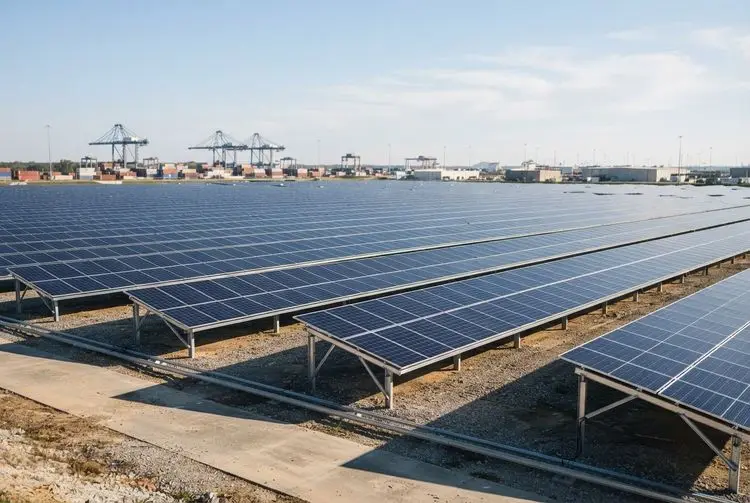
The City of Little Rock has completed a major solar energy project at the Port of Little Rock, a 6.3 MW DC / 4.9 MW AC solar array expected to save taxpayers approximately $1 million annually in electricity costs.
The project, delivered under a $12 million budget, will offset roughly 70% of the city's municipal electricity consumption. It advances Little Rock's goal of powering all city operations with clean energy by 2030.
Mayor Frank Scott Jr. emphasized the dual benefit of the project. "Our guiding principle has always been that sustainability should benefit both our environment and our taxpayers," Scott said. "This project delivers on both fronts. We're reducing long-term operating costs, making responsible use of public dollars and moving closer to our goal of powering City operations entirely with clean energy by 2030."
The city approved funding for the project in 2024. Scenic Hill Solar, a Little Rock-based solar developer, partnered with the city to design and build the installation.
Delivered under budget
The project came in $870,000 under the city's budgeted amount, a significant saving on the capital side in addition to the expected operational savings.
Bill Halter, CEO of Scenic Hill Solar, underscored the delivery performance. "We're proud to have partnered with the City of Little Rock to deliver a project that will generate clean, renewable energy for decades while providing substantial savings for taxpayers," Halter said. "We are especially proud to have delivered this project $870,000 below what the City had budgeted for it."
For a municipal solar project of this scale, completing under budget and on time is a meaningful benchmark. Public-sector renewable energy installations often face budget overruns or delays due to permitting, grid interconnection or supply chain constraints. Little Rock's experience suggests that cities with dedicated partners and early-stage budget discipline can avoid those pitfalls.
Project details and technical context
The array's 6.3 MW DC capacity refers to the total nameplate rating of the solar modules, while the 4.9 MW AC rating reflects the inverter output delivered to the grid. The roughly 1.4 MW difference between DC and AC ratings is typical, accounting for inverter clipping and system losses.
An annual saving of roughly $1 million on a $12 million investment implies a simple payback period of approximately 12 years. With solar modules typically warrantied for 25 to 30 years and inverters for 10 to 15 years, the project is expected to generate net savings for decades after the payback period ends.
Savings of this magnitude are material for a city's operating budget. Municipalities across the United States are increasingly pursuing utility-scale and commercial solar installations to hedge against volatile retail electricity rates. For Little Rock, offsetting 70% of municipal load substantially reduces exposure to future utility rate increases.
The Port of Rock location also demonstrates how underutilized industrial land can host productive solar infrastructure without competing with agricultural or residential uses. Brownfield and port-based solar installations are becoming more common as developers and municipalities look for large, unobstructed sites near existing grid infrastructure.
Broader policy context
Little Rock's 2030 clean energy target aligns with goals set by many U.S. cities under the Climate Mayors network and similar initiatives. Achieving the target will likely require additional solar capacity, possibly paired with battery energy storage systems (BESS) to handle evening and nighttime loads.
For solar industry observers, the project illustrates a growing market segment: mid-scale municipal solar installations in the 4 MW to 10 MW range. These projects are large enough to achieve economies of scale yet small enough to avoid the complex transmission interconnection requirements that challenge multi-hundred-megawatt utility-scale solar farms.
The involvement of an Arkansas-based developer like Scenic Hill Solar also highlights the role of local solar firms in driving adoption. Regional developers often have deeper knowledge of local permitting processes, utility interconnection rules and community engagement than national players.
For installers and investors tracking the municipal solar market, Little Rock's under-budget delivery and $1 million annual savings projection offer a replicable case study. The project demonstrates that city governments can pursue aggressive clean energy targets while being fiscally conservative — a narrative that may encourage other municipalities to move forward with similar initiatives.