
Mexico distributed generation adds 447 MW in H1 2026, solar PV dominates
Mexico's distributed generation sector added 447.47 MW in the first half of 2026, reaching 5,675.47 MW cumulative.
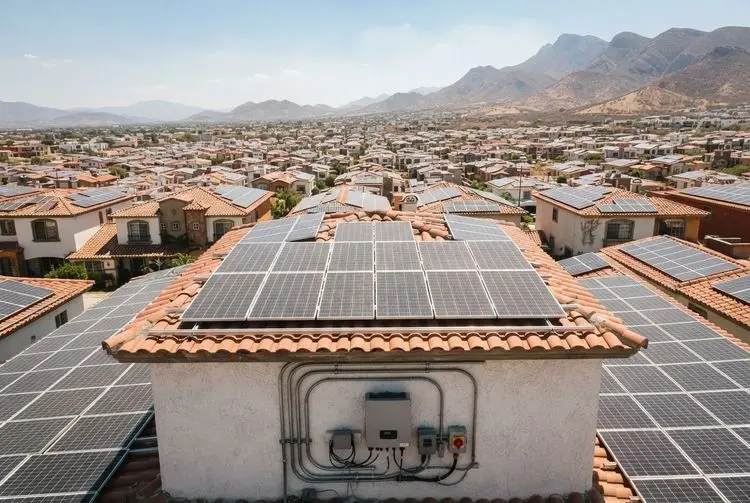
Mexico's distributed generation (DG) sector added 447.47 MW of new capacity in the first half of 2026, bringing cumulative installed capacity to 5,675.47 MW, according to data from the National Energy Commission (CNE). The figure represents an 8.56% increase compared to the 5,228 MW recorded at the end of 2025.
The CNE processed 53,087 new applications between January and June 2026, contributing to a national total of 655,417 interconnections since the distributed generation regime was implemented in 2017. The historical count since the earlier SIPyME scheme began in 2007 stands at 684,973 requests served and 5,923.06 MW of capacity.
Solar photovoltaic technology continues to dominate the sector, accounting for 99.54% of all DG capacity. Solar PV reached 5,649.34 MW across 655,124 applications. The average capital cost per kilowatt stands at $2,559.
Cumulative investment in distributed generation has surpassed $14.58 billion, with solar PV representing $14,456.66 million of that total. Other technologies registered far smaller shares: biogas contributed 20.50 MW ($105.66 million), biomass 3.11 MW ($16.03 million), cogeneration 1.36 MW ($1.81 million), and wind 1.01 MW ($2.18 million).
Jalisco leads, five states hold 43.64% of capacity
Jalisco remains the leading state for distributed generation with 808.58 MW installed across 107,285 applications, representing 14.25% of national capacity. Nuevo León follows with 596.22 MW and 75,933 applications. Chihuahua has 424.85 MW, Guanajuato 373.77 MW, and Coahuila 273.60 MW.
The top five states together account for 2,477.02 MW, or 43.64% of the national total.
By region, the North-Bajío region leads with 1,436.09 MW, closely followed by the West region at 1,422.43 MW. The Central-East region has 1,411.95 MW, and the Northwest region 1,405 MW. The West region leads in the number of applications with 191,793, or 29.27% of the national total.
The national average system size per request is 8.66 kW. Jalisco averages 7.54 kW per system, while Sinaloa records the highest average at 14.71 kW. The State of Mexico averages 12.84 kW per installation.
Small systems dominate, ANES forecasts 1,200 MW for full year
Systems up to 50 kW represent the vast majority of installations: 636,775 applications (98.23% of the total) and 3,557.98 MW (63.57% of capacity). At the other end of the scale, systems between 250 kW and 500 kW account for just 0.40% of applications but 1,081.98 MW, or 19.33% of total capacity.
The compound annual growth rate (CAGR) for applications from 2017 to 2025 reached 40.49%, while the CAGR for capacity over the same period was 40.95%.
The National Solar Energy Association (ANES) projects that Mexico will add 1,200 MW of new distributed generation capacity in full-year 2026. To reach that target, the sector would need to install 752.53 MW in the second half of the year.
Gilberto Sánchez, president of ANES, said: "This 2026 we must close with 1200 MW." He added: "This indicator tells us that we need to grow at least 20% more than we have been. This would give us 24 or 25% growth compared to 2025."
The H1 2026 data shows a 9.4% increase in capacity and a 9.1% increase in installations compared to the same period last year. A total of 54,766 new contracts were added in the first half.
Regulatory developments and self-consumption on the horizon
The sector is watching several regulatory developments closely. A new framework may include sub-700 kW projects, energy storage, and collective distributed generation. The Single Window system aims to simplify procedures for self-consumption, which is a separate regulatory segment from distributed generation.
Self-consumption currently permits approximately 20 MW, with a target of reaching 1,000 to 1,200 MW by 2030. Battery storage is seen as a significant growth opportunity, pending regulatory clarity.
Sánchez acknowledged the mixed sentiment in the market: "Some people say it's uncertainty. No, we see it as an expectation."
Medium voltage contract inspections are proceeding at double the pace of 2025 levels, according to industry sources. ANES expects continued growth through the second half of 2026, driven by the strong fundamentals of solar PV economics and rising electricity costs for commercial and industrial users.