
Pennsylvania Solar: Biodiversity Research and Home Battery Grid Payments Advance
Ecological studies under solar arrays and expanded VPP programs reshape Pennsylvania's solar landscape.
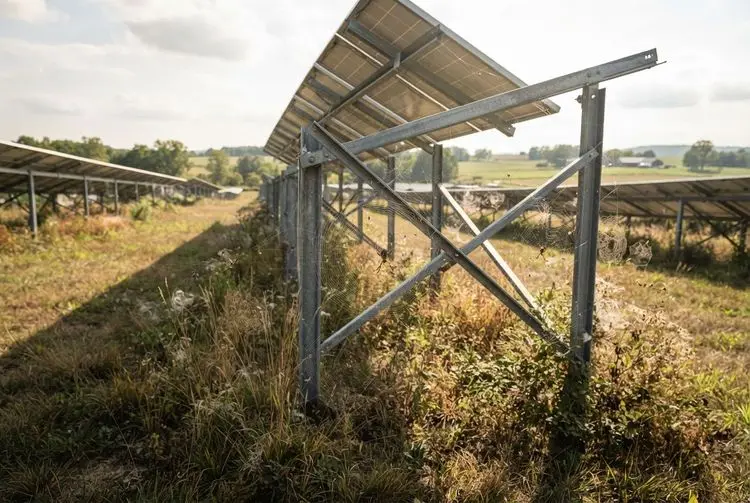
Pennsylvania's solar industry is advancing on two fronts that, while distinct, together illustrate the sector's expanding value proposition. Researchers at Susquehanna University are uncovering ecological benefits beneath solar arrays in Snyder County, while Tigo Energy has opened new grid-payment programs for home battery owners across Pennsylvania and several other PJM states.
Solar Arrays as Arthropod Nurseries
At a solar installation in Snyder County, a team from Susquehanna University has collected more than 1,000 spiders as part of a study examining how photovoltaic arrays function as wildlife habitats. Matt Persons, Charles B. Degenstein professor of biology at the university, leads the project alongside two undergraduate students: Andrew Pisano, an ecology major from Malvern, Pennsylvania, and Kaylee Rathbone, a biomedical sciences major from Mannington Township, New Jersey.
The researchers sample spiders uniformly during both day and night from plots measuring approximately 8 meters by 5 meters. "We're in each plot, which is about 8 meters by 5 meters, for about an hour and we sample as much as we can either by hand or using fine mesh sweep nets," Pisano explained. Specimens are placed into vials and sent to Persons' lab for official identification.
According to Persons, only about half of known spider species build webs, and the structure of solar arrays provides an ideal framework for web-building spiders. The research compares solar array habitats to traditional agricultural fields — which solar arrays often replace — as well as forests and goldenrod habitats, to understand ecological differences.
"Here we have an area of land that isn't sprayed and can act as a nursery for a lot of arthropods that can then disperse out to surrounding agricultural systems," Persons said. "Nobody's done research on this to test it, but it's likely that there are higher populations of pollinators and spiders in these systems."
Solar installations have increased in Pennsylvania over the past several years, according to the Public Utility Commission, including arrays placed on land once used for agriculture. Persons noted that the two uses are not mutually exclusive. "With thoughtful design and management, these sites can support a surprising diversity of microhabitats," he said, "creating a patchwork of conditions that can benefit a range of plant and animal species."
The project also serves as an opportunity to identify spider species in Pennsylvania, which has not been comprehensively surveyed since 1942. "There are over 4,000 species of spiders in the United States, but we don't really know how many there are in Pennsylvania," Persons said. "The last survey that was done in the state was in 1942, so we're hoping to add to the data currently held by the State Museum of Pennsylvania."
For Rathbone, the project represents her first research experience. "It really gives me an opportunity to explore what doing research here is like and use the scientific process to discover what does work and what doesn't work," she said. "We've had quite a few meetings already this summer to reevaluate our processes and it's been a valuable learning experience."
Tigo Expands Grid-Payment Access Across PJM States
On a separate track, Tigo Energy announced on Nov. 9, 2026, that eligible owners of its GO Battery can now access grid-payment programs in California, Texas, New York, and four PJM states: Maryland, Virginia, Pennsylvania, and Illinois. The additions include California's Demand Side Grid Support (DSGS) and Emergency Load Reduction Program (ELRP), plus the ERCOT market.
Tigo now works with four virtual power plant (VPP) aggregators. Integrations with EnergyHub, Leap, and Uplight are complete, while Virtual Peaker is still to come through integration partner Flip Energy. The announcement did not disclose enrolled capacity, customer count, or payment rates.
Payment rates vary widely across jurisdictions. Leap estimates $61 per kW-year in PJM for year-round capacity participation, with one-season commitments at $31. California set aside $19.5 million for 2026 storage VPP payments, though only aggregators active in October 2025 could join. The state's ELRP ended its $1-per-kWh residential payment after the 2025 season, according to the California Public Utilities Commission. Tigo's DSGS page does not name a provider or participation option.
In total, 12 US jurisdictions — 11 states plus Puerto Rico — appear on Tigo's program list. The GO Battery is a 5 kWh LFP home battery module, supporting up to six modules (30 kWh) with 2.5 kW of continuous power per module, running on Tigo's Energy Intelligence software in residential solar systems.
Leap's 2026 estimate for year-round PJM capacity participation is $61 per kW-year, with one-season commitments at $31. New York's DLRP and CSRP programs range from $16 to $81 per kW-year and require 100 kW aggregated. The DSGS season total is $62.10 per kW for a two-hour storage resource, before a 30% bonus in 2026. Texas has no published household rate; ERCOT sets Emergency Response Service pay through procurement, with customers contracting through Leap. Leap lists April 15 as the annual PJM enrollment deadline.
New York arrived as Tigo said it would in July, but New Jersey, named alongside it then, is not on the new list. Tigo first announced VPP qualification in January and reported third-quarter results on Nov. 4.
Isaac Gamez, a partner at installer G Power Inc., said "being able to sell storage that can actually recapture value over time is a great selling point."
Implications for Solar Professionals
For solar industry professionals, installers, investors, and engaged homeowners, these developments signal both opportunities and complexities. The ecological research at Susquehanna University may inform site design and management practices that enhance biodiversity, potentially strengthening community acceptance and permitting outcomes for new solar projects.
The VPP programs, meanwhile, offer new revenue streams for home battery owners, but require careful navigation of state-specific rules and aggregator partnerships. Payment rates vary significantly — from $16 per kW-year in some New York programs to $81 per kW-year in others, with PJM year-round participation estimated at $61 per kW-year.
As Pennsylvania continues to expand solar installations, the intersection of environmental stewardship and economic incentive will likely remain a key theme for the industry.