
Perovskite Labs and Export Controls Define Solar's 2026 Trajectory
New stability breakthroughs intersect with China's proposed export bans on next-generation solar manufacturing technologies.
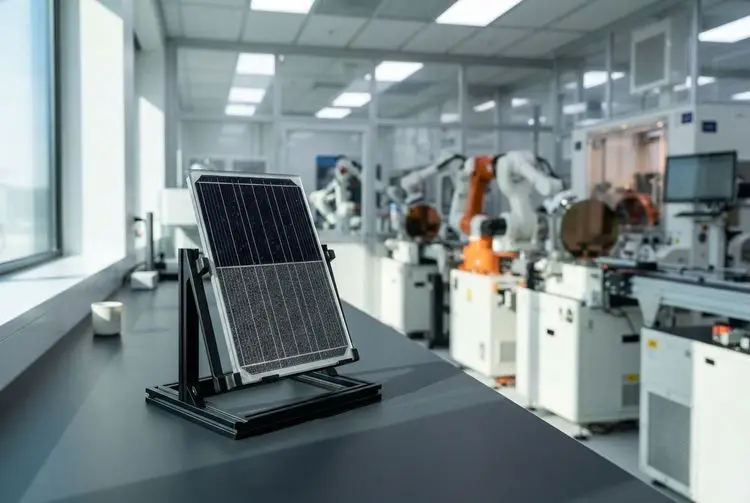
Two developments in October 2026 are reshaping the landscape for perovskite photovoltaics: a materials-science breakthrough that addresses a key stability challenge, and proposed Chinese export controls that would restrict access to the manufacturing technologies behind next-generation solar cells. Together, they highlight how quickly the technology many consider silicon's successor is moving from research labs into the realm of geopolitics and industrial strategy.
Researchers publishing in Nature Solar Energy have identified a new design principle for stabilising perovskite absorbers in bifacial tandem cells. Xu and colleagues describe lattice compliance — the ability of a crystal lattice to elastically accommodate stress — as a materials descriptor that governs photothermal stability. The work targets bifacial perovskite/silicon tandem solar cells, which offer high area-normalised power output. By using approximately 1.55 eV perovskite absorbers, the approach reduces reliance on bromide, largely mitigating light-induced halide segregation and shifting the dominant stability challenge to the intrinsic photothermal resilience of bromide-lean absorbers.
Across the compositions studied, higher lattice compliance promoted photothermal stability through a chain of effects: suppressing thermally induced microstrain accumulation, shifting deep-level defects toward shallower states, and reducing band-edge energetic disorder. Guided by this principle, bifacial monolithic perovskite/silicon tandems achieved a power-generation density of 36.2 mW cm−2 under 0.20 albedo-equivalent illumination. The cells retained 90 percent of their initial efficiency after more than 1,000 hours of ISOS-L-2 testing at one-sun illumination and 65 °C. The authors position lattice compliance as a physically testable framework for screening stable perovskites.
Commercial Tracks and Industry Targets
Industry analysis from IDTechEx segments the perovskite market into three technology tracks: double-glass single-junction perovskite, perovskite-silicon tandem, and flexible perovskite, across nine application areas. The most visible track is the perovskite-silicon tandem, which continues to break lab efficiency records and targets mainstream rooftop and ground-mounted markets as crystalline silicon approaches its practical limit.
Commercial success depends on four key engineering challenges: scaling from lab cells to large high-speed modules without performance loss; achieving yield and cost competitiveness with silicon; developing supply chains from substrates to transparent conductive films; and addressing sustainability issues including recycling and lead content. Oxford PV's Brandenburg factory is cited as the site where perovskite went commercial, while HZB achieved 30.3 percent efficiency in a tandem cell trial.
Single-junction and flexible perovskites are opening markets that silicon cannot reach. Lightweight cells on plastic films or glass with adjustable transparency could enable commercial roofing on warehouses and factories that cannot bear silicon panel weight, agri-PV with tunable light transmission, vehicle-integrated PV, roadside noise barriers, indoor IoT cells replacing disposable batteries, and space and aerospace applications.
Meanwhile, LONGi continues to push crystalline silicon toward its theoretical ceiling. The company set a 28.29 percent efficiency record with a hybrid interdigitated back contact (HIBC) design, verified by Germany's ISFH in Hamelin — its third record this year, following 28.04 and 28.13 percent, with a gain of 0.16 percentage points larger than the previous 0.09 increment. LONGi says the cell reached 96.2 percent of crystalline silicon's theoretical limit, implying a ceiling of around 29.4 percent. Modules rated above 700 W were shown in mass production. The company also developed a silicon-perovskite tandem with 35.5 percent efficiency earlier this year, an improvement of almost two percentage points in three years. Fraunhofer ISE's CalLab measured LONGi's 26.2 percent silicon module record in 2025 and confirmed a 47.6 percent quadruple-junction cell as the world's most efficient.
Professor Martin Green of UNSW, now Chief Scientific Officer at Euronergy, is focused on glass-free, lightweight, exceptionally thin and easy-to-install modules. Germany's Pero-Si-SCALE project aims to get perovskite tandems wafer-ready.
China Proposes Export Controls on Perovskite and Tandem Manufacturing
On October 16, 2026, China's Ministry of Commerce (Mofcom) and Ministry of Science and Technology proposed prohibiting exports of selected high-efficiency perovskite and tandem solar manufacturing technologies under Joint Announcement No. 48 of 2026. The proposals would add 12 photovoltaic technologies to China's Catalogue of Technologies Prohibited or Restricted from Export, part of a broader consultation covering 40 technologies across solar energy, artificial intelligence, and biomedicine. Public consultation runs until November 15.
The proposed bans cover production processes and related equipment manufacturing technologies for perovskite-silicon tandem solar cells based on wafers measuring at least 182 mm with conversion efficiencies of 30 percent or higher. They also include slot-die coating processes for perovskites with coating widths of at least 1.1 meters. Additional thresholds apply to large-area modules: single-junction perovskite modules of at least one square meter with efficiencies of 18 percent or higher, and perovskite tandem modules of the same minimum area with efficiencies of at least 28 percent. The controls target manufacturing technologies meeting these specifications rather than exports of finished modules.
Other prohibited technologies include cold-hydrogenation fluidized-bed processes for trichlorosilane production with annual single-line capacities of at least 250,000 metric tons, and silane-based fluidized-bed processes with annual capacities of at least 20,000 metric tons. The draft also covers processes for manufacturing silicon wafers no thicker than 70 micrometers and certain edge-passivation technologies for thin crystalline-silicon cells, plus related equipment manufacturing know-how.
The restricted-export category includes polysilicon plant engineering technologies for production lines with annual capacities of at least 30,000 metric tons, as well as advanced crystal-pulling and wafer-cutting processes. It also covers high-performance manufacturing processes for TOPCon, back-contact (BC), and HJT solar cells, including deposition, passivation, diffusion, and metallization technologies. HJT provisions include certain p-type technologies evaluated under air mass zero (AM0) illumination conditions relevant to space applications.
Under China's technology import and export regulations, prohibited technologies cannot be exported, while restricted technologies can be transferred overseas only with government approval and necessary licenses. A separate interim registration requirement took effect on October 16, requiring companies to register planned exports of listed technologies through Mofcom's online system before transfer. This covers IP transfers, overseas technology licensing, changes in ownership or control involving foreign entities, and transactions underway but not yet completed.
Mofcom said the proposals address national security concerns as PV technologies increasingly find applications in aerospace, defence, and other sensitive sectors. Technologies below the specified thresholds and finished products manufactured using controlled technologies are outside the proposed scope. The ministry said the measures do not target any particular country, region, or company.
Strategic Implications
If adopted, the controls could reinforce China's position in advanced PV manufacturing by limiting overseas access to sophisticated production technologies. Though exports of finished solar cells and modules would not be directly affected, transfers of controlled manufacturing know-how through licensing, overseas production-line installation and commissioning, equipment exports, and on-site technical support could be prohibited or subject to approval.
Near-term effects could include delays to overseas PV manufacturing projects, increased compliance costs, and limited deployment of advanced Chinese production technologies abroad. Longer-term, the restrictions could strengthen China's influence over international diffusion of next-generation PV manufacturing technologies, potentially slowing overseas manufacturers' efforts to close the technological gap. Tighter controls could also complicate Chinese manufacturers' international expansion plans and heighten trade tensions or prompt retaliatory measures.
Reuters reported in April that Chinese officials held initial talks with manufacturers about potential curbs on advanced solar-panel manufacturing technologies, a move that could threaten plans by US firms such as Tesla to expand production in the US. Beijing has also curbed exports of solar-manufacturing technology to India, with analysts saying China seeks to preserve its dominance as India builds domestic manufacturing.
The two storylines intersect at a single question: who will manufacture the next generation of solar, and where. The Nature Solar Energy work suggests the technical barriers to stable, high-performance perovskite tandems are being systematically addressed through testable materials design principles. The Chinese proposal suggests that access to the manufacturing know-how for those same technologies is becoming a matter of state strategy. For investors, developers, and manufacturers, the coming months — particularly the close of China's consultation on November 15 — will clarify how quickly the lab's progress translates into globally distributed production capacity, and on what terms.