
SPONSORED

ReNew Posts 37% Profit Jump as Commissioned Capacity Hits 13.7 GW

Indian developer's second-quarter net profit reaches INR 6.42 billion ($67 million) on 628 MW of new capacity and stronger module sales.
•• 4 Min
ReNew Posts 37% Profit Jump as Commissioned Capacity Hits 13.7 GW

ReNew Energy Global reported net profit of INR 6.42 billion ($67 million) for the second quarter, up 37% from INR 4.68 billion a year earlier, as commissioned capacity reached about 13.7 GW, an increase of 19.5% year on year.

Total income rose to INR 49.62 billion ($518 million) from INR 38.56 billion in the prior-year period. Adjusted EBITDA (earnings before interest, taxes, depreciation and amortization, adjusted for exceptional items) climbed to INR 33.59 billion ($350 million) from INR 26.24 billion. The Nasdaq-listed developer attributed the gains to a larger operating fleet, higher load factors and growing module and cell sales. The results were announced on Nov. 2.

Solar Dominates Quarterly Commissioning

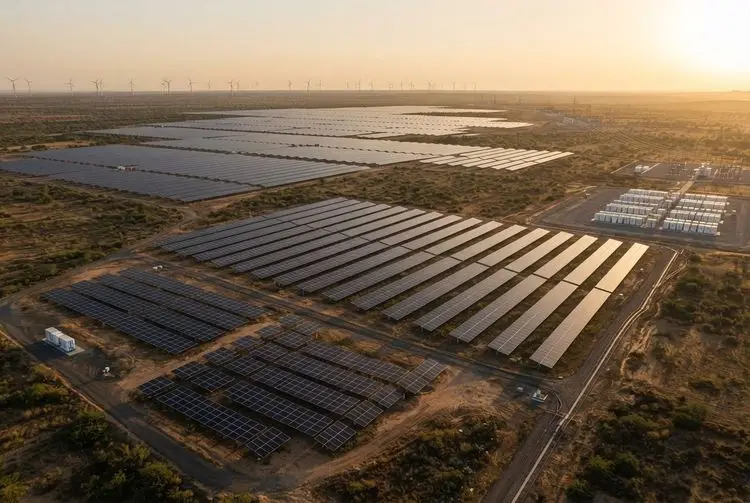
ReNew commissioned 628 MW in the quarter, split between 516 MW of solar and 112 MW of wind. The operating fleet now comprises about 7.8 GW of solar, 5.7 GW of wind and 99 MW of hydro, giving the company a generation mix that is still weighted toward photovoltaics (PV) but supported by a sizeable wind book.

Solar sales reached 3,327 million kWh, up 28.4% year on year, at a plant load factor (PLF) of 19.8%. PLF expresses actual generation as a share of what a plant would produce running at full capacity around the clock; for solar assets in India, values close to 20% indicate strong irradiation and good plant availability. For installers and asset owners, that figure is a useful benchmark when comparing portfolio performance across regions and module technologies.

Manufacturing Adds Cell Capacity

Module and cell sales income came to INR 12.46 billion ($130 million), up 23% year on year. ReNew currently runs 6.4 GW of module manufacturing capacity and 2.5 GW of cell capacity, with a further 4 GW of cells scheduled to come online by March 2027, the final quarter of the current financial year.

In the first half, external module and cell sales generated INR 29.24 billion of revenue and INR 9.73 billion of EBITDA, a margin of 33%. That disclosure gives investors a clearer read on how the manufacturing arm contributes alongside the power generation business, and it sets a reference point for the cell expansion now under construction. Cell capacity is the more technically demanding and capital-intensive part of the value chain, so the timing of those 4 GW will be closely watched.

Guidance Reaffirmed for FY27

ReNew left its guidance for the year to March 31, 2027 unchanged: 1.6–2.4 GW of construction, Adjusted EBITDA of INR 105–109 billion and cash flow to equity of INR 18–22 billion. First-half Adjusted EBITDA of INR 63.98 billion represents 60% of the midpoint of the full-year range, leaving the company needing a comparatively smaller second half to land inside its forecast.

The guidance also includes INR 12–14 billion of EBITDA from external module and cell sales and INR 1–2 billion of gains from asset sales. The total portfolio stands at 20.5 GW, including 1.7 GW / 6.2 GWh of battery energy storage (BESS), a duration of roughly 3.6 hours. Storage of that length is increasingly relevant for shifting daytime solar output into evening peak hours, a pattern that matters for developers selling power under contracts rather than at spot prices.

Asset Sales and a Take-Private Scheme

ReNew frames asset disposals as capital recycling. It has sold 100 MW of assets over the past year and agreed to sell 3E, an asset performance software firm, to Hg, with about INR 8 billion in cash expected from the transaction.

Separately, CPP Investments and founder Sumant Sinha have moved to buy the shares they do not already own at $7.02 per share. The transaction is structured as a UK scheme of arrangement, subject to regulatory approvals, and is expected to take effect in the first quarter of 2027.

For context on the market ReNew operates in, India's installed solar capacity reached 162.15 GW as of June 30, 2026, according to figures the renewable energy ministry reported to parliament. Against that base, the company's roughly 7.8 GW solar fleet represents a modest but meaningful share. The items to watch over the coming quarters are the pace of construction against the 1.6–2.4 GW guidance, the commissioning of the additional cell lines by March 2027, and the approvals needed to complete the buyout scheme.

Renew Energy GlobalSolar Capacity IndiaModule And Cell ManufacturingBattery Storage BessFy27 GuidanceNasdaq Solar DeveloperAdjusted EbitdaIndia Solar Installations

Most Popular News

  1. India adds 11.2 GW rooftop solar in nine months, up 127.5%
  2. PVT collector with graphite-paraffin storage achieves 48.7% efficiency
  3. Flexell Space and ALATYR partner on solar for orbital data centers
  4. Konya province now hosts 10% of Türkiye's total solar capacity
  5. Tungsten wire scrap value rises as PV production cuts reshape supply chains

Disclaimer


Important notice regarding existing conflicts of interest:

We expressly point out that conflicts of interest exist in connection with this publication:

1. Stock Market Media Ltd. and persons closely associated with it hold shares in the companies recommended here and intend to sell them within the scope of, and at any time during, this recommendation. This constitutes a clear and specific conflict of interest.

2. The publisher of this publication and the responsible editors receive financial remuneration for its preparation. This, too, constitutes a clear and specific conflict of interest.

3. Please also note the further statements on existing conflicts of interest in the disclaimer below, inter alia under no. 2.

Important information and mandatory disclosures pursuant to the German Securities Trading Act (Wertpapierhandelsgesetz, WpHG) and pursuant to the German Financial Investment Ordinance (Finanzanlageverordnung, FinAnV).

Stock Market Media Ltd. has notified the German Federal Financial Supervisory Authority (Bundesanstalt für Finanzdienstleistungsaufsicht, “BaFin”), pursuant to the WpHG, of its activity as a producer of investment strategy recommendations within the meaning of Article 3(1) point 34 of Regulation (EU) No 596/2014 or of investment recommendations within the meaning of Article 3(1) point 35 of Regulation (EU) No 596/2014 (formerly “financial analyses”). The obligations of Stock Market Media Ltd. are governed primarily by §§ 85, 86 WpHG, Regulation (EU) No 596/2014 and Delegated Regulation (EU) 2016/958.

Information on the producer(s) of this publication:
Mr Roberto Gonçalves de Albuquerque, as analyst and editor-in-chief, is responsible for the preparation of the texts and contents of this publication. The publisher is Stock Market Media Ltd., 405 Kings Road, Flat 600, London; SW10 0BB, United Kingdom, represented by its Director Roberto Gonçalves de Albuquerque.

Important notes on the preparation of this publication:
This publication contains both facts and factual information on the companies discussed and purely subjective value judgements, interpretations, estimates, projections, forecasts and price targets. We endeavour to distinguish these from one another as transparently as possible in order to avoid misleading statements. Research, preparation and wording are carried out using common digital and AI-supported tools; the review of the content and the editorial responsibility lie with us. The essential bases and standards of our value judgements and valuations of the shares discussed are based on the following approach:

Assessment and valuation of companies according to conventional valuation methods (fundamental valuation approach)

  • Assessment of the potential of the company's future development (growth approach) and projection onto the corresponding valuation potential (price potential analysis) as well as a possible valuation of the company's shares on the basis of potential profit expectations (P/E ratio projection)
  • Assessment of the best-case scenario expected by us in the event of the company's absolute success (blue-sky potential approach)
  • Effect on the share price of the increased awareness of the recommended share expected by us, resulting from a strong rise in demand on the market (particularly decisive in the case of illiquid shares or shares recommended newly or for the first time) on account of the publications (mostly buy recommendations) published by us or by third parties (multiplier / momentum effect, hype), and thereby a disproportionately rising return/share price with a correspondingly rising risk
  • Technical analysis of the share price in accordance with common methods of analysis, mostly for the prediction of price signals (buy or sell signal, breakout of the share, determination of price targets, support or resistance areas, expected minimum movements or minimum counter-movements, prediction of signal points (if-then), etc.), for the most part building on the expected mass psychology (technical approach).

Conventional valuation approaches often cannot be meaningfully applied to young companies or companies that do not yet generate revenue. In valuing such companies we therefore tend to rely on the potential analysis calculated by us and on the assessment of the demand for such shares on the capital market. Ultimately, the market decides on the share price of a company. If extensive recommendations of a share give rise to excessive demand for it, it is possible that the share price will rise at an above-average rate on high trading volume. Although this leads to extreme opportunities for profit, it correspondingly increases the risk of a bubble forming, with a corresponding fall in price. The increased volatility of the share in such situations gives rise to above-average opportunities for profit and loss, both in both trading directions and in the case of recurring counter-movements. Such market developments are also an important part of our trading recommendations and valuation approaches.

This publication deals exclusively with securities of above-average volatility with high potential for profit and also for loss.

Note on sources of information:
The reliability of sources of information is examined by us in detail before they are used and is subjectively assessed by us according to their credibility and significance. In doing so, we decide by our own standards which sources we consider relevant, too conservative or too optimistic. Ultimately, we determine our recommendations on the basis of our personal assessments. In obtaining information we draw on numerous publicly accessible sources such as press releases, ad hoc announcements, company announcements, company presentations, publications and articles on the company discussed, common financial media in Germany and abroad as well as company or sector analyses by third parties.

Our publications use exclusively publicly available information and sources as well as information disseminated by the company itself.

Note on existing conflicts of interest:
We hereby point out that shareholders, editors, employees and persons or companies involved in the preparation of this publication, as well as principals (third parties) commissioning the publication of Stock Market Media Ltd., hold, directly or indirectly, at the time of this publication, interests in securities which are discussed in the respective publication, and are therefore interested in an increase in price and/or turnover, i.e. also in increased trading liquidity, since it is intended to sell these securities in direct connection with this publication and to participate in rising prices and turnover. An increase in the price of the shares of the companies presented may lead to an increase in the assets of these persons. In any case, the share price of the company may be significantly influenced by the discussion of the company. In particular, the share price of the companies discussed is also materially influenced by securities transactions. This applies in particular where the companies concerned are ones whose shares do not have a broad market capitalisation and for which only a narrow market exists. Here, even small order volumes can have considerable effects on prices. However, they are also interested in the price of the company discussed falling if they wish to acquire its shares more cheaply. By law, this gives rise to a conflict of interest, to which we hereby expressly draw attention.

Stock Market Media Ltd. and its employees are furthermore remunerated for the preparation, electronic distribution and publication of this publication as well as for other services. By law, this gives rise to a conflict of interest, to which we hereby expressly draw attention.

This remuneration may be paid by the company about which Stock Market Media Ltd. publishes information, by third parties affiliated with these companies or by other third parties pursuing an interest with regard to the companies discussed in connection with this publication. By law, this gives rise to a conflict of interest, to which we hereby expressly draw attention. This arises, first of all, from the fact that Stock Market Media Ltd. could make its statements in the interest of its principal. Stock Market Media Ltd. and/or companies affiliated with it have entered into an agreement, for a fee, with the company in question or with its shareholders for the preparation of the editorial coverage. By law, this gives rise to a conflict of interest, to which we hereby expressly draw attention.

Note on the handling of internal organisational duties:
Owing to the small size of the publisher's business, internal control of the compliance processes of the employees and other parties contributing to this publication is limited.

Competent supervisory authority:
Stock Market Media Ltd. has notified BaFin of its activity pursuant to § 86 WpHG.