
Waaree Doubles Texas Module Output as Storage and Policy Surge
Waaree Solar Americas added two 800 MW lines in Brookshire, Texas, lifting module capacity to 3.2 GW as global storage and policy moves accelerated.
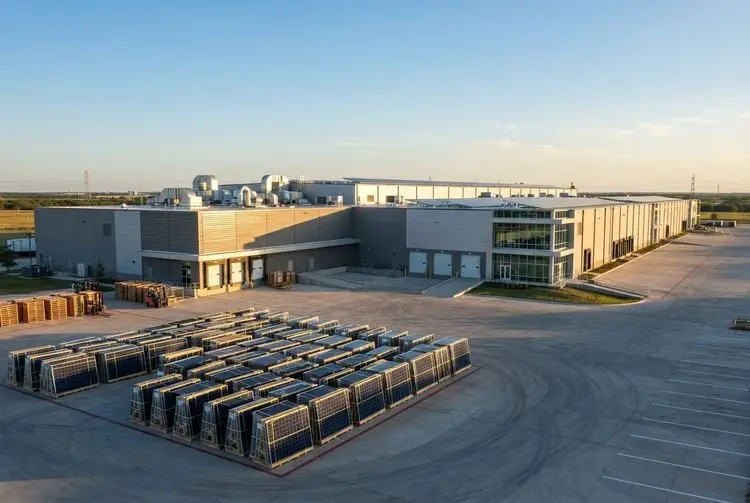
Waaree Solar Americas, the U.S. subsidiary of India's Waaree Energies, started commercial production on two new 800 MW lines at its Brookshire, Texas plant on October 29, 2026, doubling module capacity at the site to 3.2 GW. The board approved the expansion in April 2025, and the company positions it under a "Make in USA for USA" strategy.
More capacity is planned. Waaree intends to upgrade its Arizona plant from 1 GW to 1.6 GW, targeting 4.8 GW of U.S. module capacity in FY27. U.S. manufacturing revenue reached $154.8 million in Q2 FY27, up from $87.1 million a year earlier, and domestic supply contracts now account for 43.8% of a $7.05 billion order book. The global module backlog exceeds 25 GW.
"Shifting trade policy has strengthened the case for local manufacturing, and that is exactly where we have invested," said Sunil Rathi, Director at Waaree Group. In India, the company plans to expand solar cell capacity from 5.4 GW to 15.4 GW in FY27 and targets a 10 GW ingot and wafer facility by FY28.
U.S. manufacturing base widens
SEIA data cited in the roundup puts operational U.S. module capacity at 75.3 GWdc and battery cell capacity at 62.4 GWh, supported by $41.9 billion in announced investments and potential for 74,626 jobs.
Storage commissioning in India, first IPP solar in Benin
ACME Solar commissioned 88.02 MW / 366.969 MWh of battery storage at its Neemri FDRE project in Rajasthan on October 30, taking commissioned storage at the site to 159.66 MW / 664.261 MWh — about 62% of the planned 250 MW / 1,069 MWh. The remaining capacity is expected online by March 31, 2027. ACME reported roughly 5.2 GWh of commissioned battery capacity in its quarterly results, calling it the second-largest in India, and added 35.77 MW / 143.08 MWh at its Kelan project alongside a 300-MW peak power contract with SECI. The Ministry of Power estimates India will need 236 GWh of battery storage by 2031-32.
In Benin, Proparco and IFC will lend about €14 million each for four solar plants totalling 62 MWp. Owned by AXIAN Energy Green (80%) and Sika Capital (20%), the plants will sell power to state utility SBPE under 20-year power purchase agreements (PPAs), with Sagemcom building them over an estimated 12 months. The portfolio is Benin's first independent power producer (IPP) solar project and equals about 10% of the country's installed generating capacity, with expected avoidance of about 62,000 tonnes of CO2 equivalent annually and improved power access for nearly 50,000 households.
Policy: ISA facility, Peru standards, EU balance-of-system costs
The International Solar Alliance launched a $500 million Africa Solar Facility to mobilise private investment in decentralised solar, including rooftop systems, mini-grids and agricultural applications, in partnership with the World Bank, Nigeria Sovereign Investment Authority and Africa 50. It has already led to a $300 million Nigeria Distributed Renewable Energy facility. The ISA also announced a global capability center named SHINE covering grid digitisation, energy planning and an AI-enabled learning platform, and is finalising a five-year strategy targeting 6 terawatts of global solar deployment by 2030, up from around 3 terawatts currently. Among small island nations, the first 220 MW solar and storage tender in Mauritius was awarded to the private sector with nearly half a billion dollars in investment.
Peru's Ministry of Energy and Mines published a draft regulation to modernise technical specifications for photovoltaic (PV) systems in rural electrification, open for comment for 30 days. It updates component standards, extends applications to health centres, schools and water systems, and establishes a minimum ten-year warranty against manufacturing defects.
A SolarPower Europe report, "Solar Balance of System Explained," finds that balance-of-system (BOS) components now account for 33% of EU utility-scale project costs, compared with 31% for modules. Europe's inverter manufacturing base reached 96.4 GW of capacity in 2025 against domestic demand of 56 GW, yet 78% of inverters installed in Europe in 2023 came from Chinese vendors. The association calls for a Union-origin requirement under the Industrial Accelerator Act from 2028, harmonised inverter standards and stronger cybersecurity legislation, noting that control over inverters could allow outsiders to disconnect generating capacity or manipulate grid settings. Only six member states are implementing NZIA solar rules.
VPP pilot, digital twin, rooftop array for cars
DTE Energy and sonnen launched Michigan's first virtual power plant (VPP) pilot, pooling residential batteries in nearly 100 homes at the Veridian at County Farm all-electric community. The two-year project, approved by the Michigan Public Service Commission, responds to grid demands in real time; the 14-acre site holds 170 mixed-income homes with rooftop solar, sonnen batteries, Bosch geothermal heat pumps and EV chargers. "The Veridian VPP pilot will be a true demonstration of the decentralized, digitalized and decarbonized energy system of the future," said sonnen CEO Blake Richetta. DTE CEO Joi Harris cited affordability pressures on Michigan families as motivation.
In Denmark, the EU-funded BIPED project built a prototype local digital twin platform for Positive Energy District planning in Aarhus, including a solar planner that shows the solar potential of all buildings and provides personalised reports on energy yield, return on investment, savings and CO2 reduction. It analyses household occupancy patterns aggregated at a 250m x 250m grid to comply with GDPR and includes a traffic model to assess mobility impacts. It will exhibit at Enlit Europe 2026 in Vienna.
DartSolar, a Los Angeles startup, will begin delivering its expandable roof-rack solar array to pre-order customers in December 2026. Two 500-W modules give a sedan 1,000 W, while pickups take 1,500-2,000 W; the company says the system adds 10-20 miles (16-32 km) of EV range per day but pitches it mainly for portable power stations. Prices start at $1,350, with shipping included in the contiguous U.S.
Opposition in Somerset, Jinko margins, India pipeline
Residents of Mark, Somerset, voiced strong opposition to Low Carbon's proposed Somerset Energy Park, which would have a generating capacity of more than 100 MW and connect to the National Grid, providing electricity for over 140,000 homes. Locals argue the project is too large and that road infrastructure is inadequate. "I'm horrified because they're totally going to encase the village and ruin all the countryside around," said resident Jan Horn. Low Carbon development director Ed Perrin said the project is at an early stage and that the developer wants local input ahead of a public consultation next spring, while renewable energy expert Rhiannon de Wreede acknowledged the need for solar but understood residents' fears. Because of the scale, the secretary of state will make the final decision.
Jinko Holdings shipped 15,003 MW of solar modules in Q3 2026, down 25% year on year, while lifting gross margin to 12.3% from 4.2%. The net loss narrowed to $25.4 million on premium product mix and storage revenue, with guidance of 16-18 GW of module shipments in Q4 and about 10 GWh of storage shipments for 2026.
In India, Odisha holds an estimated 12.8 GW of floating solar potential by using just 20% of its reservoir area, according to MNRE Secretary Santosh Sarangi, and the state is also attracting clean-tech manufacturing investment. The country's renewable energy sector drew $67 billion of investment over the past two years, including $6.2 billion in foreign direct investment, according to Union Minister Pralhad Joshi, while rooftop installations under PM Surya Ghar reached 65 lakh households in two years. The government plans to launch Phase 2 of the scheme by March 2027 and is in talks with insurers to create tailored products.