
Solar and cookstoves transform off-grid school in Kenya's Tsavo
A solar-powered borehole and clean cookstoves bring water, food and a new teacher to Oloibor Soit school.
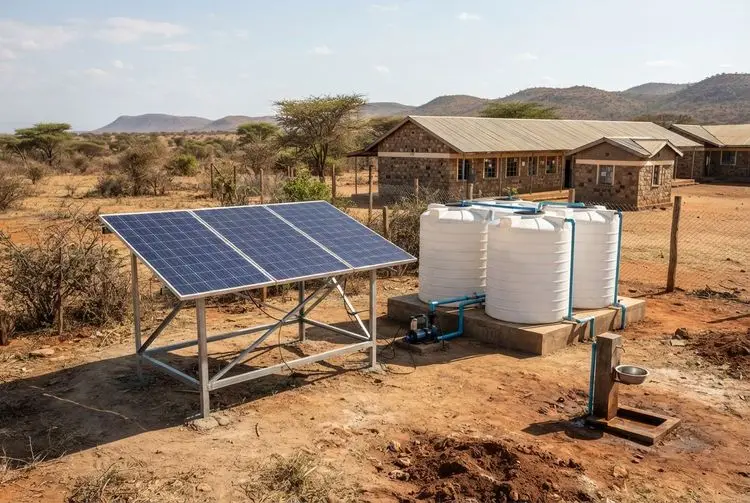
A remote school in Kenya's Kajiado County has undergone a remarkable transformation thanks to solar-powered water infrastructure and climate-smart cookstoves, delivering benefits that range from better hygiene to an additional teacher.
Oloibor Soit Comprehensive School serves approximately 600 learners in an off-grid area roughly one kilometre from Tsavo West National Park. Despite being only two kilometres from the nearest electricity line, the school had no grid connection. The African Wildlife Foundation (AWF) stepped in with a package of interventions that included borehole rehabilitation, solar system upgrades and clean cooking technology.
Water from the sun
The school's borehole had served the community since 2002 but broke down in 2022, leaving staff and students with severe water shortages. Water was rationed for drinking only. Toilets were cleaned just once a week, handwashing was often skipped, and trees on the school grounds struggled to survive.
In 2026, AWF rehabilitated the borehole with a new pump and three solar panels. The system was upgraded further later that year. Before the intervention, the school managed only about 200 litres of water per day. Today, the solar-powered system fills three tanks with a combined capacity of 30,000 litres in approximately two days, and water flows even during the dry season.
Daniel Kilasi, Deputy Head Teacher at Oloibor Soit Comprehensive School, said: "Before the rehabilitation and solarisation of our borehole, we were getting only about 200 litres of water a day. Today, the upgraded system can fill our three tanks, with a combined capacity of 30,000 litres, within approximately two days, and the water even flows in the dry season. We are very happy with this improvement because it means we can maintain better hygiene and sanitation, provide a cleaner learning environment."
The benefits extend beyond the school grounds. Approximately 16 households now collect water from the source, and a pipeline serves Njukini Health Centre, which previously relied on jerrycans to meet its water needs.
Siyaiyia Koitumet, Community Health Promoter at Njukini Health Centre, said: "Before the borehole was rehabilitated and water piped to the health centre, we had to fetch water in jerrycans to meet the facility's needs. Now that water is readily available, we can better meet our patients' needs and provide care in a more dignified environment."
Cleaner cooking, better learning
Alongside the water improvements, AWF provided climate-smart cookstoves through a project funded by the Embassy of Sweden in Kenya, implemented in partnership with Indigenous Livelihood Enhancement Partners (ILEPA). The new stoves have changed daily life at the school.
Children previously had to bring firewood and a jerrycan of water to school every day. Now they bring firewood only once a week. One cook now does work that previously required two people. The savings from reduced firewood consumption and improved efficiency helped the school employ an additional teacher in September 2026.
Sarah Nayianoi, School Chef at Oloibor Soit Comprehensive School, said: "Now the new stoves produce less smoke, use less firewood, and cook food much faster. This means learners get their meals on time and cooking is much easier for me."
Scaling the model
The Oloibor Soit project is part of a broader AWF programme. The foundation provided cookstoves to 26 schools across Kajiado and Taita Taveta counties, and installed solar systems at eight off-grid schools across three counties, including Narok. The solar-powered lighting at boarding schools also helps deter wildlife at night, a practical benefit in areas adjacent to national parks.
The school now has Wi-Fi, projectors and access to online learning materials, along with on-site printing capacity. Plans include a tree nursery and an expanded kitchen garden.
Broader context for off-grid solar
The article was published during COP31, the global climate conference. At COP28, nations pledged to triple renewable energy capacity by 2030. For off-grid areas in dryland Africa, decentralised solar systems represent the fastest route to energy access, as the Oloibor Soit case demonstrates.
The original solar panels at the school were installed in 2016. The 2026 upgrades show how incremental investment in solar infrastructure can unlock compounding benefits: water security, food security, better health outcomes and improved education. For solar industry professionals, the project illustrates the growing market for distributed solar in institutional settings across sub-Saharan Africa, where schools, health centres and community facilities remain largely unserved by grid electricity.