
Solar and storage power America's largest steel mill expansion
U.S. Steel's $3.5B Big River Steel 2 will be powered by 2.46 GW of solar and 2.94 GWh of storage.
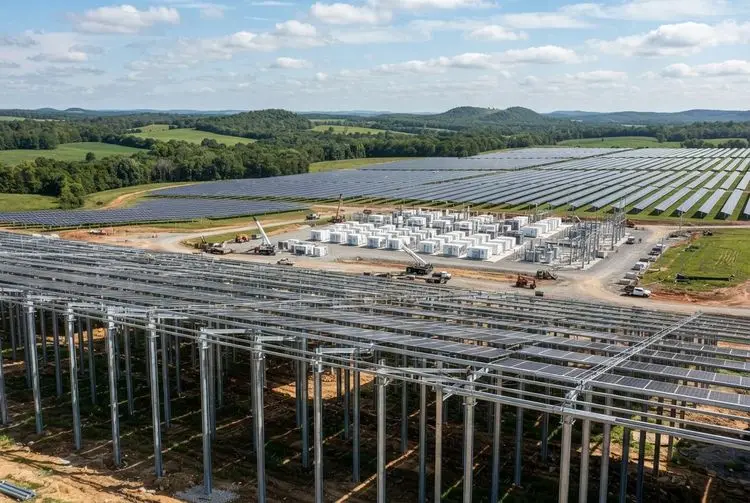
U.S. Steel is building the second phase of its Big River Steel mill in Osceola, Arkansas, backed by what developers say is the largest solar-plus-storage project in the United States. The Steel River Energy Center, developed by Cypress Creek Energy, will deliver 2.46 GW of solar capacity paired with 2.94 GWh of battery storage to power the facility.
The Big River Steel 2 investment totals close to $3.5 billion, the largest single capital commitment in U.S. Steel's 125-year history. The mill, which already produces over 3 million tons of steel annually, supplies the automotive, construction and renewable-energy industries. The expansion sits one mile from the existing plant.
A project built on domestic steel
The Steel River Energy Center broke ground in July 2026 and is scheduled for full commercial operation by 2029. Cypress Creek Energy will develop, own and operate the facility. The project represents $4.5 billion in private investment and is expected to generate 1,400 construction jobs during its first two phases alone.
Every structural component of the solar installation uses domestically sourced materials. First Solar's U.S. factories are supplying all solar panels. Nextpower is providing trackers built with domestically produced steel. LG Energy Solution Vertech is supplying the battery storage systems.
The project sits on approximately 400,000 steel piles, fabricated by PACO Steel in nearby Blytheville, Arkansas, using coils from the Big River Steel mill itself. Each pile is stamped "Proudly made in Mississippi County." In total, the installation will use over 3 million solar panels.
Dan Brown, U.S. Steel executive vice president of advanced technology steelmaking and CEO of Big River Steel, described the site selection process. "We went to 48 states and narrowed the site selection down to 20, 10, five, and then three," Brown said. The company considered proximity to customers, transport links, workforce availability and electricity supply.
Economics driving the transition
Kevin Smith, CEO of Cypress Creek Energy, said the project marks a turning point for the industry. "Ten years ago, solar was still pretty niche, and battery storage was hardly on the radar," Smith said. "Steel River is proof that solar and storage have crossed a threshold. This is not niche energy dependent on incentives. This is the foundation of American industrial competitiveness, because we can beat alternatives on price and speed, both of which are critical to businesses that depend on affordable and reliable energy."
The project is being built in 100-to-500 MW blocks, with Google signing a power purchase agreement for the first two phases. Entergy Arkansas connects the facility to the transmission grid.
Smith emphasized that the model is widely applicable. "This is very replicable. Not every location can have gigawatts of solar, but it can be built in 100-to-500-megawatt blocks across Arkansas, the Midwest, the Southeast, the West, everywhere." He added: "This should be a standard story going forward."
Local and national impact
The project is expected to generate $300 million in local tax revenue over its lifetime. Brown noted visible changes in the community. "You can already see the difference. People are spending money at the stores. There are more restaurants and more people in town."
The development reflects a broader shift in the energy landscape. Five years ago, utility-scale solar installations in the U.S. relied heavily on cheap Chinese steel. Today, the Steel River Energy Center demonstrates a fully domestic supply chain, from steel coils produced in Arkansas to solar panels manufactured by First Solar in the United States.
Smith said the decision-making is purely financial. "They are making decisions based on economics, and the economics of solar and storage are unambiguous. It's not about ideology. It's arithmetic."
For solar industry professionals, the project offers a template for pairing heavy industrial load with large-scale renewable generation. The 2.46 GW solar and 2.94 GWh storage configuration is designed to match the mill's energy demand profile, and the block-by-block construction approach allows phased deployment as load grows. More utilities and corporate users are focusing on the financial benefits of renewables, and the Steel River model shows that renewable manufacturing and deployment are advancing even in states traditionally associated with fossil-fuel industries.