
Solar BOS Overtakes Modules in EU Utility-Scale Cost Stack
Balance-of-system hardware accounted for 33% of EU utility-scale installation costs in 2025, above modules at 31%.
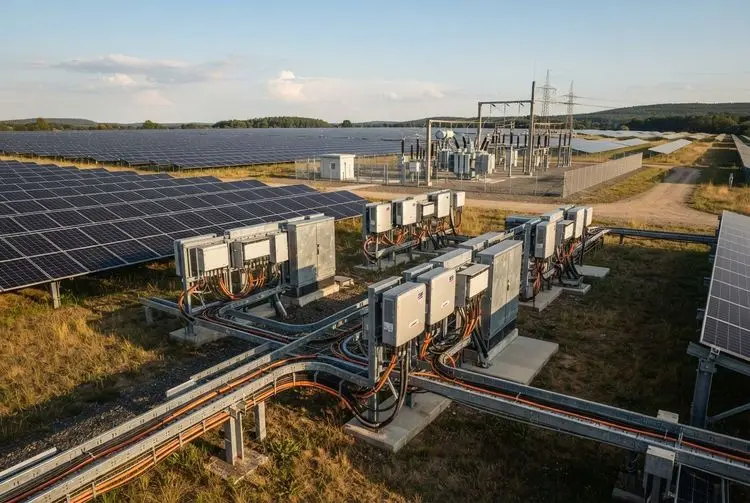
Balance-of-system (BOS) hardware made up 33% of utility-scale solar installation costs in the European Union in 2025, overtaking modules at 31%, according to a new SolarPower Europe report. In absolute terms, BOS costs stood at €241 per kilowatt. The finding reframes a debate that has focused almost entirely on module manufacturing, where European production has largely collapsed under Chinese price pressure.
BOS covers everything in a solar plant apart from the modules themselves: inverters, mounting structures, cabling, transformers, substations, monitoring and energy management software. The report, titled "Solar Balance of System Explained: The hidden components enhancing solar generation," draws on the expertise of SolarPower Europe members and was launched during a webinar hosted by the association. Its stated aim is to put BOS at the centre of the EU industrial policy discussion.
Inverter Capacity Exceeds Domestic Demand
The numbers on inverters illustrate both the sector's strength and its exposure. EU inverter manufacturing capacity reached 96.4 GW in 2025, against demand of 56 GW — a surplus that underlines Europe's position as the holder of the second-largest share of global inverter production capacity. Yet in 2023, 78% of the inverters installed in Europe came from Chinese vendors, a gap between available capacity and actual procurement that the report's authors clearly regard as a policy problem as much as a market outcome.
Walburga Hemetsberger, CEO of SolarPower Europe, framed the sector as an overlooked asset. "Despite the difficulties along the module value chain, Europe retains substantial expertise and manufacturing capabilities in solar BOS technologies," she said. "These strengths deserve recognition and conditions that support their continued development."
The report arrives as the sector enters a phase shaped by storage integration, digitalisation, electrification and flexibility needs. Those trends raise the value of BOS relative to the module, because inverters and control software increasingly determine how a plant behaves on the grid rather than simply how much power it produces.
Seven Recommendations and a 2028 Horizon
SolarPower Europe sets out seven policy recommendations, grouped around inverters, mounting systems, and electrical and digital infrastructure. Among them:
- A Union-origin requirement for inverters under Phase I of the Industrial Accelerator Act, potentially applicable from 2028, the year the act enters into force. - EU-wide harmonised inverter standards and a roadmap for grid-forming services. - Adding fixed mounting structures and trackers to the Net-Zero Industry Act (NZIA) component list. - Dedicated customs codes for mounting structures and trackers.
The customs point is a practical one for installers and importers: without dedicated HS codes, trade statistics and origin rules for mounting hardware are difficult to apply consistently across member states.
Security of Supply Enters the Debate
The policy push is inseparable from security concerns. The report identifies inverter control risk in concrete terms: mass disconnection of plants, manipulation of voltage and frequency, and overriding of safety functions. In April 2026, the European Commission reportedly moved to block EU funding over high-risk inverters, and SolarPower Europe has sought clarification on the scope and justification of that decision.
Michael Schmela, executive advisor and director of market intelligence at SolarPower Europe, argued for calibration rather than blanket restriction. "A proportionate implementation of such measures would strengthen European capabilities while preserving solar's affordability," he said.
What to Watch
For developers and investors, the economics of BOS are moving in a direction that makes the segment harder to treat as a commodity. As grid constraints tighten, curtailment rises and capture prices fall, the value of BOS rises: inverters with grid-forming capability, smarter monitoring and better energy management software determine how much revenue a plant actually earns, not just what it cost to build.
For installers and homeowners, harmonised standards and clearer origin rules could simplify procurement, though a Union-origin requirement would also reshape supplier choices if it takes effect from 2028. The central question for the coming period is whether Europe can convert 96.4 GW of inverter capacity into a larger share of its own 56 GW market — and whether policy, rather than price alone, is allowed to do the converting.