
Solar-Plus-Storage Cuts System Costs as Markets Diverge Globally
Rooftop solar with batteries could reduce total system costs by up to 40% by the 2030s.
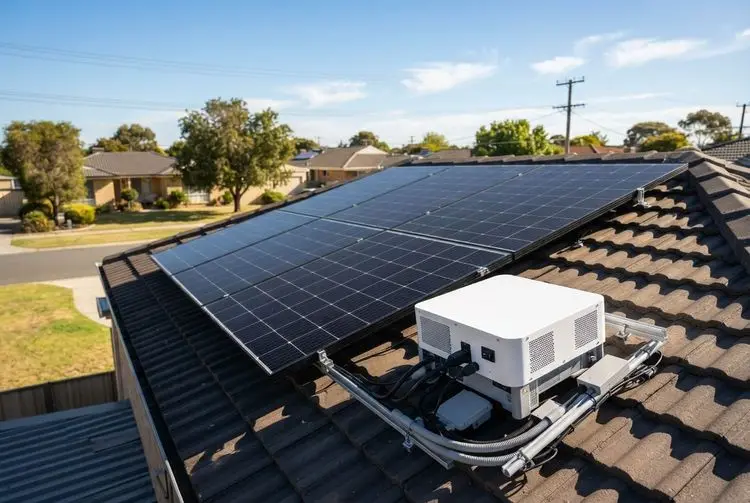
Solar energy is expanding on multiple fronts worldwide, but distinct local constraints are shaping a divergent market. From rural electrification in Kenya and Tajikistan to utility-scale hybrid projects in Florida, India, and Romania, the industry's next phase is increasingly defined by storage integration, fire safety, interconnection policy, and affordability rather than module costs alone.
System costs and storage economics
Schneider Electric's research unit modelled 40,500 scenarios and found that rooftop solar combined with batteries can cut total system costs by 10% at today's world-average installed costs and by 40% at projected 2030s costs — provided electricity demand grows alongside them. The study added levelized rooftop PV and building battery costs to central grid costs against a $160 per MWh pre-tax benchmark.
The lowest total system cost at today's world-average prices stands at $145 per MWh. At 2030s projected costs, that figure drops to $94 per MWh — $66 below the benchmark. The United States is an outlier at $191 per MWh because residential solar is assumed at $3 per watt installed, three times the world-average case.
Home battery installed costs are assumed to decline 79%, from $700 per kWh today to $150 in the 2030s. Four-hour utility-scale batteries cost about $140 per kWh in 2025, down nearly 30% according to IRENA. Laurent Bataille, Schneider Electric's EVP for Europe operations, said "solar is the fuel, the battery is the power plant." The model assumes surplus solar is stored or curtailed, never exported, and excludes network constraints. A poor battery arrangement can push costs 35% above the benchmark.
Utility-scale expansion across continents
Duke Energy Florida proposed four new utility-scale solar sites totaling 300 MW — the Nova, Bull Creek, and Wewahootee Renewable Energy Centers in Orange County and the Hogeye Renewable Energy Center in Sumter County. The projects are expected in service by mid-2028, with construction starting as early as next year. Duke currently owns, operates, and maintains 25 solar sites contributing 1,850 MW, each capable of powering nearly 15,000 homes. The utility plans over 1 GW of battery storage over the next decade and projects roughly $1 billion in customer savings over the solar projects' operating lifetimes. Each new site is projected to save about 1.1 million cubic feet of natural gas, 12,000 barrels of fuel oil, and 9,000 tons of coal annually.
In India, Oyster Renewable Energy will complete a 60.9 MW wind-solar hybrid project in Kadapa district, Andhra Pradesh by next month, at a cost above Rs 350 crore. The project comprises 39.3 MWp of solar already commissioned and 21.6 MW of wind expected by December 2026. All power will supply Laurus Labs under a captive arrangement. The commissioned solar capacity is expected to generate about 51.51 million units annually and avoid about 35,571 tonnes of CO2. The full hybrid is expected to generate about 124 million units annually and avoid 88,040 tonnes of CO2. Laurus Labs aims to source roughly 50% of its energy from renewables by Q4 FY27.
In Romania, Astronergy will supply ASTRO N7 Pro modules to Rezolv Energy's 1.36 GWp Dama Solar project in Arad County, with Tongwei as second supplier. Volumes and contract value were not disclosed. The €728 million plant covers more than 1,000 hectares with 82 hectares designated as a nature reserve. It is due for commercial operation in the second half of 2028, producing about 1,800 GWh annually — roughly 36.3% of Romania's 4.96 TWh of solar generation in 2025. The project has up to €561 million of debt from 14 lenders, including €100 million from the European Investment Bank. Some 520 MW is covered by two Contracts for Difference won in August 2025. CHINT Green Energy, CMC Europe and Solarpro hold EPC packages. EnergoBit and Siemens Energy are building the high-voltage connection. CHINT Power Systems supplies inverters. About 1,500 people will work at peak construction. Ahold Delhaize signed a 10-year virtual power purchase agreement in October for output from Dama Solar and Rezolv's Dunarea East wind farm.
Fire safety and thermal detection gain priority
In Switzerland, timber company Leimholz Haag — which lost two previous sites to fires in Arbon in 2012 and Steinach a year later — made arc fault protection and safe DC shutdown central to its new 521 kW rooftop PV system. Installed in June 2025, the SolarEdge system covers about 54% of electricity demand, saving roughly CHF 35,000 per year and avoiding about 235 tonnes of CO2. Arc fault detection interrupts faults immediately, and SolarEdge's SafeDC function reduces high DC voltage to touch-safe levels when the inverter or grid is switched off. Solar power feeds the plant's fire protection strategy, which produces nitrogen on-site.
Planning was complicated by roofs across buildings with differing heights and orientations and a 25-meter storage tower casting moving shadows. Installer CE Concept Energy used power optimisers under each pair of modules. Two SolarEdge CSS-OD batteries of 197 kWh each, totaling 394 kWh, are due in autumn, expected to raise self-consumption to 72% and enable peak shaving. SolarEdge ONE monitors and controls the batteries.
Separately, Teledyne Flir's A40 and A70 cameras gained the first UL listing under ANSI/CAN/UL 2684 for video and thermal imaging detectors in fire alarm systems. Europe lacks a dedicated harmonised product standard for radiometric thermal imaging fire detection, relying on project-specific approvals and national schemes such as VdS in Germany and CNPP in France. The UL listing provides additional technical evidence but does not replace CE marking or the EN 54 series. Typical applications include waste and recycling facilities, data centres, battery storage, and rooftop solar, where hotspots can develop at connectors and modules.
Storage integration and hybrid control
FlexGen will integrate storage at MN8 Energy's 86 MW Mammoth Solar project in West Virginia and supply its HybridOS software to run 70 MW / 280 MWh of lithium-ion and 10 MW / 100 MWh of Eos zinc batteries as one dispatchable resource. Google will buy energy, capacity, and clean energy attributes for the PJM grid. The solar plant is on a reclaimed coal mine in Kanawha County. MN8 expects solar commercial operation in 2028, lithium-ion storage in 2029, and zinc in 2030. Total storage is 380 MWh, about 4.4 MWh per MW of solar, with 26% of storage energy in zinc batteries. MN8 estimates up to $350 million in capital investment and about 200 construction jobs.
Rural electrification: Kenya and Tajikistan
In Kenya's Tsavo landscape, the African Wildlife Foundation rehabilitated and solarized a borehole at Oloibor Soit Comprehensive School, roughly a kilometre from Tsavo West National Park. The school, serving about 600 learners, had received only about 200 litres of water per day after its borehole broke in 2022. Following the 2026 rehabilitation with a new pump and three solar panels, the system now fills three tanks with a combined 30,000 litres in roughly two days. Water is also piped to Njukini Health Centre and collected by about 16 households. AWF also provided climate-smart cookstoves, cutting firewood collection from daily to weekly and allowing one cook to do work previously requiring two. Savings contributed to hiring an additional teacher in September 2026. A 2026 solar upgrade brought Wi-Fi, projectors, on-site printing, and nighttime lighting that helps deter wildlife. With support from the Embassy of Sweden in Kenya, AWF and Indigenous Livelihood Enhancement Partners provided solar systems to eight off-grid schools and cookstoves to 26 schools across Kajiado, Taita Taveta and Narok counties. The school remains off-grid though a power line runs about two kilometres away.
In rural Tajikistan, solar panels, cookers, and dryers help families cope with outages and reduce firewood use, but high upfront costs exclude many. Mizhgona Azizova of Labijay village received a solar dryer through the organization Little Earth, reducing rosehip drying from about a month to three days. Mavlyuda Ahmadova's family in Hisor received solar panels, a 150-litre water heater, and a solar cooker via the Youth Environmental Center. Shavkat of Shaykhmuzafar village cannot afford a roughly 5,000 somoni backup solar kit — more than his monthly salary of about 4,000 somoni — to keep an egg incubator running during outages; he lost two or three batches of eggs. A five-kilowatt solar system that cost more than 60,000 somoni in 2018 now costs 25,000 to 30,000 somoni, but affordability remains the core obstacle. Experts note grid-tied systems shut down during grid failures, so households need autonomous or hybrid systems with expensive batteries. High upfront costs and weak service infrastructure are primary barriers. Tajikistan's Resolution No. 449 established rules for connecting household renewables to the national grid, but affordability questions persist.
Interconnection and tariff policy battles
Connecticut regulators required Eversource and United Illuminating to offer scheduled flexible interconnection for solar and storage projects on constrained distribution circuits by May, with dynamic flexible interconnection statewide by late 2030. The order was a victory for the Connecticut Solar & Storage Association. Mike Trahan, the group's executive director, said the decision addresses time-to-interconnection, project-level capital expenditure, and revenue loss from over-curtailment. Scheduled flexible interconnection, pioneered in California, allows export amounts to vary based on forecasted minimum hosting capacity within defined time windows. Starting May 2028, utilities must offer dynamic flexible interconnection at the most constrained substations, and statewide by late 2030. Dynamic interconnection requires an Advanced Distribution Management System and grid-scale Distributed Energy Resource Management System. The order establishes project 'vintages' with maximum curtailment targets. First-vintage projects have a target of no more than 5% annual MWh curtailment, described as a basis for establishing the vintage, not a guarantee or hard limit. Commissioner David Arconti said the decision will enable faster interconnection, better utility utilization, and potential consumer savings. The Brattle Group projected flexible interconnection nationwide would yield $39 billion in savings through 2050. At least seven other states require or are considering some form of flexible interconnection.
In Brazil, ANEEL presented a proposal for a Fixed-Time Tariff differentiating electricity prices by time of consumption, with implementation expected to begin gradually in 2028, reaching low-voltage consumers. A board decision is expected by December. ABSOLAR, INEL and ABGD are demanding legal certainty and assessment of impacts on consumers who already have their own generation. ABSOLAR questions whether the tariff alone can change behavior and stimulate battery investment, citing international experiences in England, Germany, Australia, Italy, Texas, and California where tariff signals alone were insufficient. ABSOLAR warns the new structure could reduce remuneration for consumers injecting surplus energy during the day without proportional incentives for batteries, potentially penalizing those who invested under previous rules. INEL views consumption shifting positively but says effectiveness depends on grid investments, transparency, and accessible storage. It questions regulatory treatment differences between battery storage and thermal plants in capacity contracting. ABGD questions automatic classification of distributed generation units with average consumption or injection exceeding 500 kWh per month under articles 26 and 27, which would be gradually incorporated into the Time-of-Use tariff from 2028. ABGD commissioned a legal opinion from Lefosse and an analysis by Thymos Energia. It argues voluntary participation could reconcile tariff modernization with preservation of self-generation investments. ABGD's Rose Santos said "modernizing the tariff and honoring the law are not opposing objectives."
Manufacturing and technology frontiers
Singulus Technologies signed a contract with SpaceX for a turnkey heterojunction solar cell production line, with delivery scheduled for the first half of 2027. The companies plan multiple additional lines as part of a strategic partnership, scaling to support more than 100 GW of production equipment as SpaceX accelerates satellite manufacturing in Bastrop, Texas. SpaceX provided significant funding to Singulus in March 2026 and again in October via a subordinated secured loan. Elon Musk said in January that SpaceX and Tesla were each working to build 100 GW a year of solar manufacturing capacity in the US. Other manufacturers adding HJT cell capacity in Texas include Toyo's planned 1.5 GW factory and SEG Solar's planned 4 GW plant near Houston.
SMA Solar's order backlog rose to €1.86 billion at the end of September 2026 from €1.28 billion a year earlier. Nine-month sales reached €1,160.7 million, slightly above €1,134.7 million. Large Scale & Project Solutions sales slipped 2.6% to €928.8 million as planned, while Home & Business Solutions sales jumped 27.9% to €231.9 million. SMA narrowed its 2026 forecast to sales of €1,675–1,725 million and EBITDA of €205–230 million, expecting the fourth quarter to bring the year's highest sales. Reported EBITDA swung to €146.3 million from a loss of €16.9 million, helped by €39.2 million from using previously written-down inventory and €18.6 million of customs refunds. Net cash reached €301.6 million on September 30. US rival SolarEdge reported third-quarter revenue of $326.1 million on November 4 and guided to $245–275 million for the fourth quarter.
Western University researchers demonstrated that agrivoltaic installations can improve profitability of indoor farming agrotunnels by reducing electricity costs. Experiments in Ilderton, Ontario focused on Genovese basil at different planting densities and lighting conditions, scaled to a commercial agrotunnel with 12,816 growing ports. The most profitable configuration was three basil plants per pot under continuous 24-hour lighting, yielding 3,573 kg annually. Total capital investments ranged from about $567,000 to $745,000. Annual operating expenses varied between $60,000 and $119,000. Basil production costs ranged from $12.10 per kg to $22.70 per kg. Returns on investment were approximately 317% to 499%, with discounted payback periods of 1.6 to 2.2 years. Canadian locations generally achieved higher net present values than US counterparts. Electricity export compensation policies in Santa Fe and San Francisco limited PV systems' ability to offset grid electricity costs. A sensitivity analysis identified basil market prices as the most influential profitability factor, followed by agrotunnel initial investment cost.
US permitting reform in focus
In the United States, political attention remains on a Senate permitting reform bill that would make it easier to build solar farms, battery storage, power lines, and more. The Senate approved a procedural measure 73 to 25, with a final vote expected in coming weeks. The bill has support from some environmentally minded senators and the White House. Some Democrats are tempted to scrap the legislation and wait until they take control of Congress next year. Critics of that approach argue President Trump would almost certainly veto a follow-up bill next year. The situation in the House is murkier, and potential no votes include Representative Hakeem Jeffries, who has raised concerns about the bill.