
Solar-plus-storage dominates US grid as terrain challenges grow
Over 90% of new U.S. grid capacity is solar-plus-storage, driving innovation in terrain adaptation and commissioning.
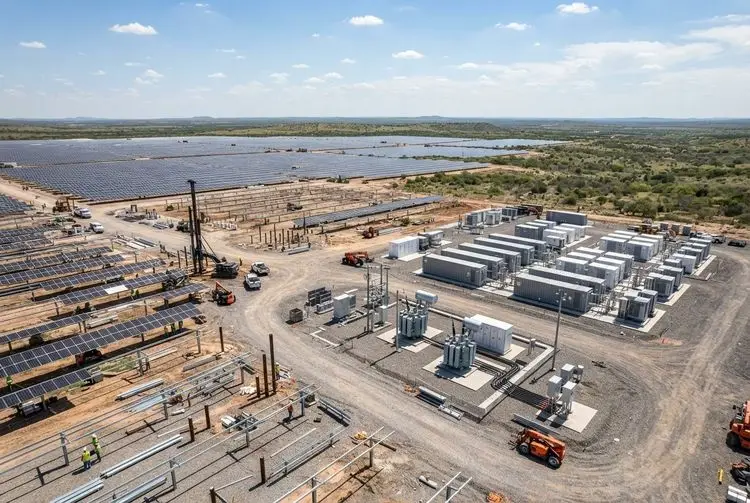
Solar-plus-storage now accounts for more than 90 percent of all new U.S. grid capacity, cementing the technology pair as the dominant foundation of power generation. That was the central message from a panel at pv magazine USA Week 2026, where speakers from OCI Energy, Array Technologies and Trina Storage outlined the operational and engineering shifts required to sustain this trajectory.
The rapid buildout is being driven in part by massive load growth from data center expansions. ERCOT, the Texas grid operator, recorded a peak demand of 91 GW this year, up sharply from the prior record of 85 GW. To meet such demand, developers are racing to bring projects online under tight timelines.
Safe harbor deadlines reshape procurement
Safe harbor provisions under U.S. tax rules have forced developers to accelerate equipment procurement. Projects must start construction by July 4, 2026, or be placed in service by the end of 2027. Daniel Wilson of OCI Energy described the practical impact.
"For us, that meant safe harboring through main power transformers. So we had to move really quickly with contracting and making sure that the material was manufactured before the deadlines," Wilson said.
The compressed timelines have pushed the industry to rethink both hardware selection and project sequencing. Early procurement of transformers and other long-lead items has become a strategic necessity.
AC coupling gains ground over DC coupling
The industry is shifting from DC-coupled to AC-coupled battery energy storage systems (BESS). AC coupling is increasingly preferred for its flexibility and the ability to hybridize existing solar plants more easily.
DC coupling remains relevant for projects with a DC-to-AC ratio above 1.5, where it can reduce inverter and interconnection costs. However, DC-coupled grid-forming BESS requires additional DC-DC converters on the PV side, adding complexity. AC-coupled architectures avoid that requirement and offer simpler retrofits.
Luciano Silva Militello of Trina Storage noted that cell count reductions of 25 percent in a 20-foot container are now achievable, improving energy density and reducing balance-of-system costs.
Terrain challenges drive tracker innovation
Prime flat sites are becoming scarce across the U.S., forcing developers to build on increasingly challenging terrain. Array Technologies presented data showing that tracker terrain-following capabilities can significantly reduce earthwork and steel costs.
Evan Nichols of Array Technologies shared benchmark results from six of the most difficult projects his company evaluated.
"We found that 90 percent of earthwork savings across the six worst projects that we benchmarked—where we looked for the worst of the worst—came from that first degree. What that second degree really does for you, though, is allows you to shift cost out of the steel, mostly in the form of shorter piles, and it also reduces disturbed area really significantly," Nichols said.
Array's Atlas One tracker system and the AWM EasyPile foundation solution are among the technologies designed to address these site constraints. Optimizing tracker row density can shorten layouts by approximately 5 percent while increasing specific yield by about 1 percent, according to the company.
Hail risk and module durability
Severe weather remains a major threat to U.S. solar assets. Nichols cited data from FM Global showing that 12 major insurance losses in U.S. solar were caused by hail, dwarfing losses from wind events.
In response, Array has developed a passive mechanical slip-clutch stow system that allows trackers to move modules into a protective position during hailstorms without active power or control signals. The industry is also moving toward 3.2 mm front glass as the preferred standard over thinner 2.0 mm glass, improving impact resistance.
Commissioning windows tighten
With project timelines compressed, commissioning has become a critical bottleneck. The typical commissioning window for a solar-plus-storage plant is roughly four months, requiring coordinated functional block integration testing.
Testing centers in the U.S. now offer pre-commissioning validation that de-risks field integration. The goal, panelists agreed, is speed-to-market without compromising asset longevity. As the grid adds more solar-plus-storage capacity at record pace, the industry must solve for terrain, weather and schedule constraints simultaneously.