
Solar's Global Growth: Mexico Hydrogen, SE Asia Equity, Europe Dunkelflaute
Three regions reveal solar's promise and its persistent infrastructure, equity and reliability challenges.
The global solar industry is expanding rapidly, but three distinct stories from Mexico, Southeast Asia and Europe show that the technology's success depends heavily on local conditions, financing models and grid infrastructure. From an integrated solar-hydrogen project in an off-grid Mexican region to affordability struggles in Malaysian villages and Europe's winter power lull, the sector faces a complex set of challenges alongside its achievements.
Mexico's Oasis Project Integrates Solar, Storage and Hydrogen
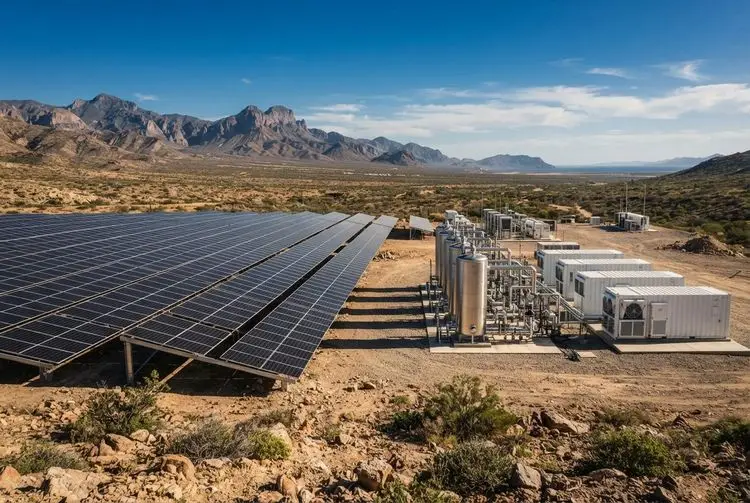
Mexico's state-owned utility CFE has opened a tender for a first-of-its-kind project that combines solar generation, battery storage and green hydrogen production in a single installation. Named 'Oasis,' the plant will be built in Mulegé, Baja California Sur, a region not connected to Mexico's national electricity grid. According to Canal Solar, this marks the first project in the country to integrate all three technologies.
The technical configuration is substantial. The facility will include 72 MW of solar capacity in direct current (60 MW in alternating current), a battery storage system with 20 MW of power and 80 MWh of energy capacity, providing up to four hours of supply. Electrolyzers with 20 MW of power will produce hydrogen from water using excess solar generation, and four fuel cells of 1.5 MW each (totaling 6 MW) will convert stored hydrogen back into electricity at night or during peak demand.
Interested companies can submit proposals between November 18 and 30, with capacity verification and the opening of technical and economic proposals scheduled for December 1. Contract award is expected on December 18. French company HDF Energy (Hydrogène de France) is participating in the development in partnership with CFE. The project was recognised as an emblematic project in CFE's 2026-2030 expansion plan and is the only green hydrogen initiative included in that planning. It falls under CFE's mixed investment model, which allows private companies to participate in energy infrastructure projects.
The Oasis project is presented as an innovative solution for an isolated region, aiming to reduce dependence on fossil fuels. For solar industry observers, it represents a test case for combining multiple clean technologies in a single off-grid installation.
Southeast Asia's Solar Equity Challenge
In Malaysia, solar power reached Kampung Bertang, a remote Orang Asli village in Pahang, in April, enabling families to power lights, refrigerators and rice cookers. For resident Osman Uki, who previously relied on kerosene and leftover cooking oil to light his home, the change is transformative. "We are happy with the light we have at night. The kids can read at night now," he said.
But bringing electricity to the village — located roughly 170 km from Kuala Lumpur and home to more than 500 members of Malaysia's Orang Asli population — was only half the battle. Keeping the power on carries recurring costs that residents must bear themselves. Each household contributes US$7 a month to a community fund covering repairs, maintenance and modest payments to the village energy committee. Battery replacements alone are estimated to cost more than US$980 per system, expected within five years, covered by pooled community savings.
The off-grid solar deployment cost about US$4,930 per household, funded by donors including Yayasan Hasanah, with Bright Spots Energy and SHER Engineering implementing the project. Yeap Mei Yi, co-founder of Bright Spots Energy, estimates that nearly 200 Orang Asli villages across Peninsular Malaysia still lack grid access. She noted it is "very, very common" for solar projects to fail within a year or two due to lack of maintenance knowledge.
The village's experience highlights a broader regional dilemma. Southeast Asia's clean-energy investments reached only US$47 billion in 2025, far short of the US$100 billion needed annually between 2026 and 2030, according to the IEA. At COP29 in 2024, developed nations agreed to mobilise US$300 billion annually in climate finance for developing countries by 2035.
In the Philippines, coal and natural gas accounted for 74 per cent of electricity generation in 2025, per the Centre for Energy, Ecology and Development (CEED). Low-income Filipino households consume about 60 kWh monthly versus 210 kWh for middle-income families. A basic 500-watt rooftop solar system costs about US$437, yielding savings of up to US$5 a month.
Experts warn the transition could create a "two-tier energy system" between those who can afford to decarbonise and those who cannot. Renard Siew of Yinson warned that fluctuating fuel subsidies could increase transport, food and logistics costs. Anjali Viswamohanan of the Asia Investor Group on Climate Change suggested investors go beyond 'do no significant harm' in due diligence to assess positive community contributions.
Malaysia launched its National Energy Transition Roadmap in 2023, targeting net-zero emissions by 2050, and raised the domestic electricity bill exemption threshold from 600 kWh to 800 kWh through end-2026. Prime Minister Anwar Ibrahim framed the enhanced relief as an immediate measure to ease cost-of-living pressures.
Europe Faces Winter Dunkelflaute
Europe risks entering its first 'dunkelflaute' of the year as cloudy, cool and windless weather dampens solar production and sends energy prices soaring. As reported by Euronews, a dunkelflaute — German for 'dark lull' — describes an extended period when wind and solar generation are low or non-existent. It typically occurs from October through February in Northern Europe.
Solar has been described as a "shining star" of the energy transition, costing as little as €0.024 per unit of power in the right conditions. It has saved the EU €42.9 billion in avoided gas imports since the beginning of the war on Iran, which broke out on 28 February. It also helped stabilise the grid in summer when back-to-back heatwaves triggered a spike in cooling-related electricity consumption.
But winter poses serious challenges. German day-ahead power prices for Thursday 29 October were above €300 per megawatt-hour, about double the October average, with hourly rates hitting above €500 for the evening peak. One UK resident with 12 solar panels (6.36 kW combined capacity) generated only 10.90 kWh on Wednesday 4 November, importing 27.40 kWh from the grid. On Thursday 5 November, the home generated just 2.40 kWh and imported 20.60 kWh, despite having an 11.52 kWh home storage battery.
In the EU, solar's share of electricity generation hit 25.4 per cent in June but dropped to just 13.2 per cent in October. Solar relies on daylight rather than heat, so rooftop panels still produce power on cold days. UK home solar systems can generate around 25-35 per cent of their annual output in winter, according to Good Energy.
A dip in solar production tends to coincide with increased hydropower generation, which started to rise in the EU last year from October. During the late-June heatwave this summer, daily electricity demand rose by up to 28 per cent in Italy, 23 per cent in Hungary, 14 per cent in France and 13 per cent in Spain compared with pre-heatwave days. Solar was the only major power source to perform "better than usual" during heatwave-driven demand increases, with average daily solar generation 17 per cent higher in France and Hungary, five per cent higher in Spain, and the same in Italy.
Water-intensive forms of energy such as coal, hydropower and nuclear struggle during heatwaves. In August, Poland reduced output on coal-fired plants following critically low water levels in the Vistula River, temporarily removing 1.3 GW from its power system.
Common Threads Across Markets
Across all three regions, a common theme emerges: solar power is expanding rapidly and delivering tangible benefits, but its integration into existing energy systems and its affordability for vulnerable populations remain unresolved challenges. Mexico's Oasis project represents a technological leap forward, combining multiple clean technologies to serve an isolated region. Southeast Asia's experience highlights the social equity dimension — solar can reach remote communities, but sustaining it requires ongoing financial and technical support. Europe's dunkelflaute underscores the seasonal limitations of solar and the need for diversified energy sources and storage.
For solar industry professionals and investors, these developments reinforce that global growth is not uniform. Success depends on local conditions, supportive policies and inclusive financing mechanisms. The technology's cost-effectiveness is proven, but its reliability and accessibility still require careful planning tailored to each market's unique circumstances.