
Cattle and solar coexist profitably at Silicon Ranch agrivoltaics site
A 3.25-MW Tennessee solar farm proves cattle grazing is commercially viable with only 3% cost premium.
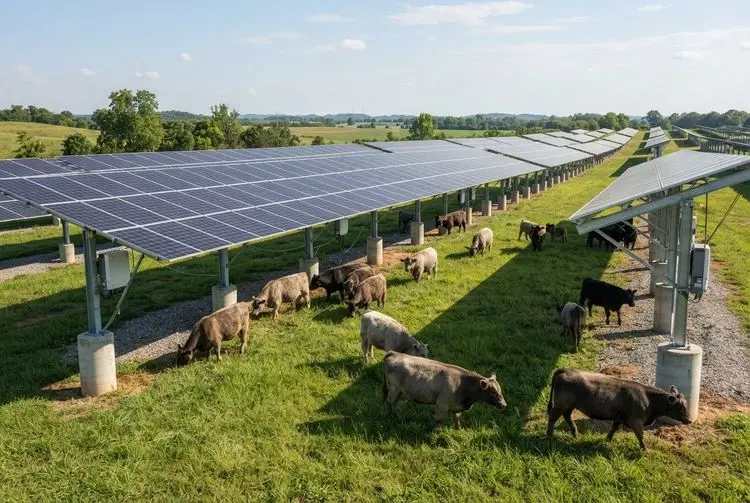
Silicon Ranch has demonstrated the first commercially viable utility-scale solar-plus-cattle project in the United States, bringing 15 Murray Grey cattle to a 3.25-MW solar farm in Christiana, Tennessee. The project challenges the long-held assumption that cattle and solar panels cannot coexist without damaging equipment.
The company deployed its patented CattleTracker system, which uses elevated mounting piles and limits tracker tilt angles during grazing periods. While a standard solar farm can tilt panels up to 60 degrees, the system restricts movement to 20-30 degrees in graze mode. The low edge of fully tilted panels sits at 24 inches on a conventional farm, but the CattleTracker design raises the entire array to accommodate livestock moving underneath.
A 3% premium for cattle-proofing
The cost premium for making the site cattle-ready came to just 3% over a standard design. That figure includes the elevated piles, modified tracker controls and fencing infrastructure needed to keep animals safe and panels protected.
Matt Beasley, Silicon Ranch's chief commercial officer, described the company's guiding principle. "The team had this anthem: It's got to be good for the land, good for the animal, and good for the solar. If it's not good for all three, we're not doing it."
The trackers were supplied by NextPower. Silicon Ranch developed the CattleTracker system with support from a Department of Energy grant.
Cattle handling 75% of mowing
In the first six months of operation, the cattle handled 75% of the vegetation management at the site. Silicon Ranch expects that figure to reach 95% once the pasture is fully established. The animals rotate through 15 paddocks on roughly a 45-day cycle, allowing grass to recover between grazing periods.
Loran Shallenberger, who manages the cattle operation, expressed surprise at the early results. "I thought it would work — I just didn't think it would work this well."
The Murray Grey breed was selected for its docile temperament, moderate size and ability to fatten on grass alone. The animals reach market weight in 18-24 months on a grass-fed regimen.
Power sold below wholesale rates
The electricity generated at the Christiana site is sold to Middle Tennessee Electric at a price below the wholesale rates offered by the Tennessee Valley Authority. Silicon Ranch, which is Tennessee's largest solar developer, owns the land outright and approaches each site as an agricultural business rather than a pure energy play.
"We're not taking land out of ag production," Beasley said. "In fact, most of the land that we're buying wasn't in ag production before, and we're going to put it into ag production."
Sheep grazing already mainstream
Sheep grazing has become a standard practice for vegetation management at solar sites across the US. Silicon Ranch acquired 400 ewes in 2022 and has since grown its herd to 5,000 animals. The company now partners with 14 sheep-farming families across six states.
Cattle have been largely excluded from agrivoltaics because of concerns about panel damage. An earlier 2-MW project by AES in Massachusetts proved the concept could work, but Silicon Ranch's Tennessee site is the first to demonstrate commercial viability at utility scale. The company's projects reach up to 300 MW in size.
Context for the solar industry
The development comes at a time when the US builds more solar than any other type of power plant, yet local opposition remains a major obstacle to project development. Agrivoltaics — combining energy generation with agricultural production — offers a pathway to reduce land-use conflicts and address community concerns.
Cattle grazing introduces a complication that sheep do not: methane emissions. Cattle release methane as part of their digestive process, which increases the overall greenhouse gas footprint of a solar site. However, roughly half of all US agricultural land is dedicated to beef production, meaning the opportunity for dual-use solar on cattle pasture is enormous.
The US cattle inventory recently hit its lowest level in 75 years, reflecting long-term structural changes in the beef industry. Silicon Ranch's model could offer ranchers an additional revenue stream that makes grass-fed beef production more economically viable.
Silicon Ranch's approach treats the land as a working farm first. The company owns the property beneath its solar arrays and manages grazing operations directly rather than leasing to third-party operators. That ownership structure allows it to make long-term investments in soil health, fencing and water infrastructure that a typical solar developer might not consider.
The Christiana project will be watched closely by developers, utilities and landowners as the industry searches for scalable models that satisfy both energy production targets and agricultural preservation goals.